🎬 Video Lesson Available
Watch the full 7-slide video lesson for Families with AI teacher narration and visual explanations.
Families — Master the five key plant families for NEET Biology: Malvaceae, Cruciferae, Leguminosae, Compositae & Graminae with floral formulas and key features.
01Introduction to Floral Taxonomy: Decoding the Plant Clans for NEET

“Welcome, future doctors! Today, we are decoding plant families. Think of these as biological 'clans.' Just like we recognize families by surnames, we identify plants by their floral parts. Let’s master these five essential families that appear repeatedly in your NEET question papers!”
Welcome, future doctors! Mastering morphology is one of the most high-yield areas for your NEET Biology preparation. Think of plant families as organized 'clans' in the botanical world. Just as we use surnames to classify people and track lineage, botanists use specific morphological markers to categorize plants into manageable groups. Understanding these families requires you to look beyond the surface; while vegetative traits like leaves, stems, and roots can vary significantly due to environmental adaptations—a phenomenon known as plasticity—floral parts like sepals, petals, stamens, and carpels are remarkably stable and evolutionarily conserved. This stability makes reproductive organs the gold standard for taxonomic classification.
In this unit, we are going to master the 'Five Clans' strategy. Instead of rote memorization of every description in your NCERT, we will focus on diagnostic features—those specific traits that act as 'ID cards' for each family. By linking these to the taxonomic [hierarchy](/neet/biology/concept-of-species-taxonomical-hierarchy-neet-biology) discussed in Chapter 1, you will learn why certain structures are constant across members of a family. A family is defined as a group of related genera which share a common set of vegetative and reproductive features. In the hierarchy, families fall between Order and Genus, representing a level of shared ancestry that is deep enough to provide consistent patterns in floral diagrams and formulas. This approach transforms a dense topic into a logical, manageable framework that makes answering matching-column questions a breeze during the exam.
Quick Revision Points
- Taxonomic Hierarchy: Kingdom, Division, Class, Order, Family, Genus, Species.
- Basis of Classification: Reproductive (floral) traits are more reliable than vegetative traits.
- The Concept of a Family: A collection of related genera with common characters.
- The Five Clans to Study: Malvaceae, Cruciferae (Brassicaceae), Leguminosae (Fabaceae), Compositae (Asteraceae), and Graminae (Poaceae).
- Diagnostic Markers: Identifying specific traits like ovary position (superior/inferior) and floral symmetry (actinomorphic/zygomorphic).
NEET Exam Angle
- Floral Formula Mastery: Learn to translate visual descriptions into shorthand notation (K, C, A, G).
- Morphological Plasticity: Be aware that vegetative traits like root type can change based on habitat, making them less reliable for classification.
- Identification Questions: Focus on identifying plants based on their reproductive morphology and evolutionary complexity.
02Malvaceae Unveiled: The Showy Hibiscus Family and Monadelphous Stamens
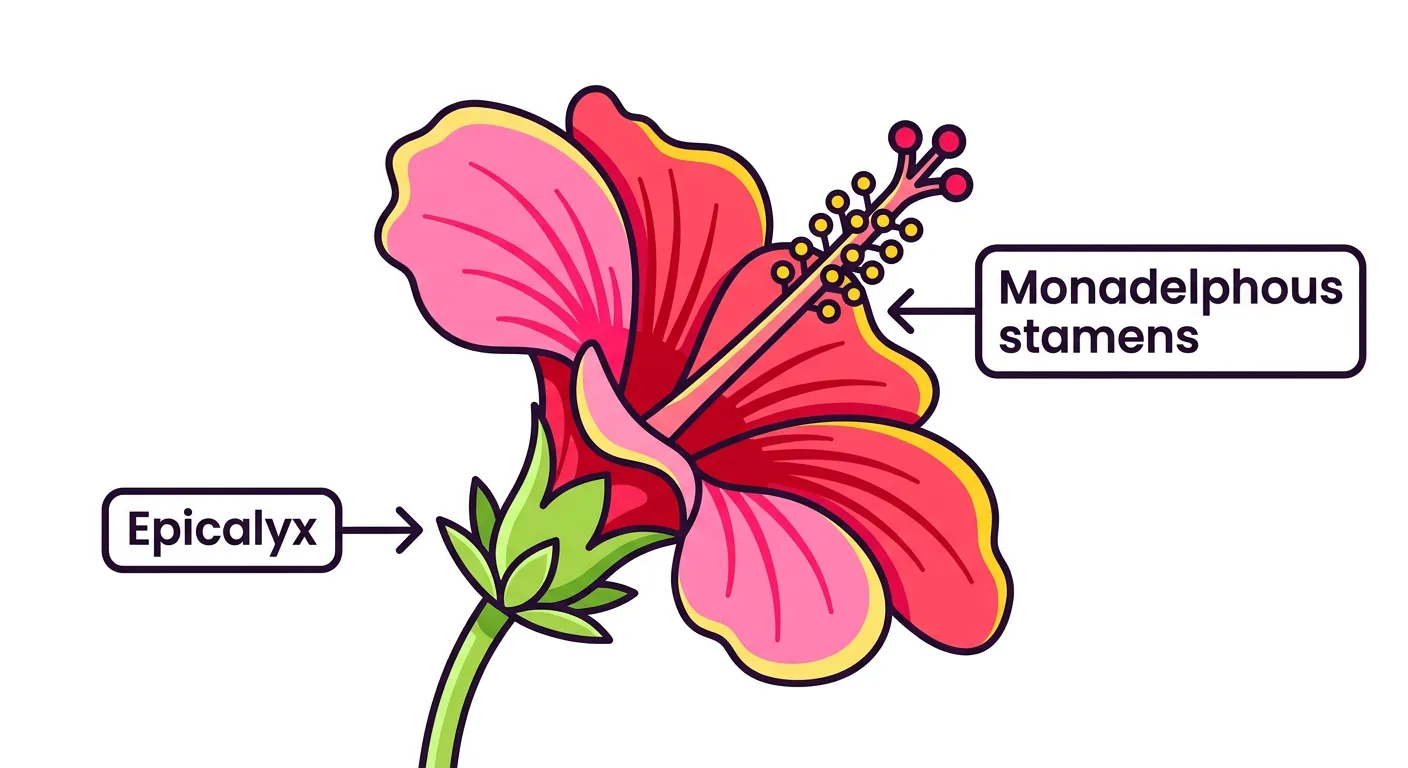
“First up, Malvaceae—the Hibiscus family! Remember this as the 'Showy' family. Key feature? The stamens are fused into a tube, called monadelphous. Spot the epicalyx, that extra whorl under the sepals. It’s the star of the show in most garden-related questions!”
The Malvaceae family, often referred to as the Hibiscus or Mallow family, is arguably the most visually striking group in your syllabus. When you look at a Hibiscus flower, the first thing you notice is its size and complexity. Unlike standard flowers, these possess an 'extra' whorl known as the epicalyx, situated just below the sepals. This epicalyx is a critical diagnostic feature that separates them from many other dicot families. The calyx usually consists of five sepals, often showing valvate aestivation, while the corolla features five petals that typically exhibit a twisted aestivation pattern.
What truly defines Malvaceae in the lab and in the NEET exam is the androecium. The stamens are 'monadelphous,' meaning they are fused by their filaments to form a distinct, elongated tube that surrounds the style of the pistil. The anthers are reniform (kidney-shaped) and monothecous (one-celled). This specific structure is a classic example of specialized floral evolution. Whether it is the garden variety Hibiscus rosa-sinensis or the commercially vital Gossypium (cotton), the pattern remains consistent. For your NEET paper, focus on the symmetry—it is actinomorphic—and the superior ovary with axile placentation. These details are frequently tested in questions regarding floral formulas and reproductive adaptations. Economically, this family provides us with fibers (cotton), food (Okra/Bhindi), and ornamental beauty (China Rose).
Diagnostic Characteristics of Malvaceae
| Feature | Description |
|---|---|
| Involucre | Epicalyx present (3 to 7 bracteoles) |
| Androecium | Monadelphous stamens forming a staminal tube |
| Anthers | Monothecous and Reniform (kidney-shaped) |
| Placentation | Axile placentation in a multicarpellary ovary |
| Aestivation | Twisted aestivation in the corolla |
Quick Revision Points
- Epicalyx: The unique extra whorl found below the calyx.
- Symmetry: Actinomorphic (radial symmetry).
- Ovary: Superior ovary, which is characteristic of most Malvaceae members.
- Economic Impact: Gossypium (cotton) is vital for the textile industry; Abelmoschus esculentus (Okra) is a staple vegetable.
NEET Exam Angle
- Remember the distinction between the staminal tube (filaments) and the style (part of the gynoecium) passing through it.
- Questions often focus on the monothecous nature of the anthers compared to the bithecous anthers found in most other families.
03Cruciferae (Brassicaceae): The Mustard Family and Tetradynamous Symmetry
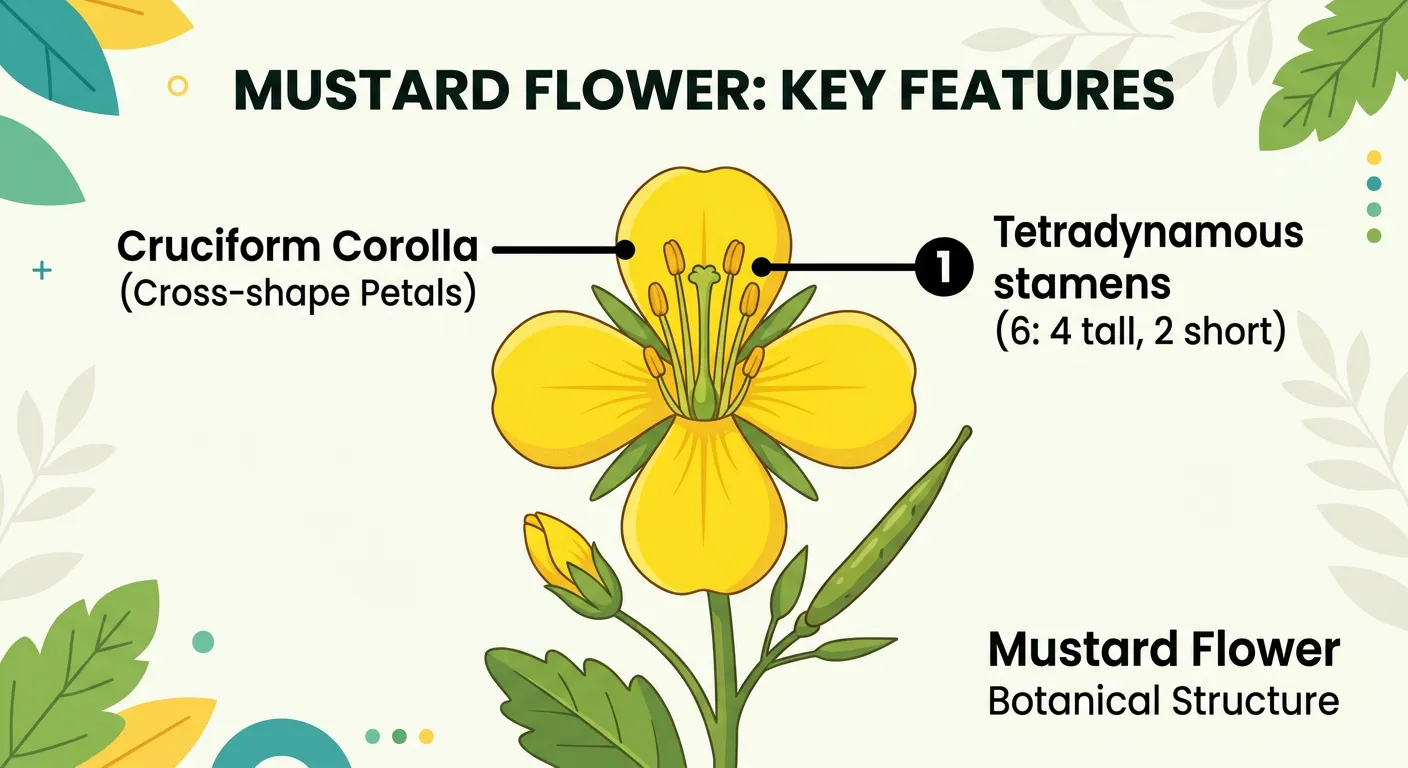
“Meet Cruciferae, the Mustard family! The name comes from 'cruciform' petals arranged like a cross. Look for 'tetradynamous' stamens—four long and two short. If you see a mustard plant in the fields, remember: it’s all about that cross-shaped floral symmetry.”
The Cruciferae family, now formally known as Brassicaceae, is a favorite among examiners because of its clear, mathematical structure and its significance in agriculture. The name 'Cruciferae' is derived from the arrangement of the four petals in a cross-shaped pattern, known as a cruciform corolla. If you have ever walked through a field of mustard (Brassica campestris), you have seen this pattern firsthand: four distinct petals arranged diagonally to form a cross.
Beyond the petals, the androecium of this family is distinctively 'tetradynamous.' This term describes a specific arrangement of six stamens: four long ones in the inner whorl and two short ones in the outer whorl (2+4 arrangement). This configuration is a diagnostic goldmine for your exam. The fruit, known as a 'siliqua,' is also a defining feature. It develops from a bicarpellary, syncarpous, and superior ovary. One unique anatomical feature of the ovary is the presence of a 'replum' or a false septum, which makes the single-chambered ovary appear two-chambered as it matures. Recognizing these specific terms—tetradynamous, cruciform, replum, and siliqua—will allow you to identify this family instantly.
Comparative Traits of Brassicaceae
| Floral Part | Characteristic Feature |
|---|---|
| Corolla | Cruciform (4 petals in a cross) |
| Androecium | Tetradynamous (2 short outer, 4 long inner) |
| Gynoecium | Bicarpellary, Syncarpous, Superior ovary |
| Fruit | Siliqua or Silicula |
| Septum | Presence of a false septum called Replum |
Quick Revision Points
- Corolla: Cruciform arrangement is the primary visual identifier.
- Androecium: Tetradynamous (4+2 arrangement) is the primary internal identifier.
- Fruit Type: Siliqua (a long, dehiscent dry fruit) or Silicula (shorter version).
- Key Examples: Brassica campestris (mustard), Raphanus sativus (radish), Iberis amara (candytuft).
NEET Exam Angle
- Never confuse tetradynamous (Brassicaceae) with didynamous (found in families like Lamiaceae).
- The siliqua fruit is a major identifying factor for this family in floral diagrams.
- Understand the floral formula: ⊕ ⚥ K2+2 C4 A2+4 G(2).
- Often tested alongside Leguminosae in 'compare and contrast' questions regarding ovary position and stamen number.
04Leguminosae (Fabaceae): Papilionaceous Flowers and Vexillary Aestivation
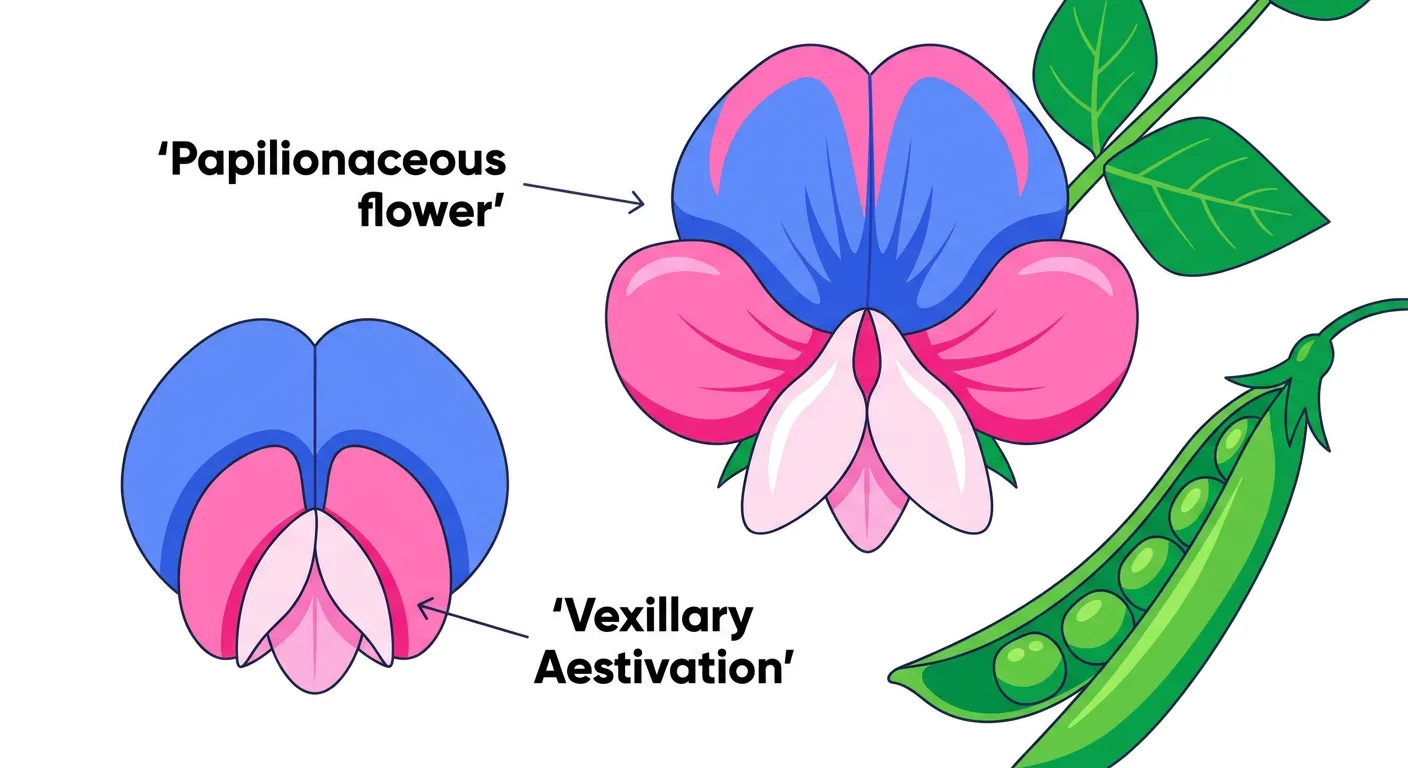
“Leguminosae is the pulse family. Think of your favorite dal! Their flowers are 'papilionaceous', meaning butterfly-shaped. The secret trick? Vexillary aestivation, where one big petal overlaps the rest. It’s the most important family for food crops in your exam syllabus.”
Leguminosae, or Fabaceae as it is formally known, is arguably the most economically significant family in your curriculum. This is the family of pulses, beans, and peas—the primary protein source for a large portion of the global population. The flower is 'papilionaceous,' which is a descriptive term for its butterfly-like appearance. If you break down this structure, you see five petals: one large posterior petal called the 'Standard' or 'Vexillum,' two lateral petals called 'Wings' or 'Alae,' and two anterior petals that are fused to form a boat-shaped 'Keel' or 'Carina.'
The way these petals overlap is called 'Vexillary Aestivation.' This is a classic NEET topic because it is a very specific type of descending imbricate aestivation where the largest petal overlaps the two lateral wings, which in turn overlap the keel. Furthermore, don't forget the ecological role of this family. Their roots often house Rhizobium bacteria in nodules, facilitating nitrogen fixation. In the exam, you should link this family to protein-rich crops and unique floral symmetry—it is zygomorphic (bilateral), not actinomorphic. The androecium is typically 'diadelphous,' meaning stamens are arranged in two bundles (usually 9+1). This complex floral architecture and its symbiosis with soil bacteria make it a peak example of evolutionary adaptation.
Structure of the Papilionaceous Corolla
| Petal Part | Count | Position & Function |
|---|---|---|
| Vexillum (Standard) | 1 | Posterior, largest, overlaps wings |
| Alae (Wings) | 2 | Lateral, paired, overlaps the keel |
| Carina (Keel) | 2 | Anterior, fused, encloses stamens/pistil |
| Aestivation | - | Vexillary (descending imbricate) |
Quick Revision Points
- Flower Symmetry: Zygomorphic (can be divided into equal halves in only one plane).
- Androecium: Diadelphous condition (9 stamens fused into a tube, 1 free).
- Economic Value: High protein crops like Gram (Cicer), Arhar (Cajanus), and Pea (Pisum).
- Nitrogen Fixation: Critical symbiosis with root-nodule bacteria for soil fertility.
NEET Exam Angle
- Vexillary aestivation and diadelphous stamens are high-frequency buzzwords in NEET MCQs.
- Focus on the zygomorphic symmetry as a differentiator from Malvaceae or Brassicaceae.
- Understand the structure of the legume (pod) fruit, which develops from a monocarpellary superior ovary.
05Compositae (Asteraceae): Evolutionary Success through Capitulum Inflorescence
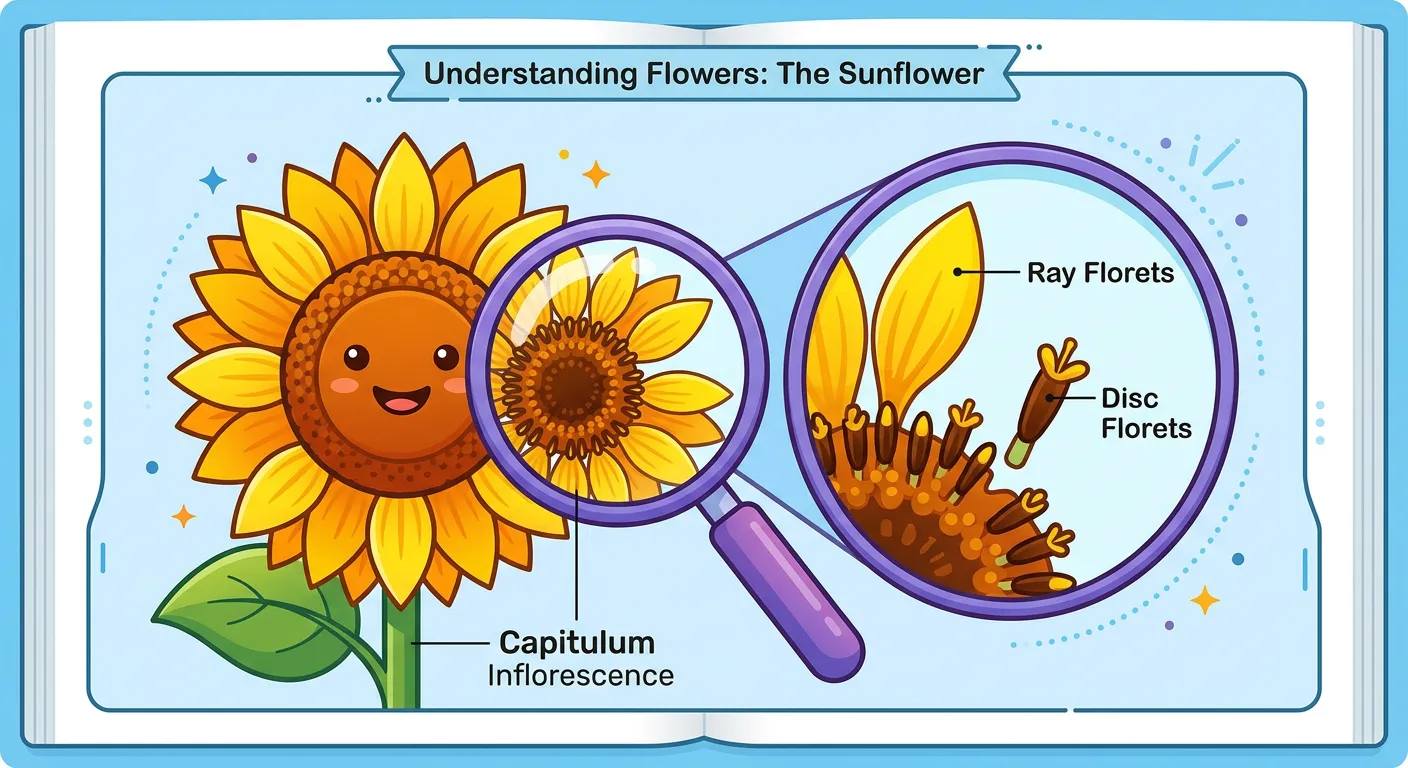
“Compositae, or the Asteraceae family, is the 'teamwork' family. Their flowers are tiny, crowded into a head called a 'capitulum'. It looks like one big flower, but it's a cluster! Think of a Sunflower—the ultimate social climber of the plant world.”
Compositae, or the Asteraceae family, is often described as the 'powerhouse of teamwork' and represents the most advanced family of dicots. When you look at a Sunflower or a Marigold, what you see isn't just one flower—it is a 'capitulum' or a 'head' inflorescence. This cluster consists of dozens or even hundreds of tiny flowers called florets, all mounted on a common receptacle. This arrangement is an evolutionary masterpiece, allowing the plant to appear large and attractive to pollinators while housing many reproductive units in one compact, efficient space.
In the capitulum, you will find two types of florets: ray florets (on the periphery, often zygomorphic and sterile/female) and disc florets (in the center, actinomorphic and bisexual). A key anatomical marker here is the 'syngenesious' condition—where the anthers are fused into a tube while the filaments remain free. This is the opposite of the monadelphous condition seen in Malvaceae. Also, look out for the 'pappus,' which is a modification of the calyx. It consists of feathery bristles that act like a parachute, helping the seed disperse via the wind (anemochory). The ovary is inferior, meaning the other floral parts are attached above it (epigynous flower). This family is highly successful globally precisely because of these collective reproductive strategies.
Comparison of Floret Types
| Feature | Ray Florets | Disc Florets |
|---|---|---|
| Position | Peripheral (margin) | Central |
| Symmetry | Zygomorphic (Ligulate) | Actinomorphic (Tubular) |
| Sexuality | Usually female or sterile | Bisexual |
| Placentation | Basal | Basal |
Quick Revision Points
- Inflorescence: Capitulum (Head), protected by an involucre of bracts.
- Androecium: Syngenesious (anthers fused, filaments free).
- Calyx: Modified into 'pappus' for wind dispersal.
- Ovary Position: Inferior ovary, resulting in epigynous flowers.
- Evolutionary Status: Considered the most highly evolved dicot family due to efficient pollination.
NEET Exam Angle
- Syngenesious stamens are a favorite point for tricky MCQ distractors; ensure you don't swap them with monadelphous.
- The function of the pappus and the basal placentation are common biological application questions.
- Distinguish between ray and disc florets in the context of floral diagrams and formulas.
06Graminae (Poaceae): Wind Pollination and the Architecture of Grasses
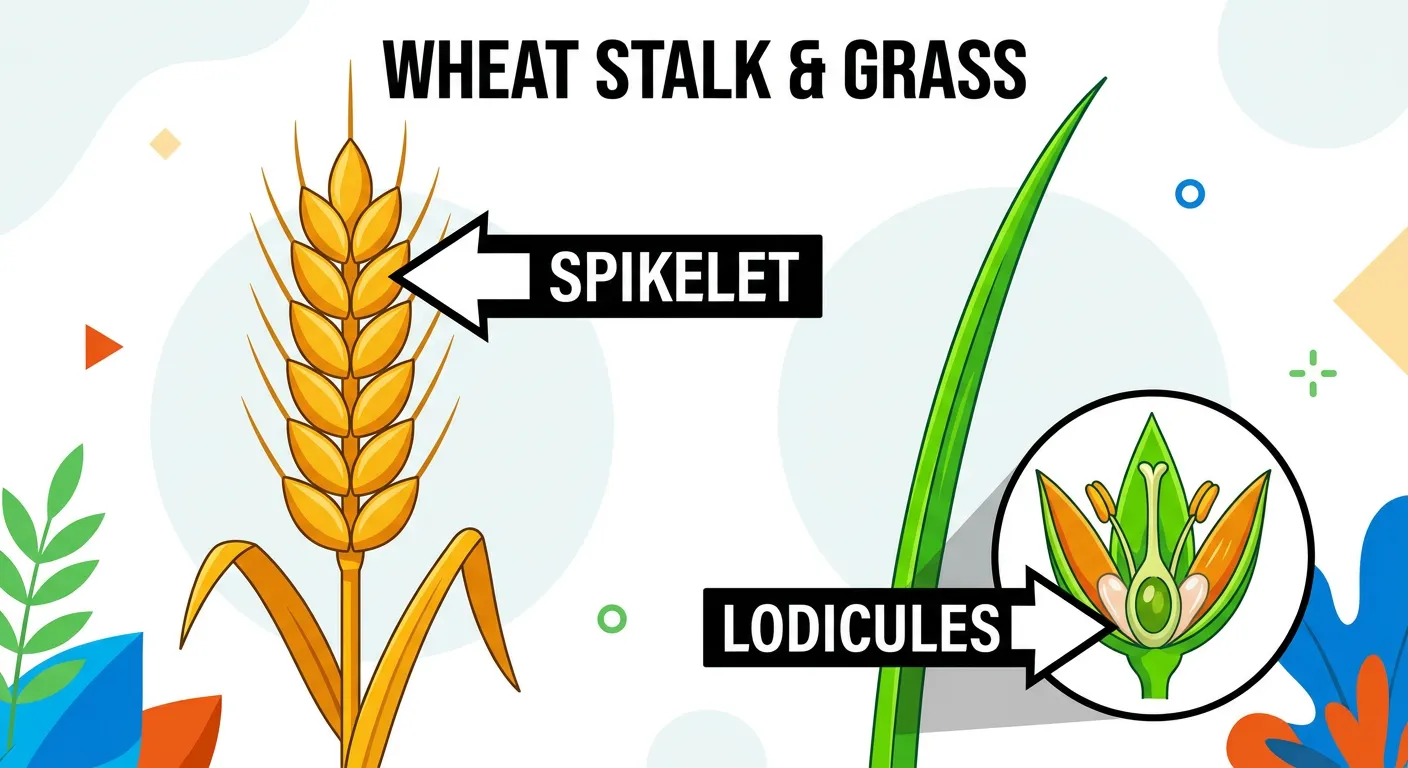
“Finally, Graminae, the Grass family. This includes wheat, rice, and maize. Their flowers are tiny and wind-pollinated, protected by glumes. They don't need petals to attract bees; they prefer the breeze! Remember, these are the true providers of our global food supply.”
Graminae, or the Poaceae family, covers the most important food crops in the world: rice, wheat, maize, barley, and sugarcane. These plants are the epitome of adaptation for wind pollination, a process known as anemophily. Because they do not rely on insects for reproduction, they have discarded showy petals and nectar. Instead, the flowers are highly reduced and protected by specialized bracts. The basic unit of the inflorescence is the 'spikelet.' Each spikelet is enclosed by two sterile bracts called 'glumes.' Within the spikelet, each individual flower is further protected by a 'lemma' (outer bract) and a 'palea' (inner bract).
The perianth is reduced to tiny, scale-like structures known as 'lodicules,' which swell to force the bracts open during flowering. The fruit of this family is the 'caryopsis,' where the seed coat and the pericarp are fused into a single, inseparable unit. The stamens are typically versatile—meaning the anthers are attached at a single point to the filament, allowing them to swing freely and release pollen into the wind. The stigmas are feathery (plumose), designed to maximize surface area to catch drifting pollen grains. This family represents the pinnacle of monocot evolution, focusing on efficiency and mass production of seeds (grains) which store energy in a large, triploid endosperm.
Structural Components of Poaceae
| Component | Description |
|---|---|
| Glumes | Pair of sterile bracts at the base of the spikelet |
| Lodicules | Reduced perianth segments (usually two) |
| Stamens | Versatile anthers for wind dispersal |
| Stigma | Feathery/Plumose to trap airborne pollen |
| Fruit | Caryopsis (Grain) |
Quick Revision Points
- Inflorescence: Spikelet (can be arranged in spikes or panicles).
- Pollination: Anemophily (wind pollination) with no need for showy corollas.
- Fruit: Caryopsis (defining monocot grain type).
- Key Examples: Triticum aestivum (wheat), Oryza sativa (rice), Zea mays (maize).
NEET Exam Angle
- Understand the hierarchy: Glumes > Lemma > Palea > Flower.
- Feathery stigmas and versatile anthers are classic adaptations for wind pollination mentioned in the 'Pollination' chapter as well.
- Caryopsis is a defining fruit type—memorize that the seed coat is fused with the fruit wall.
07Comparative Analysis and High-Yield Revision Table for NEET

“You've just conquered the five major plant families! Remember: Malvaceae is for show, Cruciferae for crosses, Leguminosae for pulses, Compositae for clusters, and Graminae for grains. Keep revising these characteristics, and you’ll definitely ace those botany questions in the NEET exam. Happy studying!”
You have reached the end of our botanical journey through the five major plant families. To succeed in NEET, you must be able to compare these families side-by-side. The examiners love to present a table or a set of descriptive statements and ask you to identify which family is being described. Consistency is the secret to mastery. Go back through your floral formulas for each of these families and draw them repeatedly. Visual memory is significantly stronger than reading text; for instance, visualizing the 4+2 stamen arrangement for Cruciferae makes it impossible to forget the term 'tetradynamous' during a high-pressure exam.
As you prepare for your final exams, remember that these families represent specific evolutionary solutions to the problems of reproduction and survival. Understanding the 'why' behind these structures—like why grasses have feathery stigmas for wind or why composites use a capitulum to attract multiple insects at once—will help you solve even the most challenging application-based questions. The following table serves as your ultimate cheat sheet for the last-minute revision of diagnostic features and economic importance. Pay close attention to the symmetry and ovary positions, as these are the most common points where students lose marks due to confusion between families.
Final Comparative Summary Table
| Family | Diagnostic Feature | Symmetry | Ovary Position |
|---|---|---|---|
| Malvaceae | Monadelphous / Epicalyx | Actinomorphic | Superior |
| Cruciferae | Tetradynamous / Siliqua | Actinomorphic | Superior |
| Fabaceae | Papilionaceous / Vexillary | Zygomorphic | Superior |
| Asteraceae | Syngenesious / Capitulum | Both | Inferior |
| Poaceae | Glumes / Lodicules / Caryopsis | Zygomorphic | Superior |
Quick Revision Points
- Malvaceae: Think 'China Rose' and 'Staminal Tube'.
- Cruciferae: Think 'Mustard' and 'Cross-shaped petals'.
- Leguminosae: Think 'Pulses' and 'Butterfly flowers'.
- Compositae: Think 'Sunflower' and 'Teamwork (Capitulum)'.
- Graminae: Think 'Cereals' and 'Wind Pollination'.
NEET Exam Angle
- Use this table for your last-minute revision before mock tests to solidify the differences.
- Focus on linking the 'Economic Importance' with the 'Floral Morphology' as NEET increasingly asks multi-concept questions.
- Practice drawing the floral diagrams for Fabaceae and Solanaceae (covered in related units) to ensure you can recognize them visually.
Recommended Reading
Explore related Biology topics to build deeper chapter connections for NEET.
- Morphology and Modifications · Topic 2.1
- Animal Tissues · Topic 2.11
- Frog Morphology · Topic 2.12
- Digestive System · Topic 2.13
- Circulatory System · Topic 2.14
- Respiratory System · Topic 2.15
- Jump to Key Terms (Quick Revision)
- Review Common NEET Mistakes
- Solve NEET Practice MCQs
- Read Topic FAQs
- Practice NEET MCQs
- Solve NEET PYQs
📚 Key Terms
⚠️ Common NEET Mistakes
- 1Confusing the monadelphous condition of Malvaceae with the syngenesious condition of Compositae.
- 2Misidentifying the symmetry of Fabaceae (zygomorphic) as actinomorphic.
- 3Forgetting that the pappus is a modified calyx, not part of the corolla.
- 4Assuming all flowers in a capitulum are identical; they can be ray or disc florets.
- 5Failing to recognize the specific petal arrangement of papilionaceous flowers in MCQ matches.
📝 NEET PYQ & Practice Questions
Test your understanding of Families with NCERT-aligned sample questions.
Which of the following statements is correct regarding "Monadelphous" in the context of NEET Biology?
In NEET question papers, questions related to "Families" predominantly test:
Consider Vexillary Aestivation associated with Families. What is the primary characteristic expected in NEET MCQs?
Master Families with NeetQ AI Tutor
Practice 50+ topic-wise MCQs, previous 15 years NEET questions, and get step-by-step doubt resolution instantly.
❓ Frequently Asked Questions
What is the difference between monadelphous and syngenesious stamens?
Monadelphous stamens (found in Malvaceae) have filaments fused into a single tube while anthers remain free. Syngenesious stamens (found in Compositae) have anthers fused together while filaments remain free.
How can I identify the Cruciferae family in a floral diagram?
Look for a cruciform (cross-shaped) arrangement of four petals and the '4+2' tetradynamous stamen arrangement (four long, two short).
Why is Vexillary aestivation considered a diagnostic feature of Leguminosae?
Vexillary aestivation refers to a specific pattern of descending imbricate arrangement where one large posterior petal (vexillum) overlaps two lateral petals (alae), which in turn overlap two anterior petals (carina). This is unique to Fabaceae.
Which plant family is known for having a pappus and what is its function?
The Compositae (Asteraceae) family possesses a pappus, which is a modified calyx consisting of hair-like bristles that aid in wind-based seed dispersal (anemochory).
What are glumes, and in which family are they found?
Glumes are sterile, scale-like bracts that protect the flowers in the Graminae (Poaceae) family.
Which family produces the fruit known as a Caryopsis?
The Graminae (Poaceae) family produces a caryopsis, a dry, one-seeded fruit where the seed coat is fused to the pericarp.
Written By
NEET Content Strategist & Biology Expert
Sangita Kumari is a NEET educator and content strategist with over 6 years of experience teaching Biology, Chemistry, and Physics to Class 11 and 12 aspirants. She helps bridge the gap between traditional NCERT preparation and modern AI-powered learning. Her content is trusted by thousands of NEET aspirants across India.