🎬 Video Lesson Available
Watch the full 7-slide video lesson for Fruit with AI teacher narration and visual explanations.
Fruit — Master the botany of fruits for NEET. Learn about Pericarp layers, False fruits, Parthenocarpy, and Composite fruits with detailed NCERT-based explanations.
01The Botanical Definition: Fruit as a Ripened Ovary
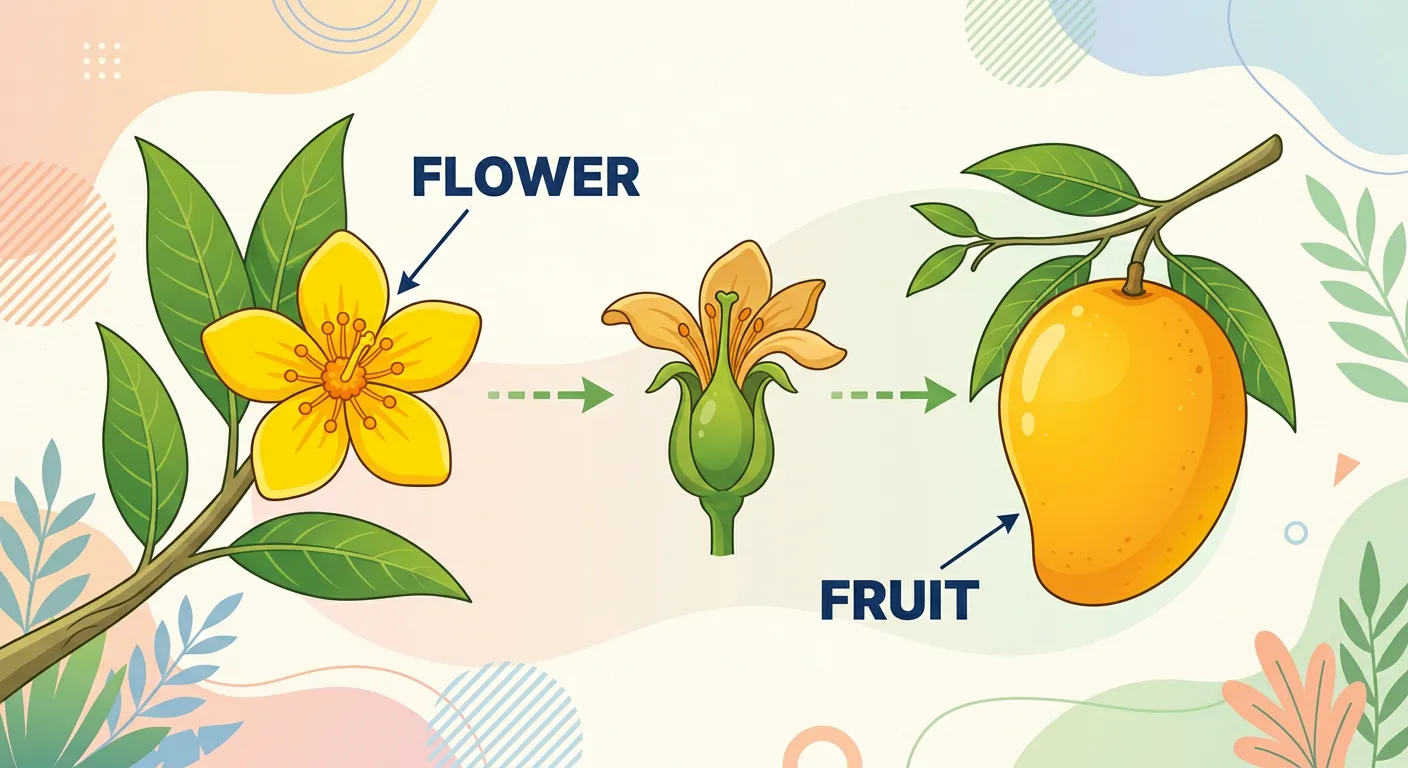
“Welcome! Ever wondered how a beautiful flower becomes the tasty fruit in your lunchbox? In biology, a fruit is simply the ripened ovary of a flower, developed after fertilization. It’s nature’s way of protecting seeds and helping them travel. Let's peel back the layers of this botanical wonder!”
In the world of Botany, a fruit is much more than a sweet snack; it represents a significant evolutionary milestone for flowering plants. Specifically, a fruit is defined as a mature or ripened ovary, developed after the process of fertilization. This development is triggered by complex hormonal changes—primarily driven by auxins and gibberellins—that occur once the pollen tube successfully fertilizes the ovules. While the ovules inside the ovary transform into seeds, the surrounding ovary wall undergoes a remarkable metamorphosis to become the fruit wall, or pericarp. This biological strategy is exclusive to angiosperms, distinguishing them from gymnosperms, which bear 'naked' seeds without any protective fruit covering.
The primary biological significance of fruit development is the protection and nurturing of the developing seeds. Inside the fruit, seeds are shielded from environmental stressors, desiccation, and premature predation by insects or microbes. Furthermore, fruits play a critical role in the survival of the species through specialized seed dispersal mechanisms. Whether a fruit is light enough to be carried by wind, buoyant enough to float on water, or succulent enough to be consumed by animals that later deposit the seeds elsewhere, the fruit acts as a specialized vehicle for migration. This ensures that the next generation of plants can thrive in new locations, effectively reducing competition for resources with the parent plant. From an evolutionary perspective, the incredible diversity in fruit structure—ranging from the aerodynamic wing of a maple seed to the fleshy sweetness of a peach—reflects the various ways plants have adapted to their unique ecosystems over millions of years.
Quick Revision Points
- Definition: A fruit is a ripened ovary developed post-fertilization in angiosperms.
- Transformation: Post-fertilization, ovules become seeds and the ovary becomes the fruit.
- Primary Function: Protection of immature seeds and facilitation of seed dispersal.
- Evolutionary Edge: Enhances the survival rate of the offspring by providing a protective, often nutrient-rich environment.
- Classification Basis: Fruits are classified based on the nature of the ovary (simple vs compound) and the number of flowers involved.
NEET Exam Angle
- Questions often link fruit development to the 'Post-fertilization events' discussed in Class 12 Biology; remember that fertilization is the trigger.
- Remember that the presence of fruit is a characteristic feature of Angiosperms only; Gymnosperms lack ovaries and thus lack fruits.
- Be prepared for questions regarding the fate of floral parts; the ovary wall becomes the fruit wall (pericarp), while the integuments of the ovule become the seed coat.
02Anatomy of the Fruit Wall: The Three Layers of Pericarp
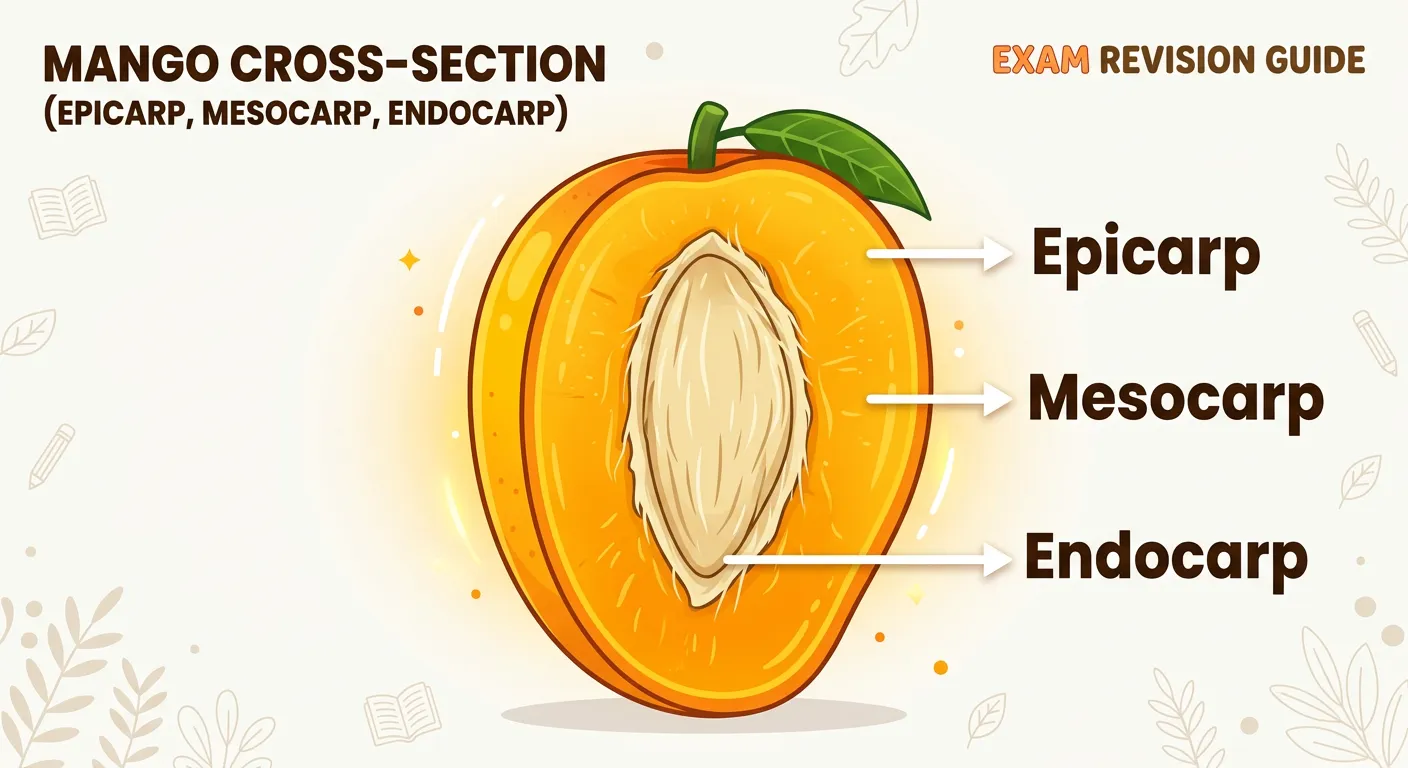
“A fruit's wall is called the pericarp. Think of it like a three-layered jacket! The outer skin is the epicarp, the juicy middle we eat is the fleshy mesocarp, and the hard shell protecting the seed inside is the endocarp. It’s all about protection and nutrition!”
Once the ovary matures into a fruit, its wall is technically referred to as the pericarp. The pericarp is derived from the wall of the ovary and can vary significantly in its physical properties; it can be thin and papery or thick and fleshy. When the pericarp is thick and succulent, it typically differentiates into three distinct histological layers: the epicarp, the mesocarp, and the endocarp. Understanding these layers is crucial for NEET aspirants, as many questions focus on identifying the edible portions of various fruits and their tissue origins. The differentiation of these layers is a result of tissue specialization, where parenchymatous, collenchymatous, or sclerenchymatous cells adapt to serve specific protective, storage, or dispersal functions.
The outermost layer is the epicarp, which forms the skin or rind of the fruit. Moving inward, the mesocarp is the middle layer; in many popular fruits like mangoes, this is the pulpy, succulent part rich in sugars and water that we enjoy. Finally, the endocarp is the innermost layer that directly surrounds the seed. The texture and thickness of the endocarp vary wildly across different species. For instance, in a grape, the endocarp is soft and barely distinguishable from the mesocarp, whereas, in a coconut or a mango, it becomes a hard, stony shell known as the 'pit.' This structural variation is a classic example of how plant anatomy adapts to protect the embryo inside the seed from physical damage or digestive enzymes of animals.
| Fruit Type | Edible Part | Description of Pericarp Layers |
|---|---|---|
| Mango | Mesocarp | Fleshy, sweet mesocarp; hard stony endocarp. |
| Coconut | Endosperm (Seed) | Fibrous mesocarp; stony endocarp (shell). |
| Grape | Pericarp & Placenta | Entire pericarp is fleshy, soft, and edible. |
| Orange | Glandular hairs | Juicy hairs arising from the endocarp fill the locules. |
Quick Revision Points
- Pericarp: The fruit wall derived from the ovary wall.
- Epicarp: The outer skin or rind of the fruit.
- Mesocarp: The middle layer; often fleshy in drupes like mango, but fibrous in coconut.
- Endocarp: The innermost layer; can be stony (Mango), fibrous, or fleshy (Tomato).
- Coconut Exception: The mesocarp is fibrous (coir), making it a 'fibrous drupe.'
NEET Exam Angle
- Identifying the 'stony endocarp' in drupes (Mango and Coconut) is a high-yield topic for matching questions.
- Note that in Coconut, we do not eat the pericarp; we consume the cellular and liquid endosperm (the seed part).
- Pay attention to the tissue types: Epicarp is often epidermal/parenchymatous, Mesocarp is parenchymatous, and the stony Endocarp is made of sclereids (sclerenchyma).
03Fleshy vs. Dry Fruits: Textural and Structural Classification
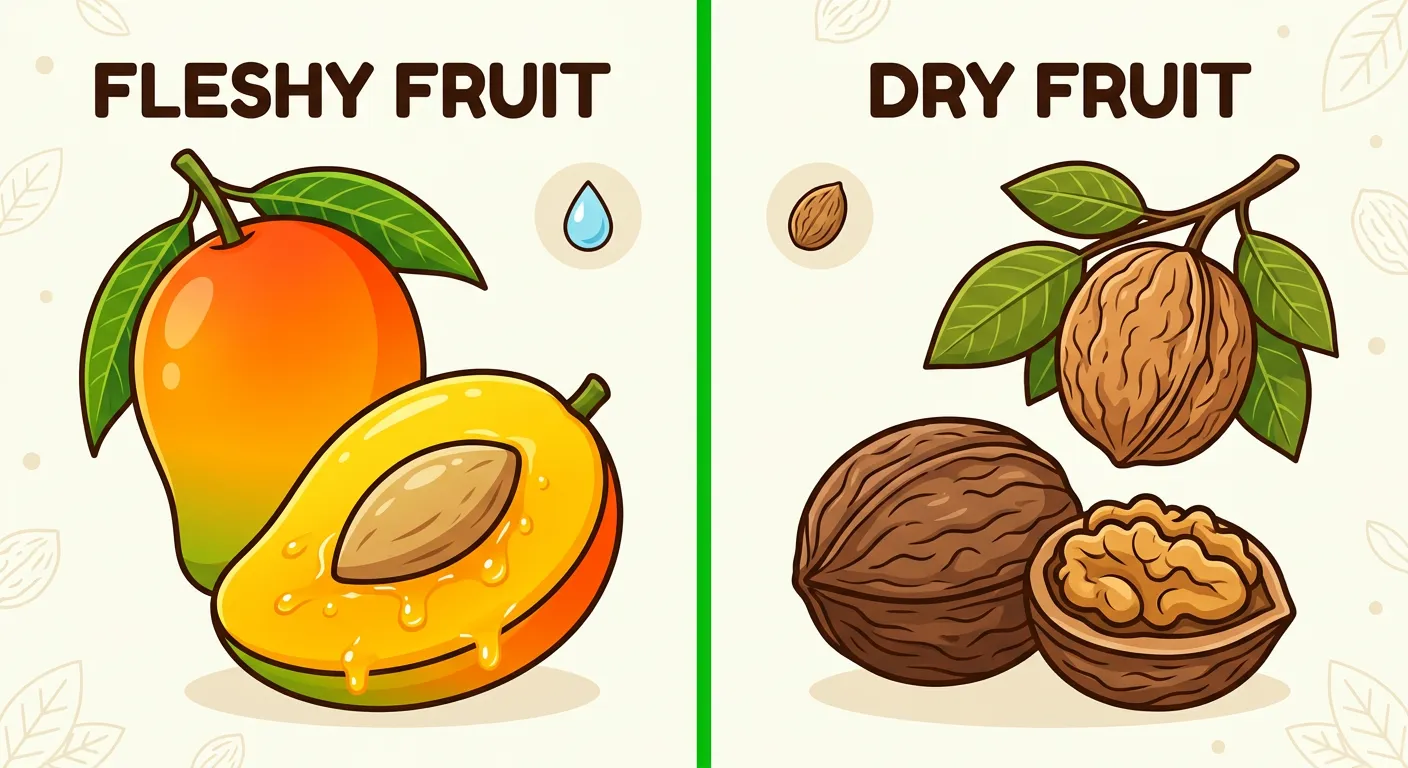
“Not all fruits are juicy like mangoes! We classify them into fleshy and dry fruits. Fleshy fruits like mangoes and oranges have a soft, pulpy wall when ripe. Dry fruits like walnuts and groundnuts have a hard, brittle wall. Remember, even a peanut is botanically a fruit!”
The classification of fruits often begins with the moisture content and thickness of the pericarp at the time of maturity. Fleshy fruits are those where the pericarp remains succulent, juicy, or pulpy when the fruit is ripe. Common examples include drupes (Mango), berries (Tomato), and pomes (Apple). In these fruits, the pericarp is usually well-differentiated into the three layers we discussed earlier. Fleshy fruits are typically designed to attract animals for dispersal; the animal eats the nutritious pulp and discards or excretes the seeds, often far from the parent plant, helping the species spread its ecological range.
In contrast, dry fruits have a pericarp that becomes hard, papery, or woody upon reaching maturity. These are further divided into three categories based on how they release seeds: dehiscent fruits, which burst open to release their seeds (like pea pods or mustard); indehiscent fruits, which do not open at maturity and rely on the decay of the fruit wall (like sunflowers or walnuts); and schizocarpic fruits, which split into single-seeded units. It is a common misconception among students that 'dry fruits' refers only to culinary nuts or raisins. Botanically, a groundnut or a pea pod is just as much a 'fruit' as a mango. The difference lies solely in the physiological state and moisture content of the ovary wall at the end of its development cycle.
| Classification | Characteristics | Examples |
|---|---|---|
| Fleshy Fruits | Thick, juicy pericarp at maturity. | Mango, Tomato, Orange, Brinjal. |
| Dry Dehiscent | Hard pericarp that splits open at maturity. | Pea, Bean, Mustard, Lady's Finger. |
| Dry Indehiscent | Hard pericarp that stays closed. | Wheat, Maize, Cashew Nut, Sunflower. |
Quick Revision Points
- Fleshy Fruits: Have a soft, edible, and moist pericarp (e.g., Guava, Mango, Grapes).
- Dry Fruits: Pericarp is dry, non-fleshy, and often woody at maturity (e.g., Mustard, Groundnut).
- Dehiscence: The natural bursting of a fruit to discharge seeds once they are fully developed.
- Indehiscent: Fruits that rely on the decay of the pericarp or external forces to release seeds.
- Common Error: Students often forget that cereal grains like wheat and maize are botanically indehiscent fruits (specifically called Caryopsis).
NEET Exam Angle
- Understand the difference between 'Drupe' (stony endocarp) and 'Berry' (fleshy endocarp) regarding the nature of the innermost layer.
- NEET frequently asks to categorize fruits like Pea and Groundnut under 'Dry' categories; don't be fooled by their culinary use.
- Be aware that in many dry fruits, the differentiation between epicarp, mesocarp, and endocarp is often indistinguishable to the naked eye.
04True Fruits vs. False Fruits: Beyond the Ovary
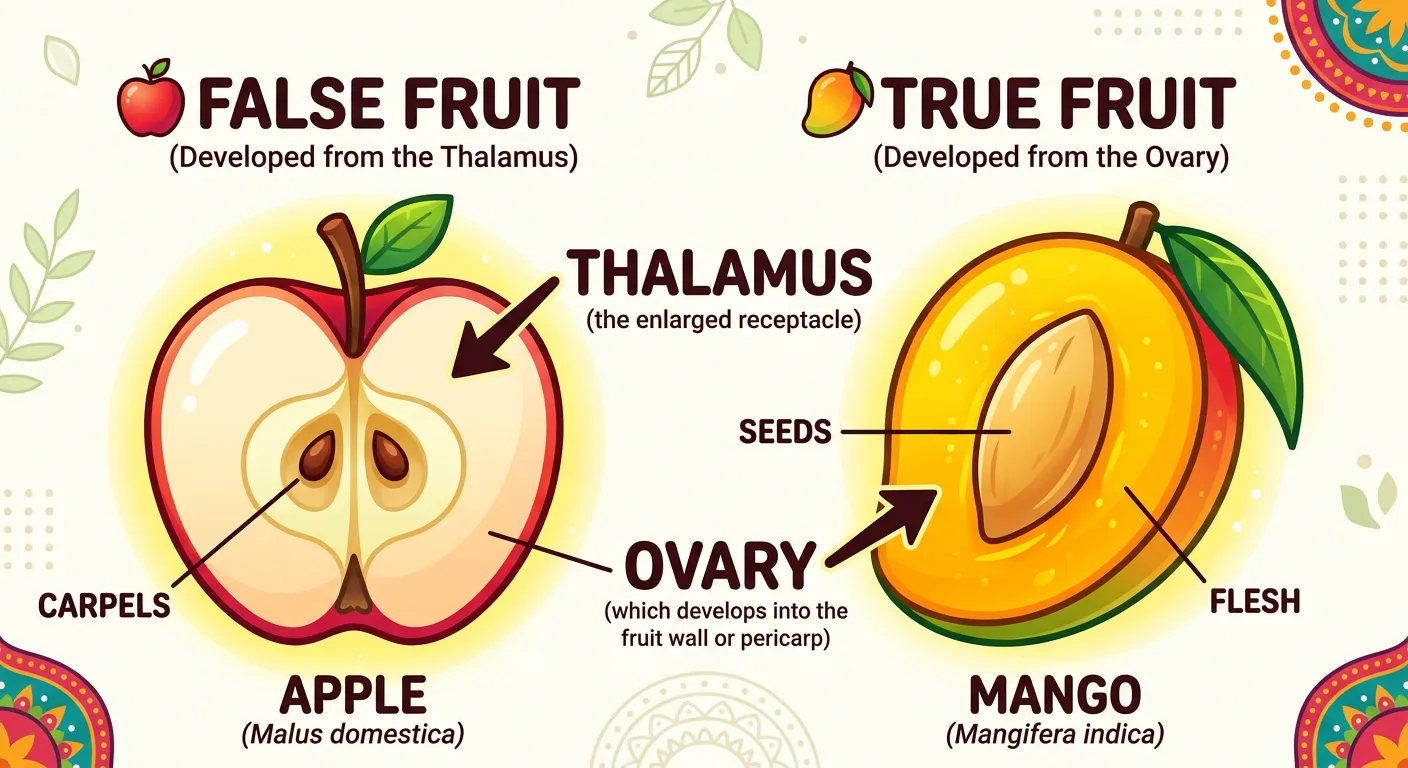
“Here’s a classic NEET trick question! True fruits develop only from the ovary. But in some plants like apples, the thalamus contributes to the fruit formation. We call these 'False Fruits'. If it’s not just the ovary doing the work, it’s a false fruit!”
In strict botanical terms, a 'True Fruit' or Eucarp is one that develops exclusively from the mature ovary of a single flower. In such cases, other floral parts like the calyx (sepals), corolla (petals), and thalamus usually wither and fall off after fertilization is complete. Mangoes, grapes, and peas are perfect examples of true fruits because the flesh you consume is derived solely from the ovary wall. However, nature is rarely that simple. In several plant species, other parts of the flower—most commonly the thalamus (the receptacle) or the pedicel—contribute significantly to the formation of the fleshy, edible part of the fruit. These are known as 'False Fruits' or Pseudocarps.
Apples and pears are the classic textbook examples of false fruits. When you bite into an apple, you aren't actually eating the ripened ovary wall; you are eating the enlarged, fleshy thalamus that has grown upward to surround the actual ovary (which forms the tough 'core' containing the seeds). Similarly, in strawberries, the fleshy red part we eat is the swollen thalamus, while the tiny 'seeds' on the surface are actually the true fruits (achenes) produced by the separate ovaries. Distinguishing between these two types is vital for NEET, as it tests your fundamental understanding of floral morphology and the varying roles of the receptacle in plant reproduction and seed dispersal strategies.
| Fruit Name | Type | Part that Becomes Fleshy |
|---|---|---|
| Mango | True Fruit | Ovary Wall (Mesocarp) |
| Apple | False Fruit | Thalamus (Receptacle) |
| Cashew | False Fruit | Pedicel (Stalk) and Thalamus |
| Strawberry | False Fruit | Thalamus (Receptacle) |
Quick Revision Points
- True Fruit (Eucarp): Develops only from the ovary (e.g., Tomato, Mango, Watermelon).
- False Fruit (Pseudocarp): Floral parts other than the ovary (like thalamus or perianth) contribute to fruit formation.
- Thalamus Role: In apples, pears, and strawberries, the thalamus becomes the main edible part.
- Identification: If any part other than the ovary is included in the mature fruit structure, it is categorized as 'False'.
NEET Exam Angle
- A very common MCQ: "Which of the following is a false fruit?" (Answer usually involves Apple, Strawberry, Pear, or Cashew).
- Be careful with Cashew; the kidney-shaped nut is the true fruit, but the 'cashew apple' above it is the swollen pedicel/thalamus.
- Remember that the presence of seeds does not determine if a fruit is true or false; only the morphological origin of the fleshy part matters.
05Parthenocarpy: The Biology of Seedless Fruit Development
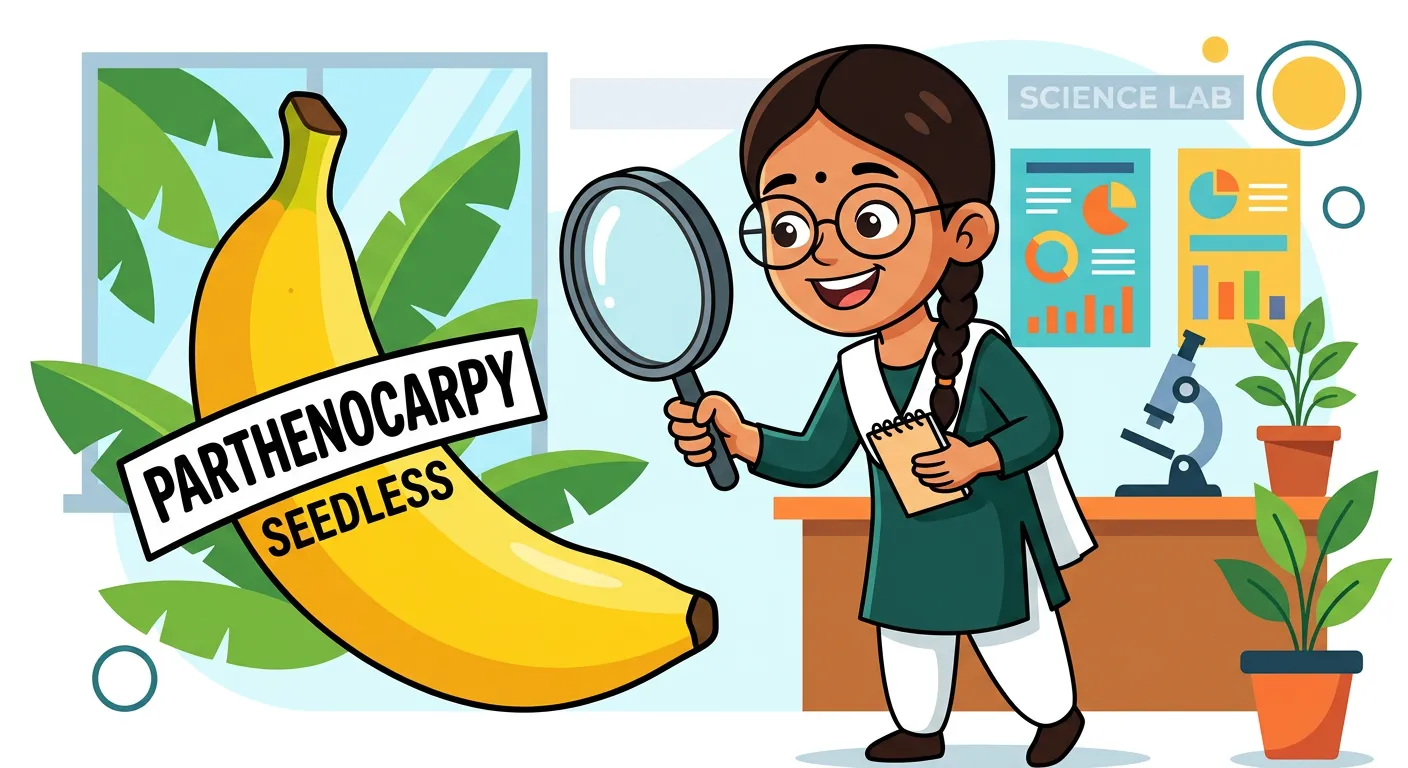
“Can you imagine a banana without seeds? That’s parthenocarpy! This happens when fruits develop without fertilization, making them seedless. Nature can be quite creative, and in agriculture, this is super important for producing the seedless grapes and watermelons you love to snack on!”
Standard fruit development is typically an 'after-effect' of fertilization. However, some plants have evolved the unique ability to develop fruits without the process of fertilization ever taking place. This phenomenon is called Parthenocarpy. In a normal cycle, fertilization (the fusion of male and female gametes) is the prerequisite for seed formation. Because this step is bypassed in parthenocarpy, the resulting fruits are naturally seedless. This process can occur spontaneously in nature due to genetic mutations or environmental factors, as seen in most commercial banana varieties, or it can be induced artificially by human intervention for agricultural and commercial benefit.
In modern agriculture, parthenocarpy is highly valued by both producers and consumers. Seedless varieties of grapes, watermelons, and oranges are produced by applying specific plant growth regulators—specifically auxins like IAA (Indole Acetic Acid) and NAA (Naphthalene Acetic Acid), or gibberellins like GA3—to unpollinated flowers. These hormones mimic the biochemical signals usually provided by a developing embryo, effectively 'tricking' the ovary tissues into maturing into a fleshy fruit. This is not just a matter of consumer convenience; seedless fruits are often easier to process for the food industry (for juices and jams) and can be produced even in environments where pollinators are scarce. From a purely biological standpoint, parthenocarpy represents a fascinating bypass of the traditional reproductive cycle, where the plant invests significant metabolic energy into fruit production even when a viable embryo hasn't been formed to carry on the genetic lineage.
Quick Revision Points
- Definition: Development of fruit from an ovary without the process of fertilization.
- Key Characteristic: Parthenocarpic fruits are always seedless (e.g., commercial Bananas).
- Natural Example: The common edible banana (Musa paradisiaca) is a naturally parthenocarpic fruit.
- Induced Parthenocarpy: Achieved by spraying unpollinated flowers with hormones like Auxins and Gibberellins.
- Commercial Value: High market demand for seedless grapes, oranges, cucumbers, and watermelons due to ease of consumption.
- Difference: It differs from apomixis, where seeds are formed without fertilization; here, no seeds are formed at all.
NEET Exam Angle
- Do not confuse Parthenocarpy (seedless fruit formation) with Parthenogenesis (development of an unfertilized egg into an entire organism/embryo).
- NEET exams often ask which specific plant hormones induce parthenocarpy; focus your revision on Auxins and Gibberellins.
- Questions may ask for examples of naturally parthenocarpic fruits; keep Banana and Pineapple at the top of your list for quick recall.
06Aggregate Fruits: Multicarpellary Apocarpous Developments
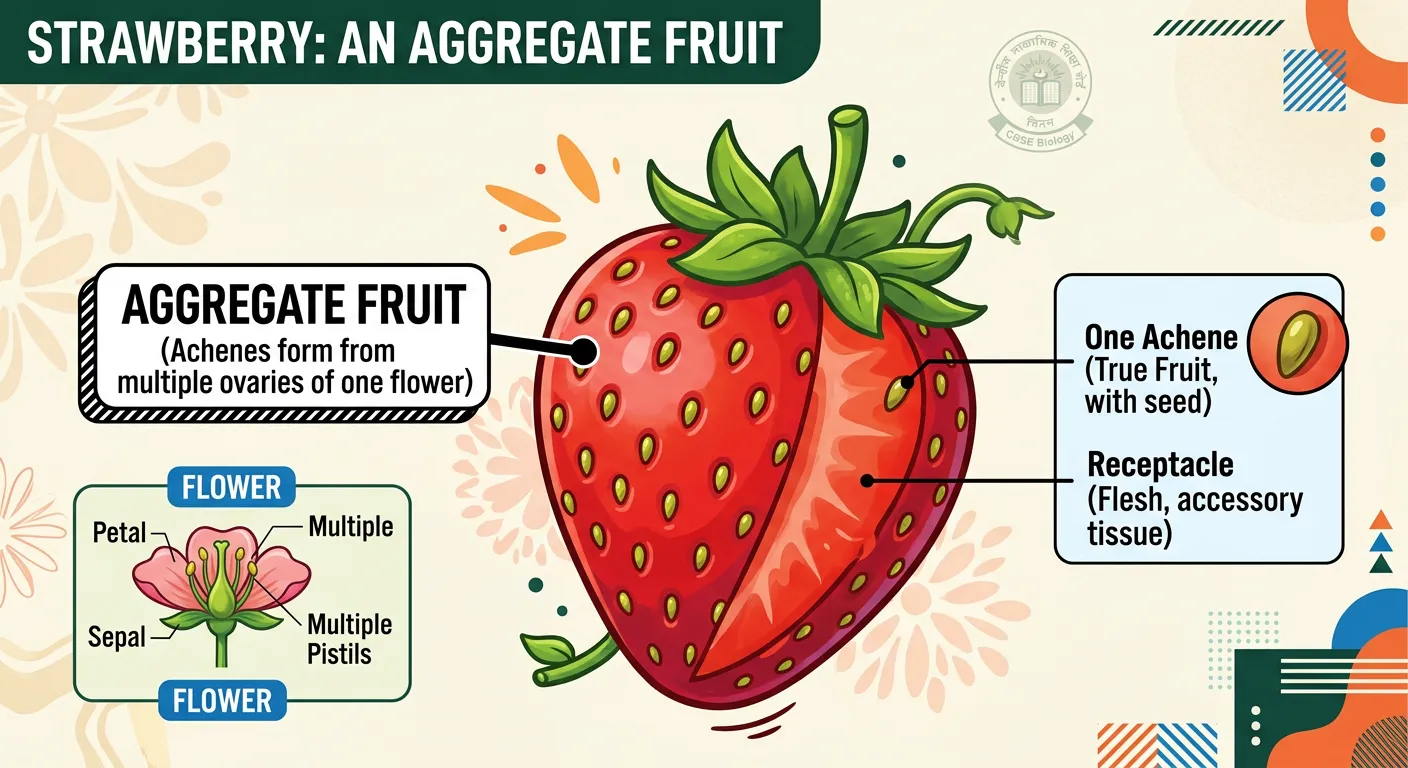
“Ever seen a strawberry and wondered, is it one fruit or many? It’s an aggregate fruit! It develops from a single flower with many ovaries, which fuse together. Think of it as a bunch of tiny fruitlets sitting together on a single receptacle. How fascinating!”
To understand aggregate fruits, we must look closely at the structure of the gynoecium, the female reproductive part of the flower. In many plants, a single flower contains multiple carpels (ovaries). If these carpels remain separate and are not fused together, the condition is termed 'apocarpous.' When such a flower matures after fertilization, each individual, free ovary develops into a tiny, distinct fruitlet. Because all these fruitlets belong to the same single flower and share a common receptacle, they cluster together to form what we call an Aggregate Fruit. A collection of these tiny fruitlets is botanically referred to as an Etaerio.
The diversity of aggregate fruits depends on the type of fruitlets formed. For example, we can have an 'Etaerio of achenes' (as seen in Strawberry or Lotus), an 'Etaerio of berries' (as seen in Custard Apple/Sugar Apple), or an 'Etaerio of drupes' (as seen in Raspberries). In the case of a strawberry, the situation is even more complex: the tiny, crunchy 'seeds' on the outside are actually individual true fruits called achenes. These fruitlets are held together by the fleshy, greatly enlarged thalamus. It is a common point of academic confusion: while the whole structure is technically an aggregate fruit because it comes from one flower with many ovaries, it is also categorized as a false fruit because the part we eat is the thalamus, not the ovary walls. This highlights why students must carefully distinguish between the 'type' of fruit based on carpel arrangement (simple, aggregate, or composite) and its 'origin' (true or false fruit).
Quick Revision Points
- Origin: Develops from a single flower that is multicarpellary and apocarpous (free carpels).
- Structure: A cluster of small fruitlets known as an 'Etaerio.'
- Key Examples: Strawberry, Raspberry, Lotus, Custard Apple (Annona), and Rose.
- Apocarpous vs Syncarpous: In aggregate fruits, carpels are free (apocarpous); in simple fruits, they are often fused (syncarpous).
- Visual Hook: Think of an aggregate fruit as a 'close-knit family' of tiny fruits all living together on one single flower base.
NEET Exam Angle
- The term 'Apocarpous' is the critical keyword; NEET often uses this term in matching-type or statement-based questions regarding fruit origin.
- Differentiate clearly between 'Aggregate' (one flower, many ovaries) and 'Composite' (many flowers, many ovaries).
- Remember that Lotus and Rose also show an apocarpous gynoecium, leading to aggregate fruit structures even if they aren't 'succulent' in the way we usually think of fruits.
07Composite Fruits: The Inflorescence Transformation
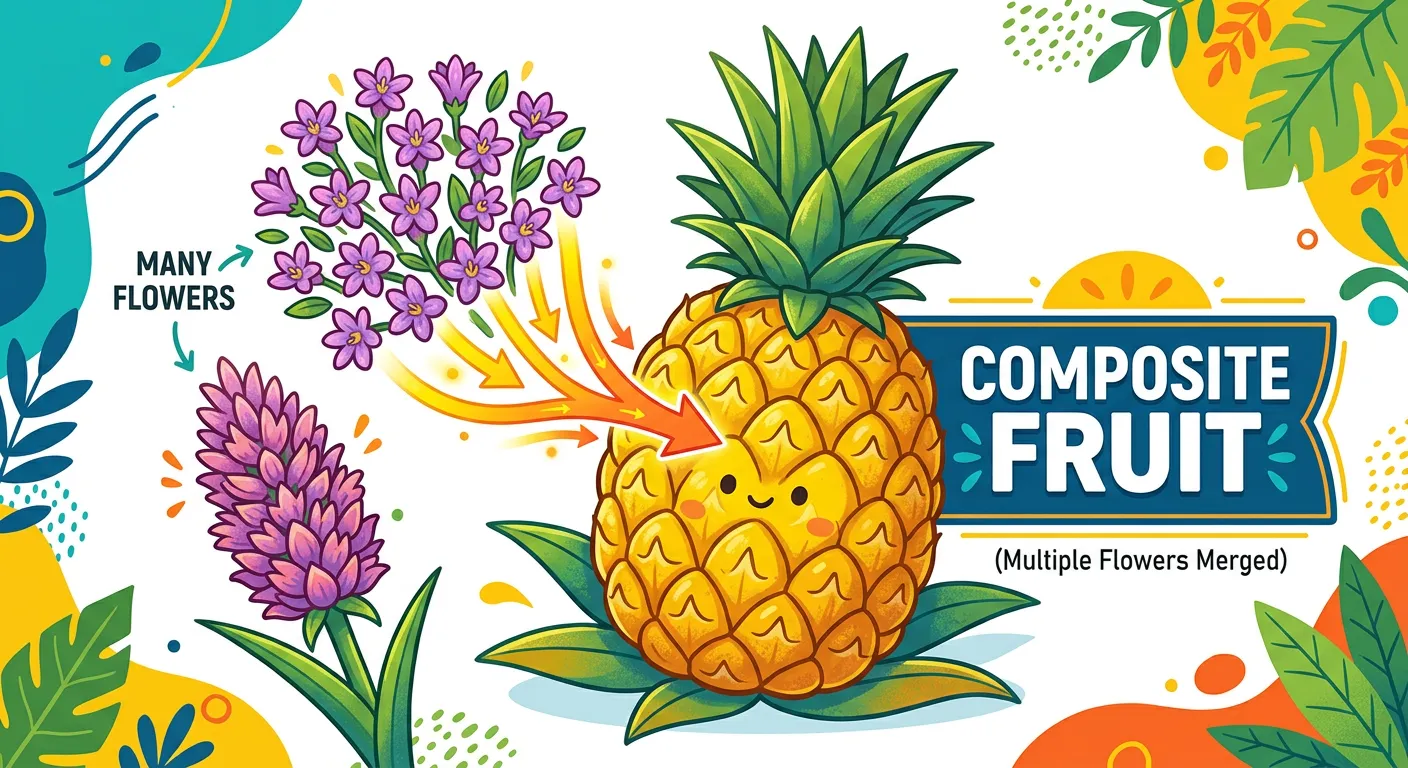
“Finally, we have composite fruits like pineapples. Unlike aggregate fruits, these develop from a whole cluster of flowers! These flowers fuse to form a single, massive fruit structure. You've mastered the botany of fruits! Keep this clear for your NEET exam, and you'll ace it!”
While aggregate fruits originate from a single flower, Composite fruits (also known as multiple fruits) take botanical complexity to the next level. These fruits develop not from a single flower, but from an entire inflorescence—that is, a whole cluster of flowers arranged on a common axis or peduncle. As the individual flowers within the cluster are fertilized, their ovaries, the central peduncle, and even the surrounding bracts (leaf-like structures) and perianth all grow and fuse together into a single, large fleshy mass. This creates a fruit that appears to be one unit but is actually the collective result of dozens or even hundreds of flowers working in unison.
There are two primary types of composite fruits that NEET students must master: Sorosis and Syconus. In Sorosis, found in pineapples, mulberries, and jackfruits, the fruit typically develops from a spike, spadix, or catkin inflorescence. In a pineapple, the 'woody core' is actually the central axis of the inflorescence, and each 'eye' on the surface represents an individual flower that has fused with its neighbors. The second type, Syconus, is characteristic of the Ficus genus (like figs, gular, and banyan). In this case, the fruit develops from a specialized cup-shaped, fleshy inflorescence called a hypanthodium. The tiny 'crunchy bits' inside a fig are actually the true fruits (achenes) produced by the many tiny female flowers that were hidden inside the hollow, fleshy receptacle. This level of structural integration, often involving symbiotic relationships with pollinating wasps, is one of the most complex reproductive strategies in the entire plant kingdom.
| Type of Composite Fruit | Inflorescence Type | Examples |
|---|---|---|
| Sorosis | Spike, Spadix, or Catkin | Pineapple, Jackfruit, Mulberry. |
| Syconus | Hypanthodium | Fig (Ficus), Gular, Banyan. |
| Structures Involved | Entire Inflorescence | Floral axis, bracts, perianth, and ovaries. |
Quick Revision Points
- Composite Fruit: Develops from a whole inflorescence (a cluster of multiple flowers).
- Sorosis: A sub-type where flowers fuse along a central axis (e.g., Pineapple and Jackfruit).
- Syconus: A sub-type where flowers are enclosed in a fleshy, hollow receptacle (e.g., Fig).
- Key Structural Difference: Aggregate = 1 Flower; Composite = Many Flowers.
- Fusion: Unlike simple fruits, composite fruits involve the floral axis, bracts, and perianth alongside the ovaries.
NEET Exam Angle
- NEET often asks about the 'type of inflorescence' for Composite fruits; be sure to link Sorosis to Spadix/Spike and Syconus to the Hypanthodium inflorescence.
- Be aware that in Jackfruit, the edible part is actually the fleshy perianth and bracts, not just the ovary wall.
- Understand that a pineapple 'eye' is the remnant of an individual flower; this demonstrates the 'multiple fruit' nature perfectly for MCQ identification.
Recommended Reading
Explore related Biology topics to build deeper chapter connections for NEET.
- Morphology and Modifications · Topic 2.1
- Families · Topic 2.10
- Animal Tissues · Topic 2.11
- Frog Morphology · Topic 2.12
- Digestive System · Topic 2.13
- Circulatory System · Topic 2.14
- Jump to Key Terms (Quick Revision)
- Review Common NEET Mistakes
- Solve NEET Practice MCQs
- Read Topic FAQs
- Practice NEET MCQs
- Solve NEET PYQs
📚 Key Terms
⚠️ Common NEET Mistakes
- 1Thinking that all 'nuts' are dry fruits and all 'juicy' things are fleshy fruits; remember that botanically, a groundnut is a fruit.
- 2Confusing the edible part of a coconut (endosperm) with the mesocarp (which is actually the fibrous husk and is inedible).
- 3Assuming that strawberries are true fruits because they have 'seeds' on the outside; those 'seeds' are the actual fruits (achenes), and the red part is the thalamus.
- 4Misidentifying Parthenocarpy as Parthenogenesis; remember that Parthenocarpy is specifically about fruit formation, not embryo/organism formation.
- 5Forgetting that in a drupe like mango, the 'stone' is the endocarp, not the seed itself; the seed is protected inside the stony endocarp layer.
📝 NEET PYQ & Practice Questions
Test your understanding of Fruit with NCERT-aligned sample questions.
Which of the following statements is correct regarding "Pericarp" in the context of NEET Biology?
In NEET question papers, questions related to "Fruit" predominantly test:
Consider Drupe associated with Fruit. What is the primary characteristic expected in NEET MCQs?
Master Fruit with NeetQ AI Tutor
Practice 50+ topic-wise MCQs, previous 15 years NEET questions, and get step-by-step doubt resolution instantly.
❓ Frequently Asked Questions
Why is an apple considered a false fruit while a mango is a true fruit?
An apple is a false fruit because its edible fleshy part develops from the thalamus (receptacle) rather than the ovary wall. In contrast, a mango is a true fruit because it develops exclusively from the mature ovary, with the mesocarp being the edible part.
What are the three layers of the pericarp and how do they differ in a coconut?
The three layers are the epicarp (outer skin), mesocarp (middle layer), and endocarp (inner layer). In a coconut, the epicarp is the thin outer skin, the mesocarp is thick and fibrous (used for coir), and the endocarp is the hard, stony shell that protects the seed inside.
Can a fruit be formed without fertilization? Explain the process.
Yes, this process is called parthenocarpy. Fruits like bananas develop without fertilization, resulting in seedless fruits. This can be induced artificially using plant growth regulators like auxins and gibberellins to produce seedless varieties of grapes and watermelons.
What is the difference between an aggregate fruit and a composite fruit?
An aggregate fruit develops from a single flower that has multiple free (apocarpous) ovaries, forming a cluster of fruitlets (e.g., strawberry). A composite fruit develops from an entire inflorescence (a cluster of many flowers) that fuses into one mass (e.g., pineapple).
Identify the edible part of a mango and a coconut.
In a mango, the edible part is the fleshy mesocarp. In a coconut, the edible part is the endosperm of the seed (both the liquid water and the white kernel); the pericarp (the fibrous husk and shell) is not edible.
Give examples of dry fruits where the pericarp is not fleshy at maturity.
Common examples include Pea (Pod), Mustard (Siliqua), Groundnut (Lomentum), and Wheat (Caryopsis). In these plants, the pericarp becomes dry, woody, or papery instead of pulpy when ripe.
Written By
NEET Content Strategist & Biology Expert
Sangita Kumari is a NEET educator and content strategist with over 6 years of experience teaching Biology, Chemistry, and Physics to Class 11 and 12 aspirants. She helps bridge the gap between traditional NCERT preparation and modern AI-powered learning. Her content is trusted by thousands of NEET aspirants across India.