🎬 Video Lesson Available
Watch the full 7-slide video lesson for Flower with AI teacher narration and visual explanations.
Flower — Master flower anatomy for NEET. Detailed notes on Thalamus, Calyx, Corolla, Androecium, and Gynoecium based on Class 11 Biology and recent PYQ trends.
01The Flower as a Modified Shoot: Biological Significance in Angiosperms
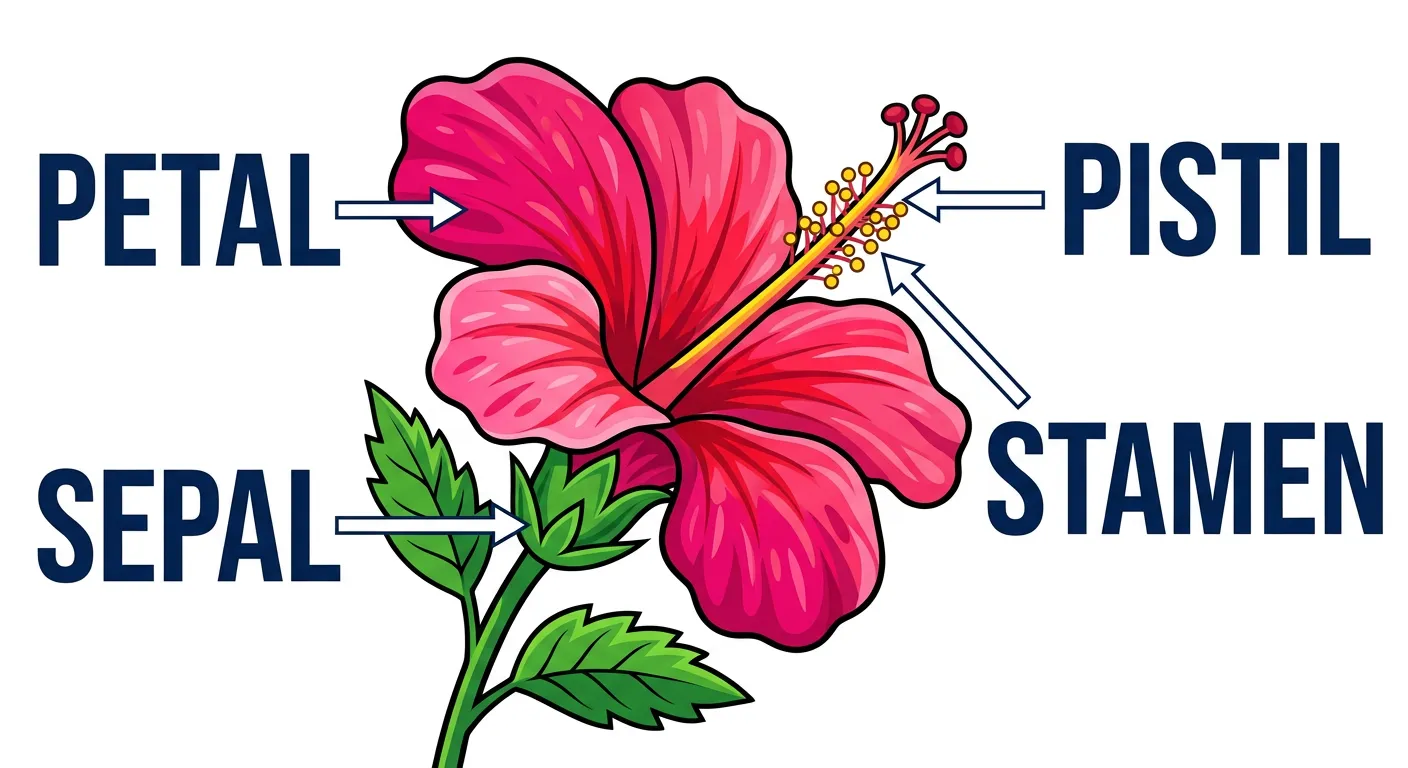
“Welcome, future doctors! Think of a flower as the 'marriage hall' of a plant. It’s not just for decoration; it’s a biological masterpiece designed for reproduction. Today, we’re breaking down the anatomy of a flower so you can ace those NEET questions on floral morphology!”
When we look at a flower, we often see beauty and color, but for a NEET aspirant, a flower is strictly defined as a highly specialized and modified shoot meant for sexual reproduction. In Angiosperms, the transition from a vegetative state to a reproductive state is a pivotal biological event. This transformation begins when the shoot apical meristem (SAM) changes into a floral meristem-cymose-racemose-neet-biology-class-11)-cymose-racemose-neet-biology-class-11)-cymose-racemose-neet-biology-class-11)-cymose-racemose-neet-biology-class-11)-cymose-racemose-neet-biology-class-11)-cymose-racemose-neet-biology-class-11)-cymose-racemose-neet-biology-class-11)-cymose-racemose-neet-biology-class-11)-cymose-racemose-neet-biology-class-11)-cymose-racemose-neet-biology-class-11)-cymose-racemose-neet-biology-class-11)-cymose-racemose-neet-biology-class-11)-cymose-racemose-neet-biology-class-11)-cymose-racemose-neet-biology-class-11)-cymose-racemose-neet-biology-class-11)-cymose-racemose-neet-biology-class-11)-cymose-racemose-neet-biology-class-11)-cymose-racemose-neet-biology-class-11)-cymose-racemose-neet-biology-class-11)-cymose-racemose-neet-biology-class-11)-cymose-racemose-neet-biology-class-11)-cymose-racemose-neet-biology-class-11)-cymose-racemose-neet-biology-class-11)-cymose-racemose-neet-biology-class-11)-cymose-racemose-neet-biology-class-11)-cymose-racemose-neet-biology-class-11)-cymose-racemose-neet-biology-class-11)-cymose-racemose-neet-biology-class-11)-cymose-racemose-neet-biology-class-11). During this process, the internodes of the shoot do not elongate, causing the axis to become compressed. Consequently, the apex produces different types of floral appendages laterally at successive nodes instead of traditional leaves. This structural homology between leaves and floral parts is why we refer to sepals and petals as modified leaves.
Think of the flower as a highly efficient 'marriage hall' where the complex choreography of gamete fusion occurs. This evolutionary adaptation ensures that the plant can produce seeds and fruit, securing the next generation. The development is triggered by complex hormonal shifts and environmental cues such as photoperiodism and temperature (vernalization). For taxonomists, the morphology of the flower is the most reliable tool for plant classification. Because floral characters are more conservative—meaning they are less likely to change due to environmental factors than vegetative characters like leaves or stems—they serve as the primary criteria for distinguishing different plant families. Understanding this shoot-to-flower transition is fundamental because it sets the stage for everything you will learn in Class 12 regarding embryology and plant development.
| Feature | Vegetative Shoot | Reproductive Shoot (Flower) |
|---|---|---|
| Meristem Type | Shoot Apical Meristem | Floral Meristem |
| Internode Growth | Elongated | Compressed/Non-elongated |
| Lateral Appendages | Leaves | Floral Whorls (Sepals, Petals, etc.) |
| Primary Function | Photosynthesis and Growth | Sexual Reproduction |
Quick Revision Points
- A flower is morphologically a modified shoot with a condensed axis.
- Floral organs are homologous to leaves but specialized for reproduction.
- The transformation is triggered by hormonal and environmental changes.
- Floral morphology is the most stable parameter for botanical classification and identification.
NEET Exam Angle
- Direct questions often ask: 'The flower is a modified ________?' (Answer: Shoot).
- Expect conceptual questions on the changes occurring at the shoot apex during flowering.
- NCERT highlights that internodes do not elongate in a flower; this is a frequent True/False statement in exams.
02The Thalamus: Analyzing the Structural Foundation of Floral Organs
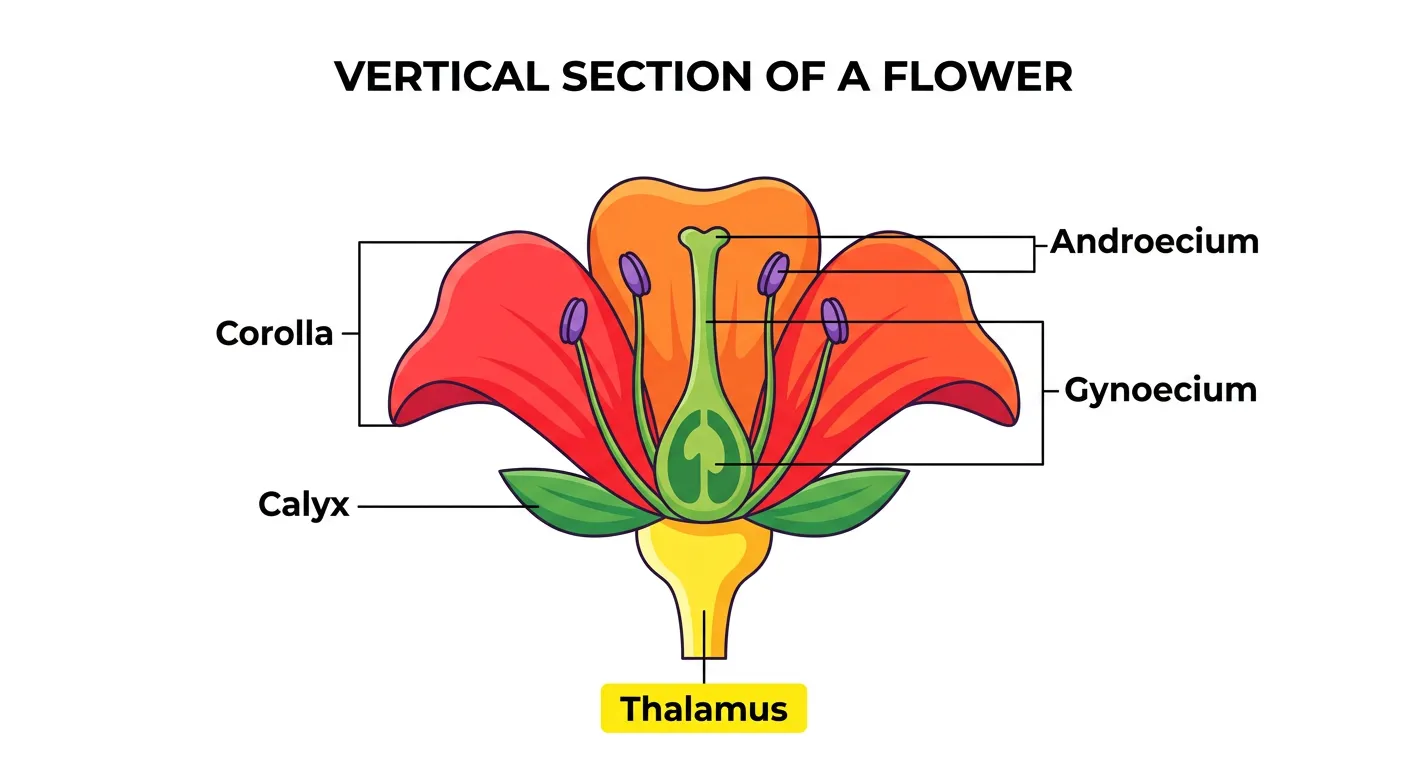
“Everything sits on the Thalamus, the stem's swollen tip. Imagine it as the sturdy stage where all the floral drama happens. Every part of the flower—the petals, stamens, and carpels—is neatly arranged on this platform. It’s the essential foundation for plant reproduction.”
Every masterpiece needs a stage, and for the flower, that stage is the thalamus. Also known as the receptacle or torus, the thalamus is the swollen, slightly flattened or dome-shaped tip of the flower stalk, which we call the pedicel. If you imagine the flower as a high-rise building, the thalamus is the foundation slab that supports all the 'floors' or whorls. The nodes on this modified shoot are so close together that the floral appendages—sepals, petals, stamens, and carpels—appear to arise from the same point, though they are actually arranged in a specific sequence. In some rare instances, the internodes between floral whorls do elongate, such as the anthophore (between calyx and corolla) or androphore (between corolla and androecium), providing clear proof of the flower's shoot-like nature.
It is crucial to distinguish between the terms used for plant stalks to avoid confusion in the exam hall. The 'peduncle' refers to the main axis of an entire inflorescence (a group of flowers), whereas the 'pedicel' is the stalk of a single individual flower. The thalamus isn't just a passive support structure; its shape and size can determine the position of the ovary relative to other parts. Based on the position of calyx, corolla, and androecium in respect of the ovary on the thalamus, flowers are described as hypogynous, perigynous, and epigynous. For example, in hypogynous flowers (Mustard, China rose, Brinjal), the ovary occupies the highest position while the other parts are situated below it. This spatial arrangement is a favorite topic for NEET examiners because it bridges the gap between simple anatomy and complex classification principles.
Quick Revision Points
- Thalamus (Receptacle): The swollen end of the pedicel that bears floral whorls.
- The thalamus represents the condensed nodes of the modified shoot.
- Internodal elongation proof: Anthophore, Androphore, and Gynophore.
- The shape of the thalamus influences the classification of the flower (e.g., cup-shaped in perigynous flowers).
NEET Exam Angle
- Differentiate clearly between Pedicel (stalk of a flower) and Peduncle (stalk of inflorescence).
- NEET 2020 and 2022 featured questions on the position of the ovary on the thalamus.
- Remember that the thalamus is technically the axis of the flower, and its nodes bear the floral organs. Always associate 'Swollen end of pedicel' with the Thalamus.
03Accessory Whorls: The Protective Calyx and Attractive Corolla
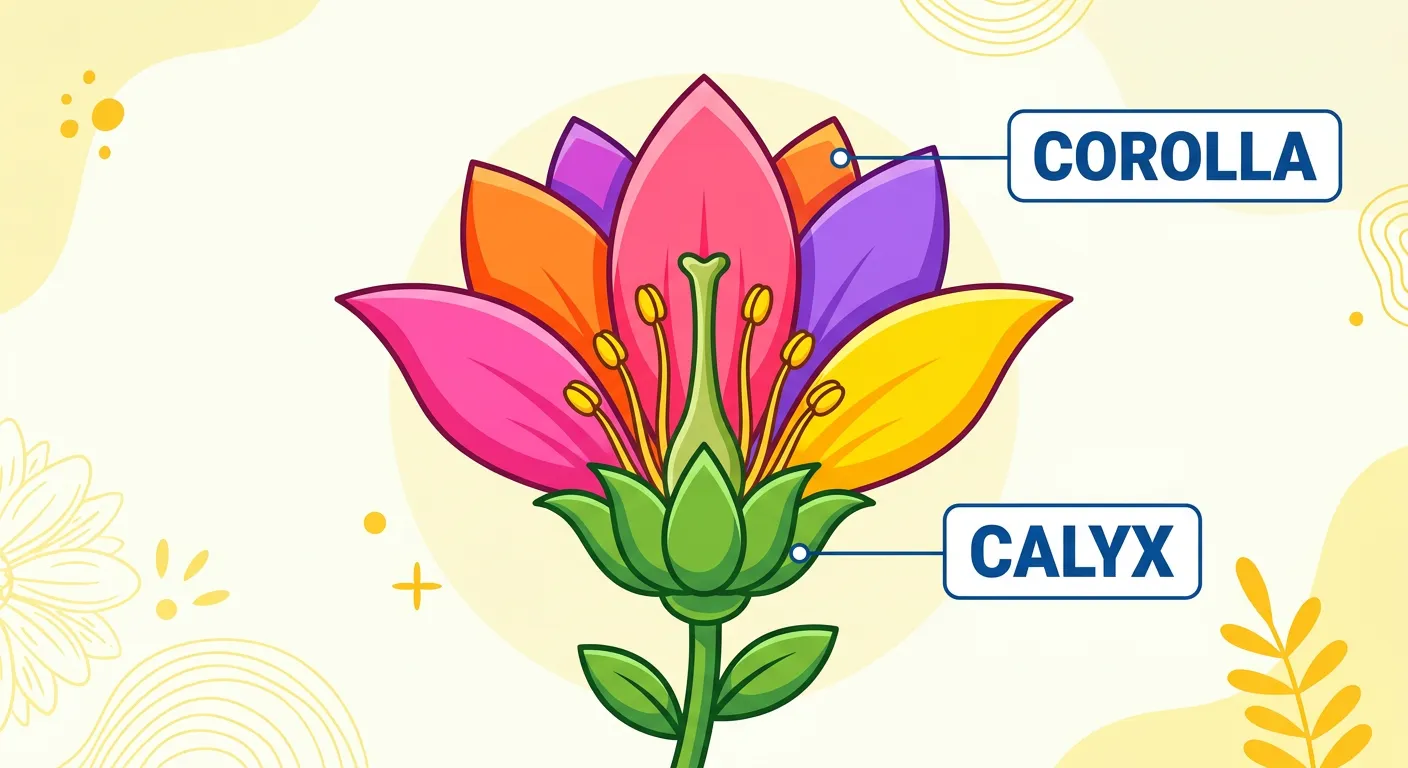
“The outer ring is the Calyx, protecting the flower in its bud stage like a security guard. Inside are the colorful petals, the Corolla. Their job? To act like neon advertisements, attracting pollinators like bees and butterflies to visit the flower. Nature’s own marketing team!”
Not every part of a flower is directly involved in making gametes. The Calyx and Corolla are known as 'accessory whorls' because while they don't produce pollen or ovules, they are indispensable for the success of reproduction. The Calyx, composed of sepals, is the outermost layer. Usually green and leaf-like, its primary mission is protection—specifically shielding the delicate inner organs while the flower is still a tiny bud. When sepals are fused, we call the condition gamosepalous; when they are free, it's polysepalous. In some plants like Hibiscus, an extra whorl called the epicalyx is present below the calyx, acting as an additional layer of defense.
Moving inward, we find the Corolla, the ring of petals. These are often brilliantly colored and scented. Why? Evolutionarily, petals are advertisements. They use pigmentation and fragrance to attract pollinators like insects (entomophily) or birds (ornithophily). However, in some plants like the Lily (Liliaceae family), the calyx and corolla are so similar they cannot be distinguished. In such cases, we use the term 'Perianth,' and the individual units are called tepals. This is a common point of confusion, so keep it clear: Calyx (sepals) + Corolla (petals) = Perianth (tepals) when indistinguishable. The arrangement of these parts in the bud stage relative to others of the same whorl is called aestivation, which is vital for identification.
| Aestivation Type | Description | Classic Example |
|---|---|---|
| Valvate | Sepals/Petals just touch each other without overlapping. | Calotropis |
| Twisted | One margin overlaps the next one consistently. | China Rose, Lady's finger |
| Imbricate | Margins overlap but not in a specific direction. | Cassia, Gulmohar |
| Vexillary | Large petal (Standard) overlaps wings, which overlap keel. | Pea, Bean |
Quick Revision Points
- Calyx: Protective outermost whorl (sepals). Gamosepalous (fused) or Polysepalous (free).
- Corolla: Attractive second whorl (petals). Gamopetalous (fused) or Polypetalous (free).
- Perianth: Term used when calyx and corolla are identical (e.g., Lily).
- Aestivation: The mode of arrangement of sepals or petals in the floral bud.
NEET Exam Angle
- 'Aestivation' is a high-yield keyword. Match-the-following questions with examples (like Calotropis for valvate) are very common.
- The Perianth is a signature characteristic of the family Liliaceae.
- Understand the difference between Polypetalous (free petals) and Gamopetalous (fused petals). Questions often mix these up with 'polysepalous'.
04The Androecium: Dissecting the Male Reproductive Unit
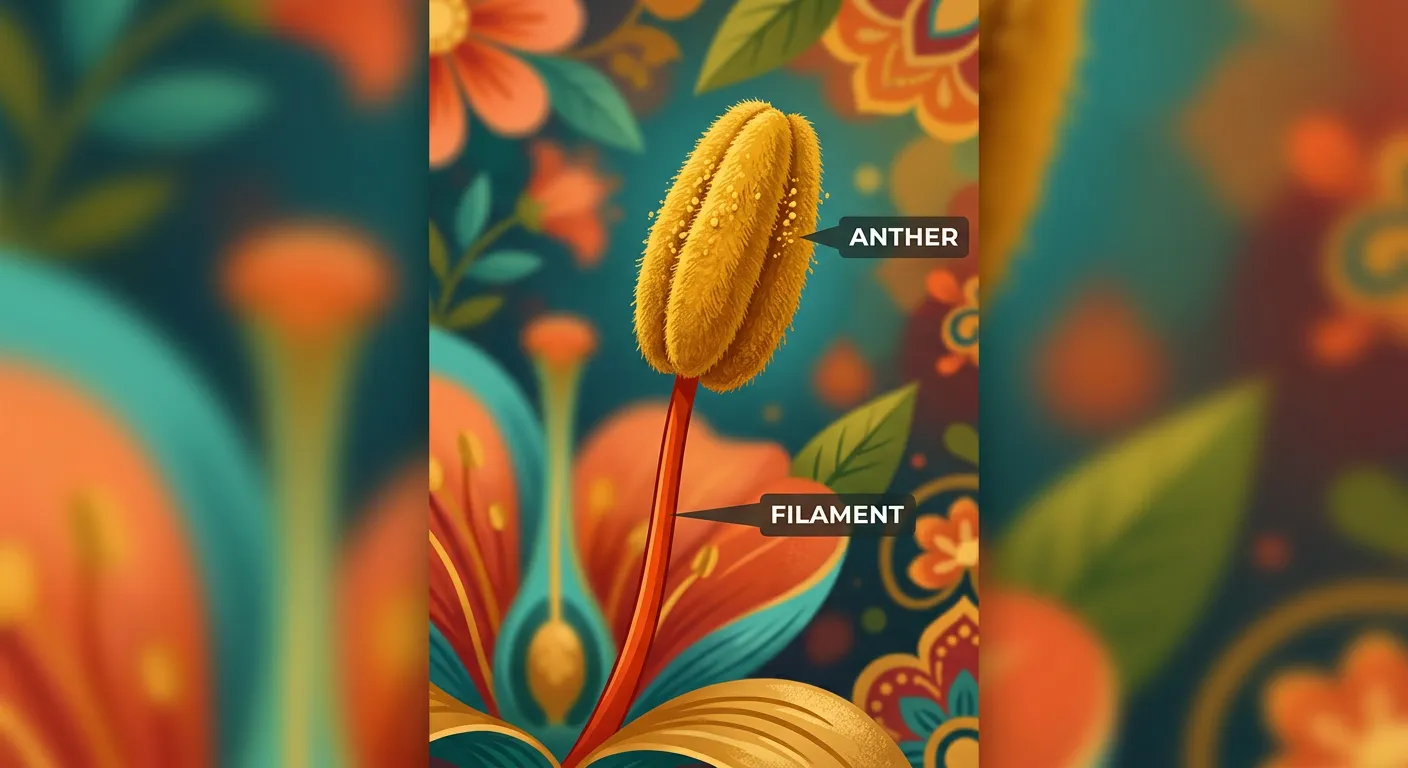
“Meet the male reproductive unit: the Androecium or Stamen. It’s made of a long filament and a pollen-factory called the Anther. Think of the Anther as a tiny pollen-producing machine waiting to disperse its cargo. Every grain of pollen here is a future generation in waiting!”
The Androecium represents the third whorl and is the male reproductive part of the flower. It consists of individual units called stamens. A typical stamen is bipartite, consisting of a long, slender stalk called the filament and a terminal, usually bilobed structure known as the anther. The filament's base is typically attached to the thalamus or sometimes to the petals (epipetalous condition, as seen in Brinjal) or the perianth (epiphyllous condition, as seen in Lily). While the filament provides support and positions the anther for dispersal, the anther is where the real action happens.
Most angiosperm anthers are 'dithecous,' meaning they have two lobes, and each lobe contains two pollen sacs (microsporangia). This makes a total of four pollen sacs per anther. Inside these sacs, pollen grains are produced through a process called microsporogenesis. Pollen grains represent the male gametophyte. NEET aspirants must also master the terminology of stamen fusion. If stamens are fused into one bunch, it's 'monadelphous' (Hibiscus); two bunches is 'diadelphous' (Pea, usually 9+1); and many bunches is 'polyadelphous' (Citrus). If stamens are sterile and do not produce pollen, they are called staminodes. Furthermore, variation in the length of filaments within a single flower can occur, such as in Salvia (two short, two long) and Mustard (four long, two short).
| Fusion Type | Description | Representative Example |
|---|---|---|
| Monadelphous | Stamens united into a single tube/bundle. | China Rose (Hibiscus) |
| Diadelphous | Stamens united into two bundles (usually 9+1). | Pea (Pisum sativum) |
| Polyadelphous | Stamens united into more than two bundles. | Citrus fruits |
| Epipetalous | Stamens attached to the petals. | Brinjal |
Quick Revision Points
- Androecium: The male whorl consisting of stamens.
- Dithecous Anther: Two lobes, four microsporangia.
- Pollen Grain: The immature male gametophyte.
- Staminode: A sterile, non-functional stamen (e.g., Cassia).
NEET Exam Angle
- Pay close attention to the examples of fusion types (monadelphous, diadelphous, etc.).
- The concept of 'Epipetalous' vs 'Epiphyllous' is frequently tested in 'Match the Column'.
- Remember that Salvia and Mustard show variation in the length of filaments within a single flower—this is an often-overlooked NCERT detail.
05The Gynoecium: Anatomy of the Female Powerhouse
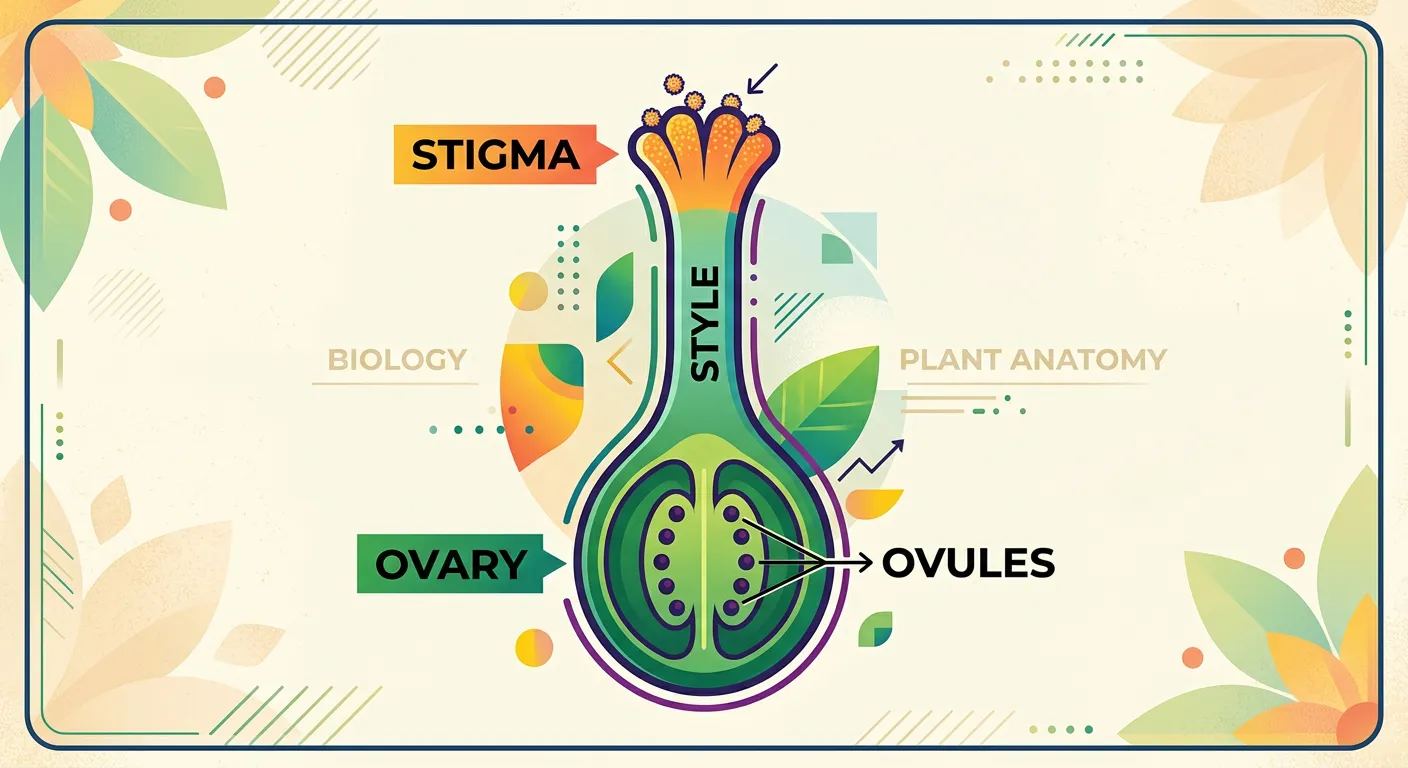
“The Gynoecium is the female powerhouse. It has the Stigma, which acts like a sticky landing pad for pollen; the Style, a long pipe; and the Ovary, which holds the precious Ovules. This is where the magic of fertilization truly begins. NEET examiners love this part!”
The Gynoecium sits at the very center of the flower and is the female reproductive whorl. It is composed of one or more 'carpels' or 'pistils.' Each carpel is divided into three distinct regions: the stigma, the style, and the ovary. The stigma is the uppermost part and serves as the landing platform for pollen grains. Depending on the pollination method, the stigma might be sticky (to trap wind-borne pollen) or feathery (to catch pollen in the air). The style is the elongated tube that connects the stigma to the ovary, providing a path for the pollen tube to grow downward during fertilization.
At the base lies the ovary, the enlarged basal portion which contains one or more ovules. The ovules are attached to a flattened, cushion-like tissue called the placenta. The arrangement of ovules within the ovary is known as placentation, and it comes in various types: Marginal (Pea), Axile (China rose, Tomato), Parietal (Mustard, Argemone), Free central (Dianthus, Primrose), and Basal (Sunflower, Marigold). After fertilization, the ovary transforms into the fruit and the ovules become the seeds. In terms of morphology, if a flower has multiple carpels that are free from each other, it is called 'apocarpous' (seen in Lotus and Rose). If the carpels are fused together, it is 'syncarpous' (seen in Mustard and Tomato). Understanding these terms is essential for identifying plant families in both Class 11 and 12 botany.
Quick Revision Points
- Gynoecium: The innermost female whorl made of carpels.
- Three parts: Stigma (reception), Style (conduction), Ovary (ovules).
- Placentation: The arrangement of ovules (Marginal, Axile, Parietal, Free Central, Basal).
- Apocarpous: Carpels are free (Rose, Lotus).
- Syncarpous: Carpels are fused (Mustard, Tomato, Brinjal).
NEET Exam Angle
- Identifying Apocarpous vs. Syncarpous conditions from examples is a high-frequency PYQ.
- Questions often focus on the fate of floral parts: Ovary becomes Fruit; Ovule becomes Seed.
- Master the placentation examples! NEET often asks for the specific type of placentation found in Dianthus or Sunflower. Basal placentation is common in single-ovule ovaries.
06Floral Sexuality: Bisexual vs. Unisexual Reproductive Strategies
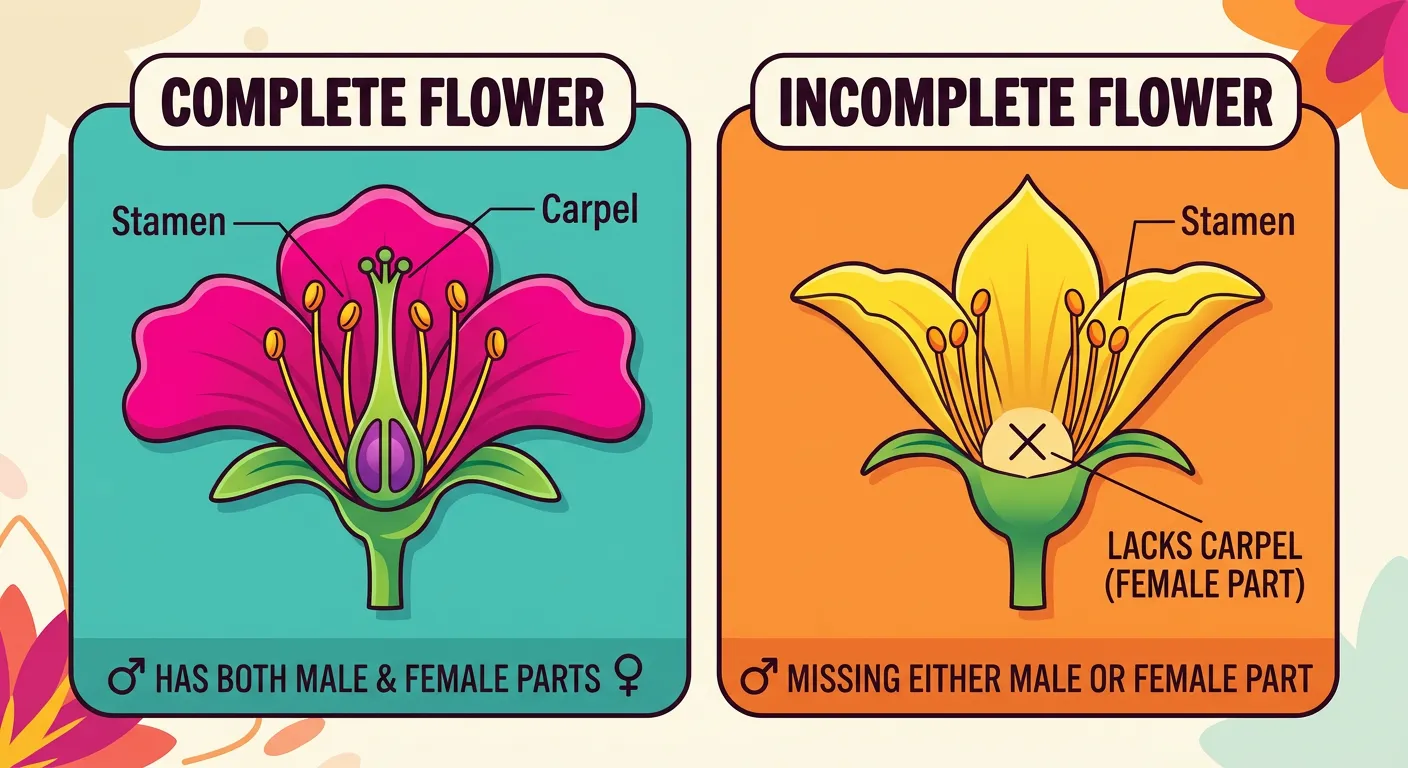
“Is a flower 'perfect' or 'imperfect'? A bisexual flower has both male and female parts, like a self-sufficient unit. A unisexual flower has only one. Remember, evolution loves diversity, so plants use these different arrangements to ensure they pass their genes to the next generation successfully.”
Nature uses different sexual strategies to ensure the survival of plant species. Most flowers are 'bisexual' or 'hermaphrodite,' meaning they possess both the androecium and gynoecium. This allows for self-sufficiency and high reproductive assurance, though many plants have evolved mechanisms to prevent self-pollination to maintain genetic vigor. On the other hand, some flowers are 'unisexual.' A unisexual flower that possesses only stamens is called a staminate flower, while one that has only carpels is a pistillate flower. The absence of one reproductive whorl often necessitates external agents for pollination.
This leads to an important distinction for NEET: the difference between monoecious and dioecious plants. In monoecious plants ('one house'), both male and female flowers are found on the same individual plant (e.g., Maize, Castor, Coconut, Cucurbits). This arrangement prevents 'autogamy' (pollination within the same flower) but still allows 'geitonogamy' (pollination between different flowers on the same plant). In dioecious plants ('two houses'), male and female flowers are on separate individual plants (e.g., Papaya, Date palm). This is a strictly enforced outbreeding device to ensure cross-pollination (xenogamy) and maximum genetic diversity, effectively preventing inbreeding depression. Some plants are even 'polygamous,' bearing bisexual, staminate, and pistillate flowers on the same individual (e.g., Mango).
| Condition | Definition | Examples | Evolutionary Benefit |
|---|---|---|---|
| Bisexual | Both male & female parts in one flower. | Pea, Hibiscus | High chance of pollination. |
| Monoecious | Separate male/female flowers on same plant. | Maize, Castor | Prevents autogamy. |
| Dioecious | Male/female flowers on separate plants. | Papaya, Date palm | Forces cross-pollination. |
Quick Revision Points
- Bisexual (Perfect): Flower with both stamen and carpel.
- Unisexual (Imperfect): Flower with either stamen or carpel.
- Monoecious: Both sexes on the same plant individual (e.g., Maize).
- Dioecious: Male and female plants are separate individuals (e.g., Papaya).
NEET Exam Angle
- Papaya is the most common example used for 'Dioecious' in MCQ options. Remember it forces Xenogamy.
- Maize and Castor are common examples for 'Monoecious'—know that they prevent autogamy but not geitonogamy.
- Understand that sexuality influences the type of pollination and genetic variation in the offspring.
07Summary of Floral Whorls: A Strategic Review for NEET Preparation
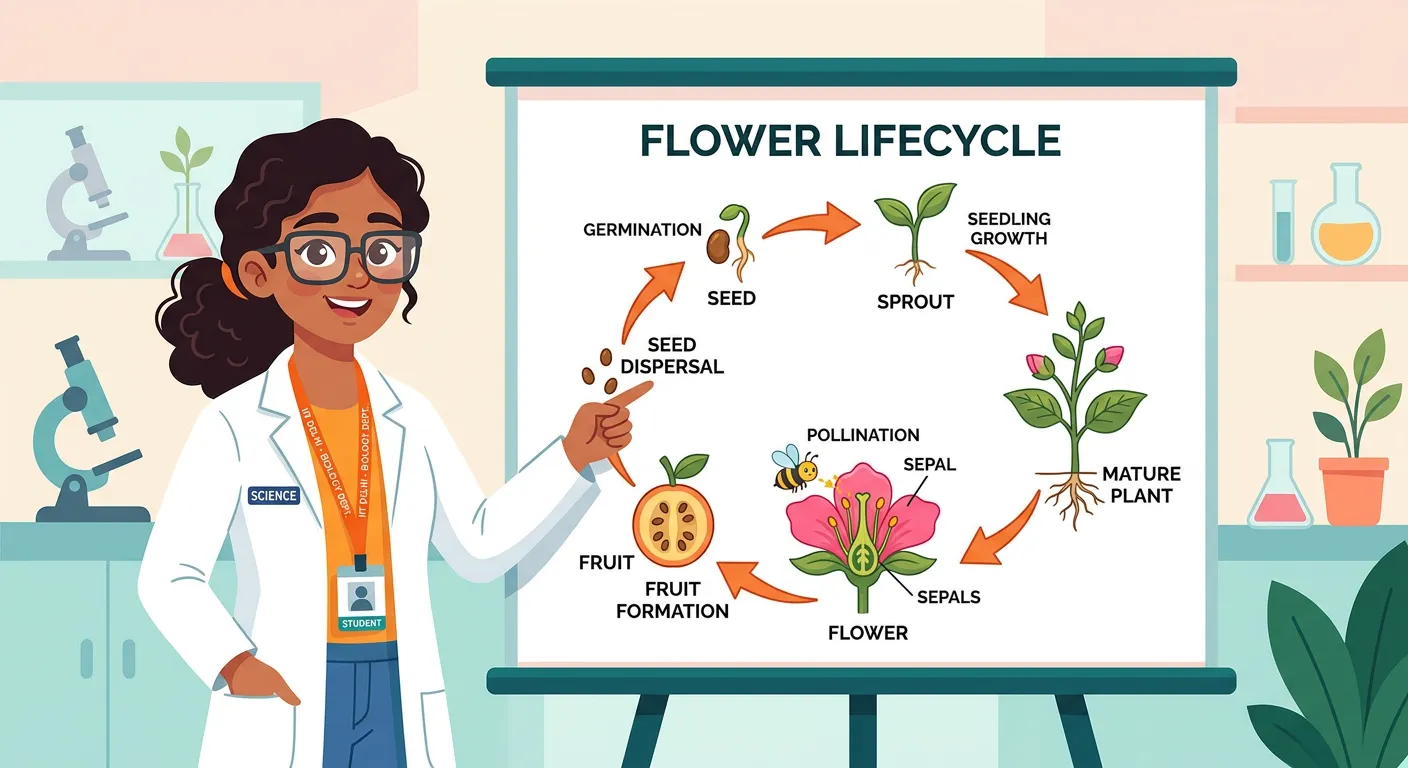
“We’ve just dissected the flower! Remember: Calyx for protection, Corolla for attraction, Androecium for pollen, and Gynoecium for the seeds. Master these parts, and you've conquered the basics of plant reproduction. Stay curious, keep studying, and I’ll see you in the next NEET biology session!”
As we wrap up our study of flower morphology, it's essential to categorize these structures logically for quick recall. We divide the four whorls into two groups: essential and non-essential. The Calyx and Corolla are non-essential or accessory whorls because they don't produce gametes directly. However, they are vital for protection and attracting pollinators. The Androecium and Gynoecium are the essential or reproductive whorls because they are the actual sites of gamete formation. Additionally, we must consider floral symmetry. Flowers can be actinomorphic (radial symmetry, e.g., Mustard), zygomorphic (bilateral symmetry, e.g., Pea), or asymmetric (e.g., Canna).
In the NEET exam, you will often encounter labeling-based questions or 'Match the Column' grids involving these parts. Success depends on knowing not just the names, but the collective nouns and the biological functions. For instance, if the question asks about the 'unit of the Perianth,' the answer is 'Tepal.' If it asks about the 'male gametophyte,' the answer is 'Pollen grain.' Mastering these nuances transforms a difficult biology paper into a scoring opportunity. Also, remember the concept of bracts: reduced leaves found at the base of the pedicel. Flowers with bracts are 'bracteate' and those without are 'ebracteate.' Every fruit you eat was once an ovary, and every seed was an ovule. This botanical transformation is the foundation of life and agriculture.
| Whorl Name | Individual Unit | Category | Primary Function |
|---|---|---|---|
| Calyx | Sepal | Accessory | Protection of bud |
| Corolla | Petal | Accessory | Pollinator attraction |
| Androecium | Stamen | Essential | Pollen production |
| Gynoecium | Carpel/Pistil | Essential | Ovule/Seed production |
Quick Revision Points
- Essential whorls: Androecium and Gynoecium. Non-essential: Calyx and Corolla.
- Floral Symmetry: Actinomorphic (Mustard), Zygomorphic (Pea), Asymmetric (Canna).
- Perianth: Characteristic of Monocots like Lily (Liliaceae).
- Bracts: Reduced leaves at the base of the pedicel.
NEET Exam Angle
- Expect diagrams where you must label the four whorls correctly.
- Understand the post-fertilization changes: Sepals and petals usually wither, while the ovary grows into the fruit.
- Focus on the terminology used for symmetry (Actinomorphic/Zygomorphic) as these are frequently used in floral formulas which are high-yield for the exam.
Recommended Reading
Explore related Biology topics to build deeper chapter connections for NEET.
- Morphology and Modifications · Topic 2.1
- Families · Topic 2.10
- Animal Tissues · Topic 2.11
- Frog Morphology · Topic 2.12
- Digestive System · Topic 2.13
- Circulatory System · Topic 2.14
- Jump to Key Terms (Quick Revision)
- Review Common NEET Mistakes
- Solve NEET Practice MCQs
- Read Topic FAQs
- Practice NEET MCQs
- Solve NEET PYQs
📚 Key Terms
⚠️ Common NEET Mistakes
- 1Confusing the Pedicel (individual flower stalk) with the Peduncle (main inflorescence axis).
- 2Thinking that the Calyx and Corolla are 'useless' because they are non-essential; they are vital for protection and pollination success.
- 3Using the term 'Perianth' for all flowers; it should only be used when sepals and petals are indistinguishable (e.g., Lily).
- 4Mixing up 'Monoecious' (same plant) and 'Dioecious' (different plants) conditions.
- 5Assuming all anthers have the same structure; remember that sterile stamens (staminodes) exist.
📝 NEET PYQ & Practice Questions
Test your understanding of Flower with NCERT-aligned sample questions.
Which of the following statements is correct regarding "Thalamus" in the context of NEET Biology?
In NEET question papers, questions related to "Flower" predominantly test:
Consider Corolla associated with Flower. What is the primary characteristic expected in NEET MCQs?
Master Flower with NeetQ AI Tutor
Practice 50+ topic-wise MCQs, previous 15 years NEET questions, and get step-by-step doubt resolution instantly.
❓ Frequently Asked Questions
What is the function of the thalamus in floral morphology?
The thalamus (or receptacle) acts as the foundation or base of the flower. It is the swollen end of the pedicel that supports all four floral whorls: calyx, corolla, androecium, and gynoecium.
How do you distinguish between a bisexual and a unisexual flower?
A bisexual flower contains both male (androecium) and female (gynoecium) reproductive organs. A unisexual flower contains only one—either stamens (staminate) or carpels (pistillate).
What are the four concentric whorls of a typical flower?
The four whorls, from outermost to innermost, are: 1. Calyx (sepals), 2. Corolla (petals), 3. Androecium (stamens), and 4. Gynoecium (carpels/pistils).
Which parts of the flower are considered non-essential or accessory organs?
The calyx and corolla are considered non-essential or accessory organs because they are not directly involved in the production of gametes, unlike the androecium and gynoecium.
What is the role of the stigma in the gynoecium?
The stigma serves as the receptive landing platform for pollen grains during pollination. It often has specialized surfaces (sticky or hairy) to ensure pollen adherence.
How does the corolla assist in the process of pollination?
The corolla consists of petals that are usually brightly colored and scented to attract biotic pollinators like insects and birds, facilitating the transfer of pollen.
Written By
NEET Content Strategist & Biology Expert
Sangita Kumari is a NEET educator and content strategist with over 6 years of experience teaching Biology, Chemistry, and Physics to Class 11 and 12 aspirants. She helps bridge the gap between traditional NCERT preparation and modern AI-powered learning. Her content is trusted by thousands of NEET aspirants across India.