🎬 Video Lesson Available
Watch the full 7-slide video lesson for Bryophytes with AI teacher narration and visual explanations.
Bryophytes — Master Bryophytes for NEET Biology. Explore why they are the 'Amphibians of the Plant Kingdom', their dominant gametophyte phase, and key examples like Funaria.
01The Amphibians of the Plant Kingdom: Why Bryophytes Bridge Land and Water
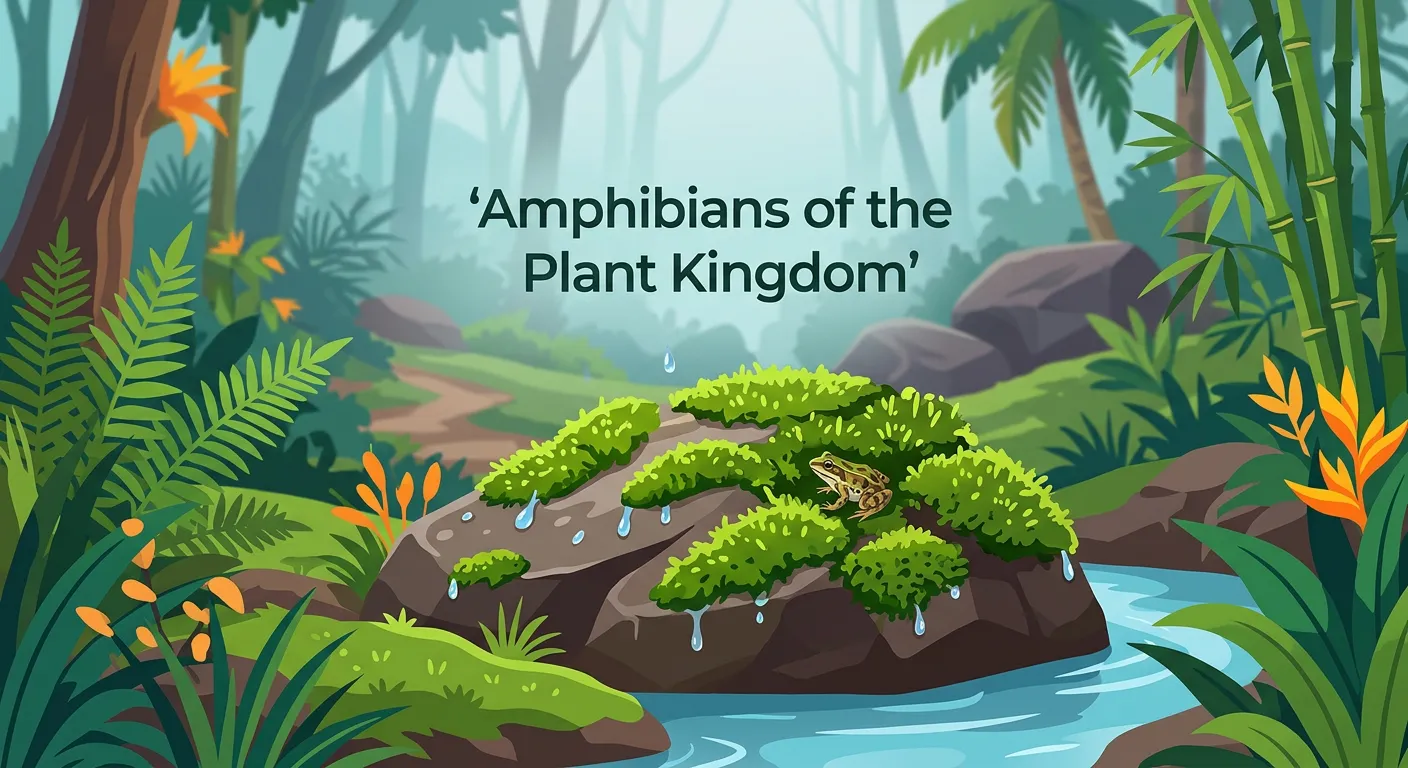
“Welcome, NEET warriors! Meet the Bryophytes—the 'Amphibians of the Plant Kingdom.' Just like a frog needs water to breed, these plants need moisture to complete their life cycle. Imagine them as the adventurous pioneers that first stepped onto land but never truly left the water behind!”
In the complex evolutionary timeline of the Plant Kingdom, Bryophytes hold a unique and pivotal position as the first group of plants to successfully colonize terrestrial environments. However, their transition from aquatic to terrestrial life was incomplete, earning them the famous and frequently tested title: 'Amphibians of the Plant Kingdom.' To understand this designation, we must look at their dual nature. While they primarily inhabit land—specifically damp, humid, and shaded localities—they remain strictly tethered to water for the critical stage of sexual reproduction. Without a thin film of external moisture, their male gametes are unable to swim and reach the female reproductive organs. This absolute requirement for water restricts their geographic distribution and explains why you rarely find Bryophytes in arid, desert, or even moderately dry conditions.
From a NEET perspective, the term 'Amphibian' serves as a conceptual bridge to the Animal Kingdom. Just as frogs and salamanders must return to the water to lay eggs or support their larval stages, Bryophytes must have water present to facilitate the movement of their motile sperm. This evolutionary milestone represents the transitional bridge between fully aquatic algae and more advanced, truly terrestrial vascular plants like Pteridophytes. They lack the complex vascular systems (xylem and phloem) seen in higher plants, which is the primary reason they generally remain small in stature. They rely on simple diffusion and capillary action to move water throughout their tiny bodies, further highlighting their primitive but successful adaptation to the terrestrial world. They essentially occupy the 'moist skin' of the Earth, acting as an interface between the soil and the atmosphere.
| Feature | Amphibian (Animal) | Bryophyte (Plant) |
|---|---|---|
| Habitat | Land and Water | Shaded, moist land |
| Reproduction | Needs water for egg-laying/larvae | Needs water for sperm motility |
| Skin/Surface | Moist and permeable | Thallus with thin cuticle |
| Evolutionary Role | First land vertebrates | First land plants |
Quick Revision Points
- Bryophytes are non-vascular terrestrial plants that depend on external water for fertilization.
- They usually grow in moist, shady places like damp soil, rocks near streams, and tree trunks.
- They lack xylem and phloem, which limits their height and structural complexity.
- Evolutionarily, they are more advanced than algae but more primitive than Pteridophytes.
- Their distribution is geographically limited due to their specific moisture requirements.
NEET Exam Angle
- Focus on the 'Amphibian' analogy; questions often ask why they are called so (Answer: requirement of water for fertilization).
- Note the specific habitats mentioned in NCERT: 'damp, humid and shaded localities.'
- Identify the lack of vascular tissues as a primary reason for their small size.
02Plant Body Architecture: The Thallus and Primitive Root-like Rhizoids
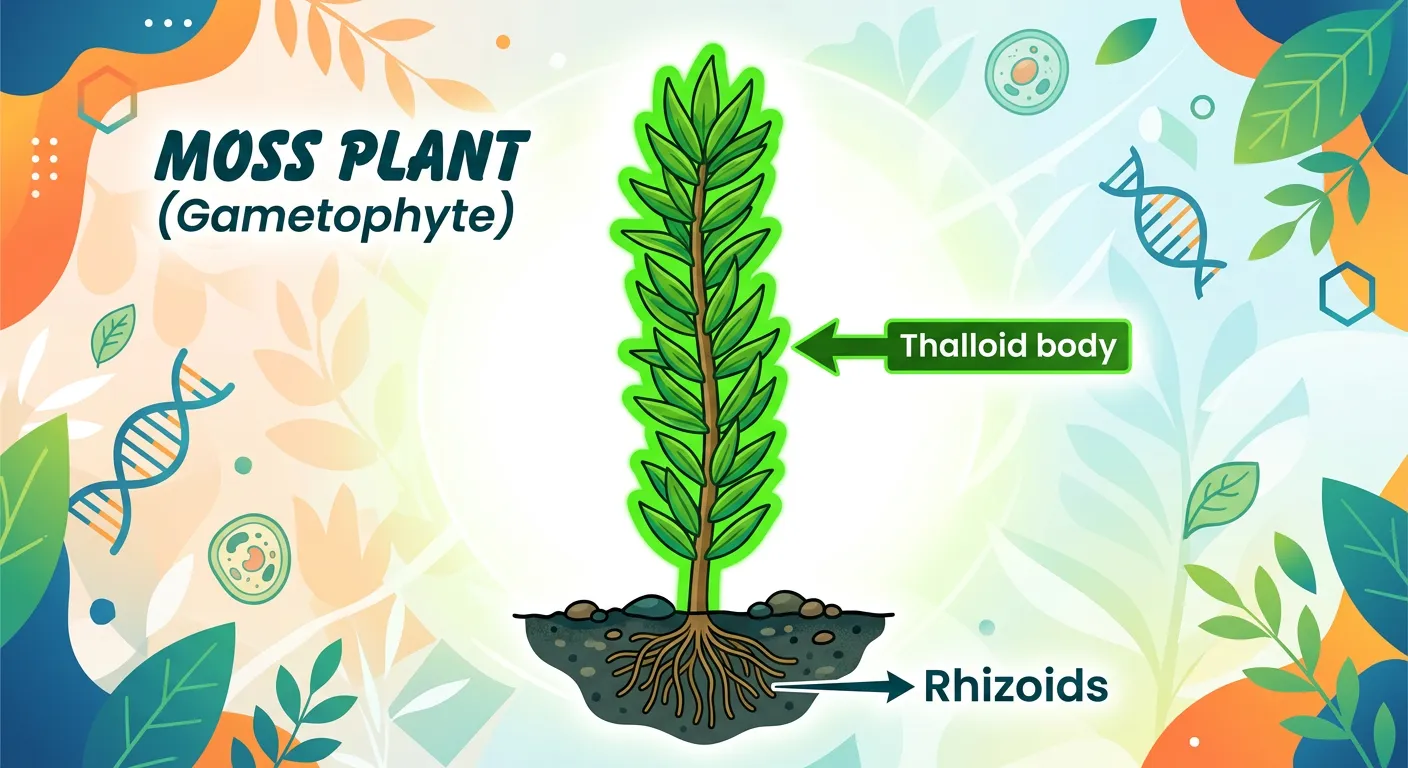
“Unlike the tall mango trees in your garden, Bryophytes are small and humble. They lack true roots, stems, or leaves. Instead, they have simple 'root-like' rhizoids to anchor themselves and a flat, green thallus body. They are the ultimate minimalists of the botanical world!”
Unlike the Angiosperms or Gymnosperms we observe daily, Bryophytes do not possess 'true' roots, stems, or leaves. In rigorous botanical terms, a 'true' organ must contain specialized vascular tissue, namely xylem and phloem, to transport water and nutrients over long distances. Instead, the Bryophyte body is accurately described as a 'thallus.' This thallus exhibits various forms: it can be prostrate, meaning it lies flat against the substrate as seen in many liverworts, or it can be erect and upright, which is common in mosses. While they might appear to have tiny leaves and stems to the naked eye, these are technically referred to as 'leaf-like' and 'stem-like' structures because they lack internal vascular bundles. This lack of differentiation is a fundamental characteristic that students must memorize for plant classification and morphology questions.
One of the most important structural features to understand is the 'rhizoid.' Rhizoids are hair-like projections that emerge from the ventral surface of the thallus. They perform two primary functions: securely anchoring the plant to the soil or rocky substrate and facilitating the absorption of water and minerals through the cell surface. However, unlike the complex multicellular roots of higher plants, rhizoids in Bryophytes vary by class. This distinction is a classic 'trap' in NEET papers: in liverworts (like Marchantia), rhizoids are typically unicellular and unbranched, whereas in mosses (like Funaria), they are multicellular and branched with oblique septa. The absence of a complex internal transport system means that every part of the plant must stay relatively close to the ground and the water source to ensure survival, which explains their low-growing, mat-like habit.
| Structure | Liverworts (e.g., Marchantia) | Mosses (e.g., Funaria) |
|---|---|---|
| Body Form | Dorsiventral, prostrate thallus | Erect, leafy stage |
| Rhizoids | Unicellular and unbranched | Multicellular and branched |
| Symmetry | Dorsiventrally flattened | Radial symmetry in leafy stage |
Quick Revision Points
- The plant body is a thallus, meaning it is not differentiated into true roots, stems, or leaves.
- Rhizoids serve for anchorage and absorption but lack vascular tissues.
- Body forms range from prostrate (liverworts) to erect (mosses).
- 'Root-like', 'leaf-like', and 'stem-like' are the correct terms to use for their morphology.
- The absence of vascular tissue is the defining anatomical characteristic.
NEET Exam Angle
- Distinguish between unicellular rhizoids (Liverworts) and multicellular rhizoids (Mosses).
- Remember that the lack of true roots is because they lack vascular bundles.
- Be prepared for 'Assertion-Reason' questions regarding the thalloid nature of Bryophytes.
03The Dominant Gametophyte: Understanding the Haploid Life Phase
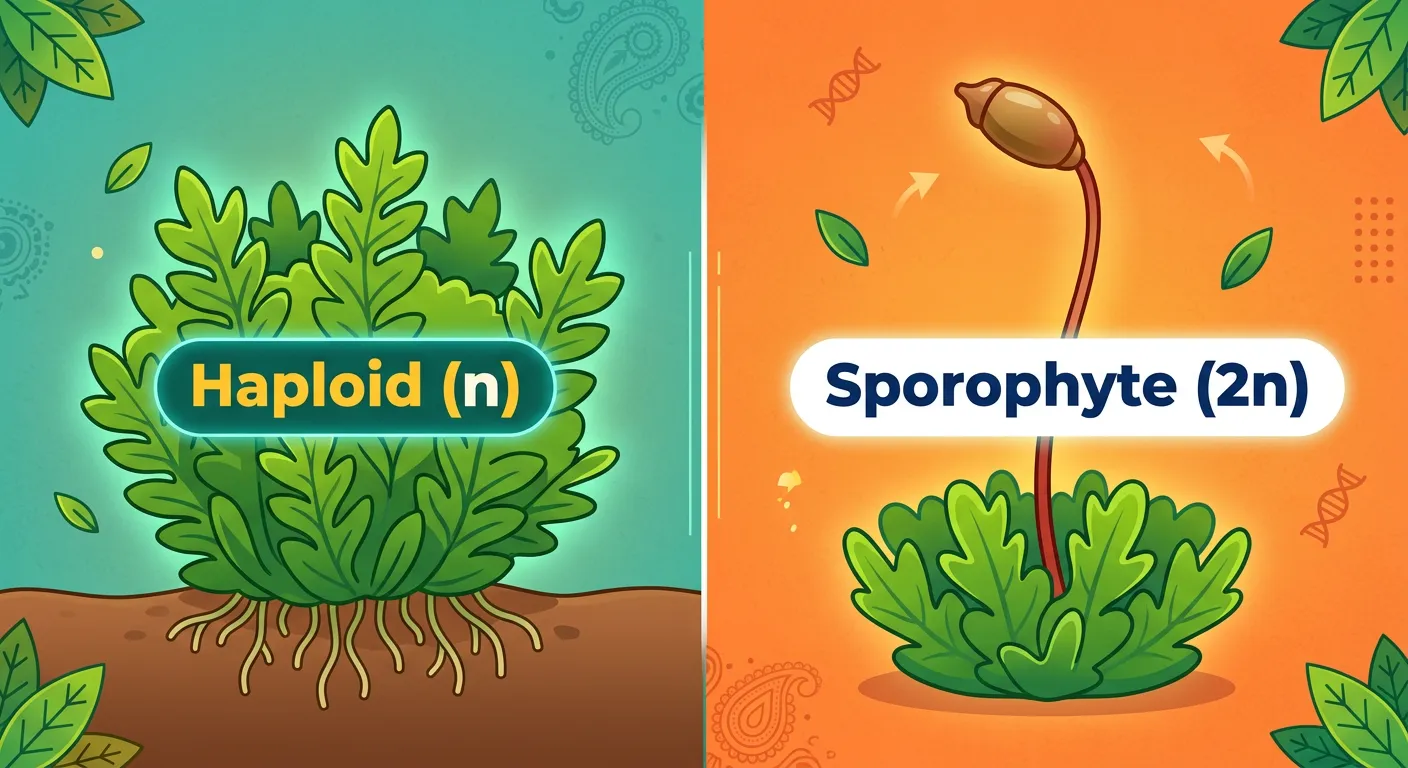
“Here is a high-yield NEET point: the main plant body is haploid, producing gametes. It's called the gametophyte. The sporophyte isn't independent; it lives like a guest, attached to the gametophyte for nutrition. Remember, the gametophyte is the boss here, unlike in higher plants!”
In the study of Plant Life Cycles, Bryophytes are exceptional because their 'dominant' stage is the gametophyte. This is a sharp contrast to higher plants like gymnosperms or angiosperms, where the large, visible tree or plant is a diploid sporophyte (2n). In Bryophytes, the green, leafy, or flat part that you see performing photosynthesis and covering the forest floor is the gametophyte (n). This means the main plant body is haploid, containing only one set of chromosomes. A key point that often confuses students during exams is that the gametophyte produces gametes through mitosis, not meiosis, because the cells are already haploid. This stage is the most conspicuous and long-lived part of the cycle.
The gametophyte is entirely independent, free-living, and autotrophic, meaning it manufactures its own food. In contrast, the sporophyte (the diploid phase) is not a free-living entity in the Bryophyte world. It remains physically attached to the parent gametophyte throughout its entire existence, depending on it for water, nutrients, and physical support. This relationship is often described as the sporophyte being 'partially or totally parasitic' on the gametophyte. This 'Alternation of Generations'—where the haploid phase is the dominant, photosynthetic stage—is considered a primitive evolutionary trait. As we progress toward more evolved plant groups like Pteridophytes and seed plants, we see a dramatic shift where the sporophyte becomes dominant and the gametophyte becomes reduced and dependent. Understanding this inversion is crucial for mastering plant evolution.
| Property | Gametophyte | Sporophyte |
|---|---|---|
| Ploidy | Haploid (n) | Diploid (2n) |
| Independence | Free-living, Photosynthetic | Dependent on Gametophyte |
| Function | Produces Gametes | Produces Spores |
| Duration | Long-lived / Dominant | Short-lived / Transient |
Quick Revision Points
- The main plant body of a Bryophyte is a haploid gametophyte.
- The gametophyte is the stage that produces gametes (sex cells) via mitosis.
- The sporophyte is multicellular but remains attached to the gametophyte for its entire existence.
- Nutrition for the sporophyte is derived from the photosynthetic gametophyte tissue.
- This represents a 'Haplo-diplontic' life cycle where the haploid phase is prominent.
NEET Exam Angle
- This is a high-frequency topic: Always remember the main body is 'n' (haploid).
- Questions often ask about the 'independence' of the sporophyte (Answer: it is dependent).
- Contrast this with Pteridophytes, where the sporophyte becomes the dominant stage.
04Reproductive Mechanisms: Antheridia, Archegonia, and the Water Bridge
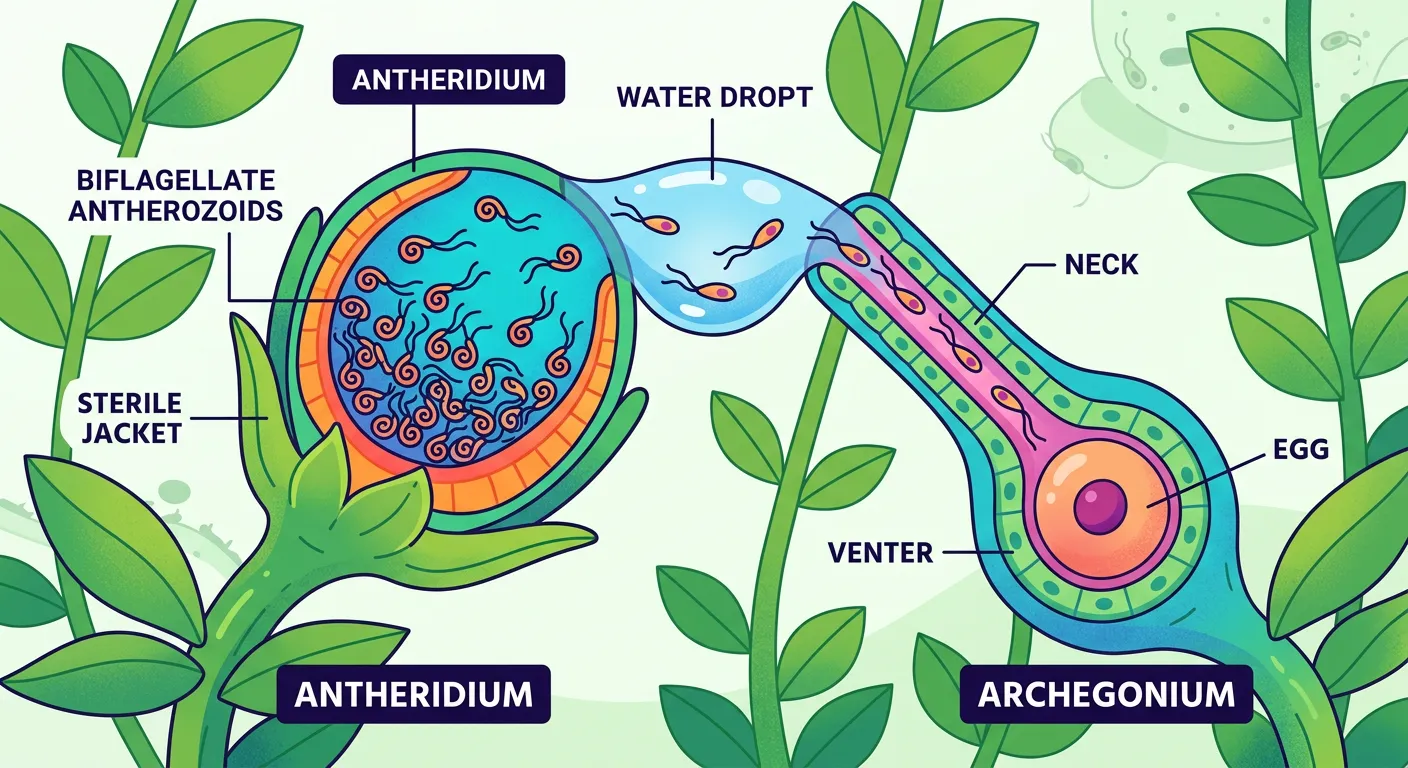
“How do they reproduce? They use the 'water bridge' method! The male sex organ, the antheridium, releases biflagellate antherozoids that literally swim through water to reach the female archegonium. It is a watery, romantic journey essential for their fertilization. Always remember, water is their mandatory wedding venue!”
Sexual reproduction in Bryophytes is strictly oogamous, a type of heterogamy involving a large, non-motile female gamete and a small, motile male gamete. This process involves specialized multicellular sex organs that are protected by a layer of sterile jacket cells, an adaptation for life on land. The male sex organ is called the 'Antheridium,' which is typically club-shaped. The female sex organ is the 'Archegonium,' which is famously 'flask-shaped' and consists of a swollen base called the venter and a slender neck. The venter contains a single, large egg cell. The Antheridium produces numerous 'Antherozoids,' the male gametes. It is crucial to remember for NEET that these antherozoids are 'biflagellate' (possessing two whip-like flagella), which allows them to propel themselves through water.
The actual process of fertilization is a fascinating example of chemotaxis. When water is present (as dew or rain), the antherozoids are released and must swim toward the archegonium. They are attracted by specific chemical substances, such as sugars or malic acid, secreted by the neck of the archegonium. The sperm navigate through a 'water bridge' to reach the egg nestled deep inside the flask-shaped organ. Once a single antherozoid successfully fuses with the egg, a diploid zygote (2n) is formed. Unlike in algae, where the zygote often undergoes meiosis immediately (zygotic meiosis), the Bryophyte zygote stays within the archegonium and begins to divide mitotically. This leads to the development of a multicellular sporophyte. This delay in meiosis and the retention of the embryo within the female organ are significant evolutionary steps toward the 'embryophyte' condition seen in all higher land plants.
Quick Revision Points
- Male organ: Antheridium (produces biflagellate antherozoids).
- Female organ: Archegonium (flask-shaped, produces a single egg).
- Water is essential for the transport of antherozoids to the archegonium.
- Fertilization results in a zygote that initiates the sporophyte generation.
- Chemotactic movement ensures the sperm finds the egg by following chemical gradients.
NEET Exam Angle
- Identify the shape of the archegonium (flask-shaped) and the nature of the male gamete (biflagellate).
- Note that the zygote does NOT undergo meiosis immediately; it produces a multicellular sporophyte first.
- The requirement of water for fertilization is the primary reason for their classification as amphibians.
05The Sporophyte Cycle: From Zygote Formation to Spore Germination
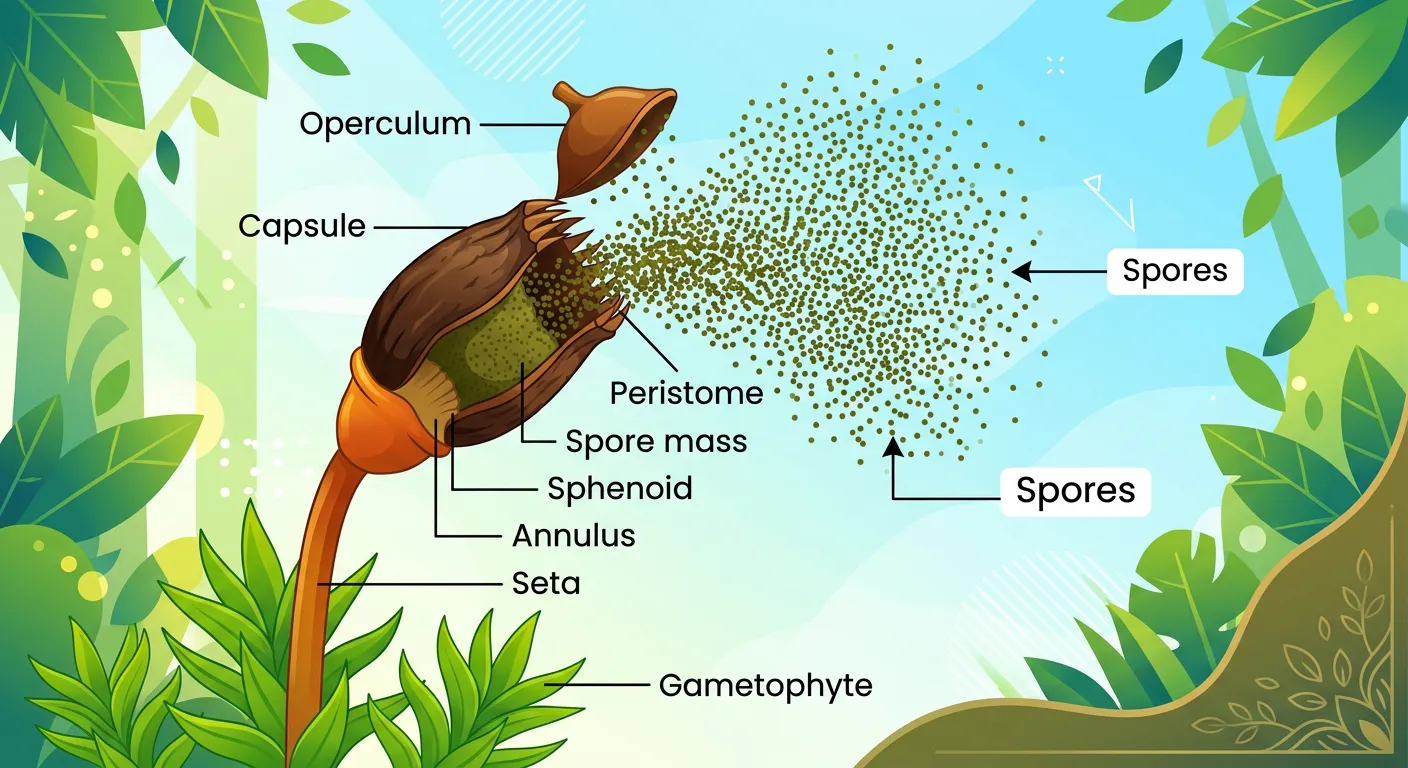
“After fertilization, the zygote develops into a sporophyte. Inside its capsule, meiosis occurs, creating millions of tiny spores. These spores are like botanical seeds of hope—when they land on a moist surface, they germinate to grow into a brand-new, green gametophyte. The cycle continues!”
The development of the zygote into the sporophyte marks the beginning of the diploid (2n) generation in the Bryophyte life cycle. This sporophyte is not a simple structure; it is multicellular and differentiated into three distinct morphological parts: the foot, the seta, and the capsule. The foot is the basal portion that remains embedded in the gametophyte tissue, acting as an anchor and an absorptive organ for nutrients. The seta is a long, slender stalk that elevates the capsule above the plant body to aid in spore dispersal. The capsule is the most complex part, serving as the site for spore production. Within the capsule, specialized cells known as 'spore mother cells' undergo meiosis (reduction division) to produce haploid spores (n).
Bryophytes are generally 'homosporous,' meaning they produce only one type of spore, and all spores are morphologically identical. This is another key concept for competitive exams. Once the spores are mature, the capsule dehisces—often using specialized mechanisms like the peristome teeth in mosses or elaters in some liverworts—to release them into the air. These spores are dispersed by the wind. If a spore lands on a suitable, moist, and shaded substrate, it begins to germinate. In mosses, the germination process is indirect, involving an intermediate filamentous stage called a 'protonema,' which eventually gives rise to the leafy gametophyte. In liverworts, the spore usually germinates directly into a new thallus. This entire cycle, moving from zygote to sporophyte to spore and back to gametophyte, ensures genetic variation through meiosis while maintaining the dominance of the haploid phase.
Quick Revision Points
- The sporophyte consists of three parts: Foot, Seta, and Capsule.
- Meiosis occurs exclusively inside the capsule to produce haploid spores.
- Bryophytes are homosporous (all spores produced are of one kind).
- Spores are dispersed primarily by wind and germinate into a new gametophyte.
- The sporophyte is physically and nutritionally dependent on the gametophyte for survival.
NEET Exam Angle
- Memorize the sequence: Zygote -> Sporophyte -> Meiosis in Capsule -> Spores -> Gametophyte.
- Be aware that 'Spore Mother Cells' are 2n, while 'Spores' are n (haploid).
- Questions often ask which specific part of the sporophyte produces spores (Answer: Capsule).
- Remember that the protonema stage is a hallmark of moss development.
06Liverworts and Mosses: A Comparative Study of Marchantia and Funaria
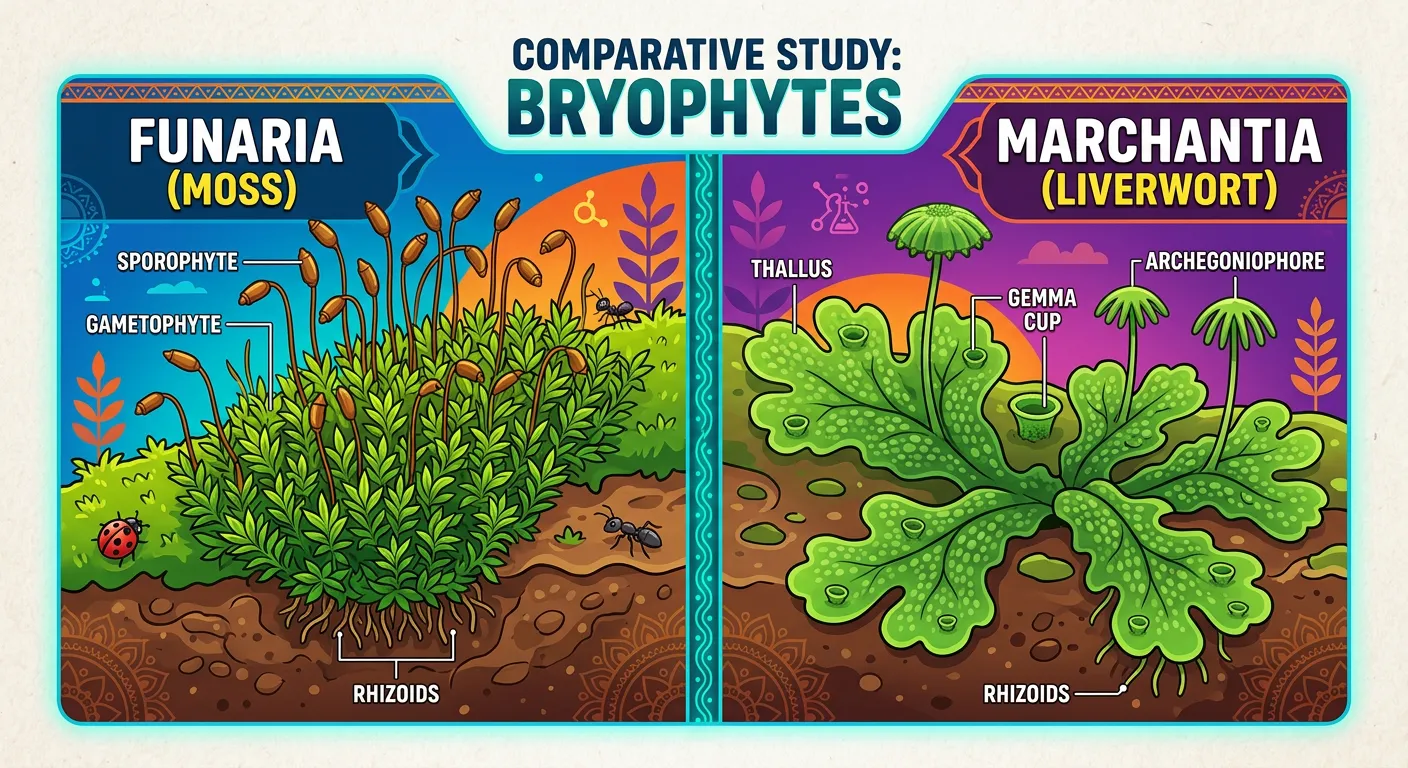
“Memorize these two NEET must-know examples: Funaria, the common moss, and Marchantia, a liverwort. Marchantia looks like a flat, liver-shaped ribbon. Seeing them in nature is like spotting living history—these little plants have been chilling on Earth for millions of years!”
Bryophytes are broadly classified into two major groups that every NEET aspirant must master: Liverworts (Hepaticopsida) and Mosses (Bryopsida). Liverworts, such as the genus Marchantia, represent a simpler, more primitive body plan. Their thallus is dorsiventrally flattened, meaning it has distinct upper and lower surfaces, and it is usually closely appressed to the ground. A unique and high-yield feature of Marchantia is the presence of 'gemma cups' on the dorsal surface. These cups contain 'gemmae'—green, multicellular, asexual buds that detach and germinate into new, independent individuals. Furthermore, Marchantia is typically dioecious, meaning the male and female sex organs are borne on different plants (Antheridiophores and Archegoniophores), a fact often tested in MCQ format.
Mosses, exemplified by Funaria, exhibit a more complex morphology and life cycle. The moss gametophyte develops in two distinct stages. The first stage is the 'protonema' stage, which develops directly from a spore and appears as a creeping, green, branched, and often filamentous structure. The second stage is the 'leafy' stage, which develops from the protonema as a lateral bud. This stage consists of an upright, slender axis bearing spirally arranged leaf-like structures and is anchored by multicellular, branched rhizoids. Mosses also possess a more sophisticated spore dispersal mechanism involving a peristome with teeth that respond to changes in humidity. While Marchantia is the textbook liverwort, Sphagnum (peat moss) and Polytrichum are other common mosses frequently mentioned in exams. Understanding these structural differences—from the unicellular rhizoids of liverworts to the protonema of mosses—is essential for distinguishing between these two groups.
| Character | Liverworts (Marchantia) | Mosses (Funaria) |
|---|---|---|
| Dominant Body | Thalloid (Flattened) | Leafy (Erect) |
| Asexual Repro. | Gemma cups common | Fragmentation/Budding in protonema |
| Protonema | Absent | Present |
| Spore Dispersal | Simple (often with elaters) | Complex (Peristome teeth) |
Quick Revision Points
- Liverworts: Thalloid body, unicellular rhizoids, gemmae for asexual reproduction.
- Mosses: Leafy body, multicellular branched rhizoids, protonema stage.
- Marchantia is a liverwort; Funaria, Sphagnum, and Polytrichum are mosses.
- Gemmae are green, multicellular, and asexual structures.
- Mosses have an elaborate mechanism of spore dispersal compared to liverworts.
NEET Exam Angle
- Marchantia is dioecious (unisexual)—this is a very frequent MCQ topic.
- Recognize the 'protonema' as a characteristic stage of mosses only, not liverworts.
- Understand that gemmae are strictly asexual, not sexual structures.
07Ecological Significance: Soil Formation and Plant Succession
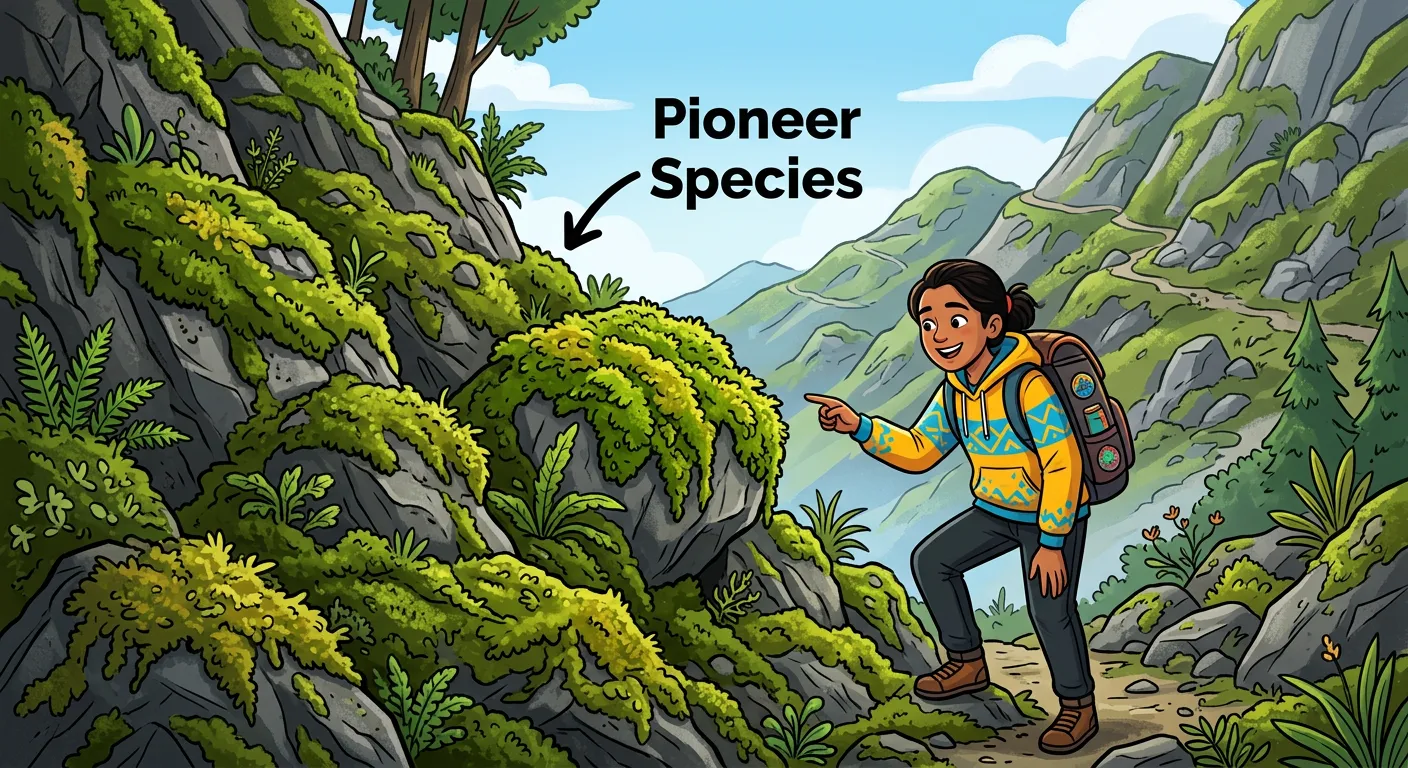
“To wrap up: Bryophytes are 'Pioneer Species' in ecological succession. They pave the way by breaking down rocks into soil, allowing bigger plants to grow later. They are the unsung heroes of nature's foundation. Stay curious, study hard, and keep growing like a moss!”
While Bryophytes may lack the commercial 'glamour' of timber trees or high-yield cereal crops, their ecological importance is monumental and essential for planetary health. They are quintessential 'Pioneer Species.' Along with lichens, they are among the very first organisms capable of colonizing bare, inhospitable rocks. Bryophytes secrete organic acids that gradually weather and decompose the rock surface into soil over long periods. This biological weathering makes it possible for higher plants to eventually take root, a process known as primary plant succession. Without Bryophytes, the transformation of barren rock into a fertile forest ecosystem would be significantly hindered. They essentially create the 'living skin' of the Earth in harsh environments.
Another vital ecological role is the prevention of soil erosion. Because they grow in incredibly dense, thick mats, they act like a living carpet that softens the impact of falling rain and binds the soil particles together with their rhizoids. This reduces the runoff and prevents valuable topsoil from being washed away. Economically, the moss Sphagnum is a biological superstar. Over time, it provides 'peat,' which is dried and compressed organic matter used as a fuel source in many parts of the world. Furthermore, Sphagnum has an incredible water-holding capacity due to its unique cellular structure. This property makes it invaluable as a packing material for the trans-shipment of living materials like flowers, seedlings, and even sensitive biological specimens, ensuring they do not dry out during transit. They are also vital in the water cycle of forest ecosystems, acting as a giant sponge that absorbs and slowly releases moisture.
Quick Revision Points
- Bryophytes (with lichens) colonize rocks to initiate the process of soil formation.
- They prevent soil erosion by forming dense mats on the forest floor and slopes.
- Sphagnum provides peat used as fuel and as a soil conditioner.
- High water-retention capacity makes certain mosses valuable for transporting living plants.
- They play a key role in the water cycle by absorbing runoff and maintaining humidity.
NEET Exam Angle
- Remember Sphagnum specifically for its use as peat and its extraordinary water-holding capacity.
- Be prepared for questions on 'Ecological Succession'—Bryophytes are pioneers on rocks.
- Understand the physical role they play in reducing the impact of rain to prevent soil wash-off.
Recommended Reading
Explore related Biology topics to build deeper chapter connections for NEET.
- What is Living · Topic 1.1
- Kingdom Fungi · Topic 1.10
- Lichens · Topic 1.11
- Viruses and Viroids · Topic 1.12
- Algae · Topic 1.13
- Gymnosperms · Topic 1.16
- Jump to Key Terms (Quick Revision)
- Review Common NEET Mistakes
- Solve NEET Practice MCQs
- Read Topic FAQs
- Practice NEET MCQs
- Solve NEET PYQs
📚 Key Terms
⚠️ Common NEET Mistakes
- 1Thinking that Bryophytes have true roots. They only have root-like rhizoids.
- 2Confusing the ploidy: remember that the main plant body is haploid (n), not diploid (2n).
- 3Assuming the sporophyte is independent. In Bryophytes, it is always dependent on the gametophyte.
- 4Believing that meiosis occurs during gamete formation. Gametes are formed by mitosis; meiosis occurs in the capsule to form spores.
- 5Mistaking gemmae for sexual reproductive structures; they are strictly for asexual reproduction.
📝 NEET PYQ & Practice Questions
Test your understanding of Bryophytes with NCERT-aligned sample questions.
Which of the following statements is correct regarding "Gametophyte" in the context of NEET Biology?
In NEET question papers, questions related to "Bryophytes" predominantly test:
Consider Rhizoids associated with Bryophytes. What is the primary characteristic expected in NEET MCQs?
Master Bryophytes with NeetQ AI Tutor
Practice 50+ topic-wise MCQs, previous 15 years NEET questions, and get step-by-step doubt resolution instantly.
❓ Frequently Asked Questions
Why are Bryophytes referred to as the amphibians of the plant kingdom?
Bryophytes are called amphibians because they live on land but are strictly dependent on water for sexual reproduction, as their male gametes (antherozoids) must swim through water to reach the egg.
What is the ploidy level of the main plant body in Bryophytes?
The main plant body of a Bryophyte is the gametophyte, which is haploid (n). It produces gametes through mitosis.
Does the sporophyte of a Bryophyte perform photosynthesis independently?
No, the sporophyte is not free-living. It is physically attached to the photosynthetic gametophyte and depends on it for anchorage and nutrition.
What is the specific function of rhizoids in mosses and liverworts?
Rhizoids function to anchor the thallus or plant body to the substrate and assist in the absorption of water and minerals, acting as primitive root-like structures.
How does the fertilization process in Bryophytes differ from Gymnosperms?
In Bryophytes, fertilization requires external water for flagellated sperm to swim to the egg (zoidogamy). In Gymnosperms, fertilization occurs via a pollen tube (siphonogamy) and does not require external water.
Why are Bryophytes ecologically important in primary succession?
They are pioneer species that colonize bare rocks along with lichens. They decompose rocks into soil through biological weathering, paving the way for the growth of higher plants.
Written By
NEET Content Strategist & Biology Expert
Sangita Kumari is a NEET educator and content strategist with over 6 years of experience teaching Biology, Chemistry, and Physics to Class 11 and 12 aspirants. She helps bridge the gap between traditional NCERT preparation and modern AI-powered learning. Her content is trusted by thousands of NEET aspirants across India.