🎬 Video Lesson Available
Watch the full 7-slide video lesson for What is Living with AI teacher narration and visual explanations.
What is Living — Master the defining characteristics of living organisms for NEET. Detailed analysis of growth, metabolism, reproduction, and consciousness for Class 11.
01Defining Life: The Biological Imperative for NEET Aspirants

“Welcome, future doctors! Have you ever wondered what truly separates a buzzing butterfly from a cricket ball? In NEET Biology, we don't just guess; we define life using specific, non-negotiable criteria. Let's embark on this journey to decode the mysterious spark of life itself!”
Welcome, future doctors. As you begin your journey into the vast realm of Biology, the first question that demands our attention is, 'What is living?' This is not just a philosophical query but the bedrock upon which the entire Diversity in the Living World unit stands. In the context of NEET, defining life requires us to move beyond superficial observations. We need to distinguish between biological entities and inanimate matter based on objective, non-negotiable criteria. The NCERT textbook meticulously categorizes these properties into defining features and characteristic features. While a rock might seem 'sturdy' and a plant 'vibrant', the biological distinction lies in the complex interactions of molecules that maintain the living state.
To master this, you must learn to categorize biological phenomena. Ask yourself: does this property apply to all living organisms without exception? Does it apply to any non-living matter? If the answer is 'yes' to the latter, it cannot be a defining feature of life. Throughout this chapter, we will dissect properties like growth, reproduction, metabolism, and consciousness. Understanding these concepts is essential because they form the foundation for later units, including Cell Biology, Plant Physiology, and Genetics. Think of this as your diagnostic framework; just as a doctor assesses symptoms to reach a diagnosis, a biologist assesses traits to define life. We will explore how life emerges from the organized molecular chaos, setting the stage for everything from classification systems to the complexity of the human body. Stay focused, because the questions that appear in the NEET examination often test your ability to separate 'universal' traits from 'incidental' ones. Let’s dive deeper into the first of these criteria.
02The Nuances of Growth: Internal Mass Accumulation
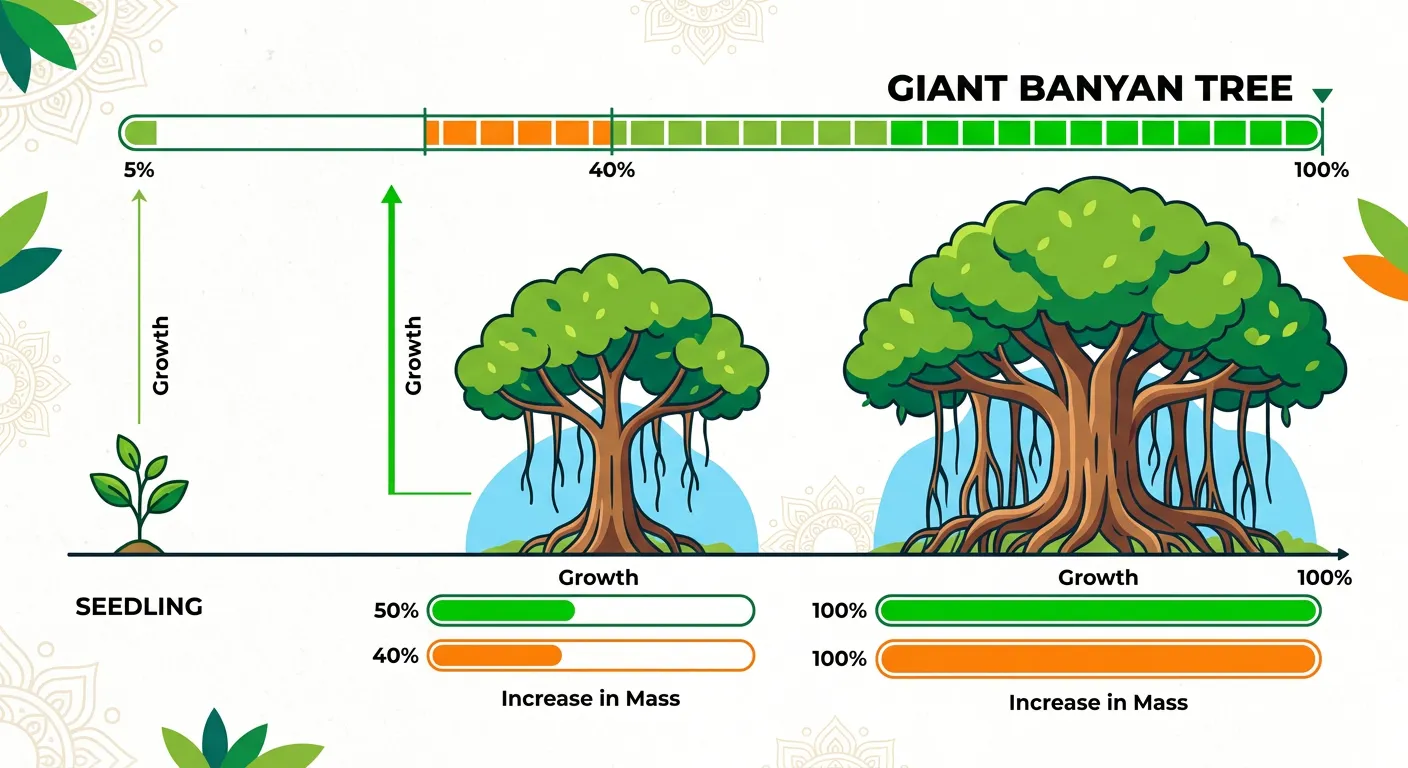
“First, growth! All living organisms grow. But wait—mountains and sand dunes increase in size too! In biology, growth means an increase in cell number or mass from within. It’s an internal process, distinct from the external accumulation seen in non-living things like rocks.”
Growth is the first property we encounter when discussing what is living. In standard biological terms, growth is characterized by an increase in mass and an increase in the number of individuals or cells. However, for a NEET aspirant, the devil is in the details. You will encounter questions that explicitly challenge your understanding of growth. For instance, mountains, boulders, and sand dunes also exhibit growth—but this is 'accretion' or accumulation of material from the outside. In contrast, true biological growth is an internal process. Living organisms grow by cellular division, which leads to an increase in biomass from within.
This distinction is crucial. When you study the 'Cell: The Unit of Life' chapter later, you will learn the mechanics of mitosis, which is how multicellular organisms increase their cell number. In plants, growth occurs continuously throughout their lifespan due to meristematic tissue, whereas in animals, it occurs only up to a certain age. The reason growth is not considered a 'defining' property of life in the strictest sense is because of the external accretion seen in non-living objects. Always keep this in mind: non-living objects grow by surface accumulation, whereas living organisms show internal development. In the NEET exam, you may be presented with a scenario involving an organism that cannot reproduce; the examiner might test if you can identify it as living based on its ability to grow. Never forget that growth, while a characteristic, is not a 'defining' feature because non-living objects can also show a form of growth under specific environmental conditions. Focus on the word 'internal'—it is the key to mastering this concept.
03Reproduction and the Continuity of Species
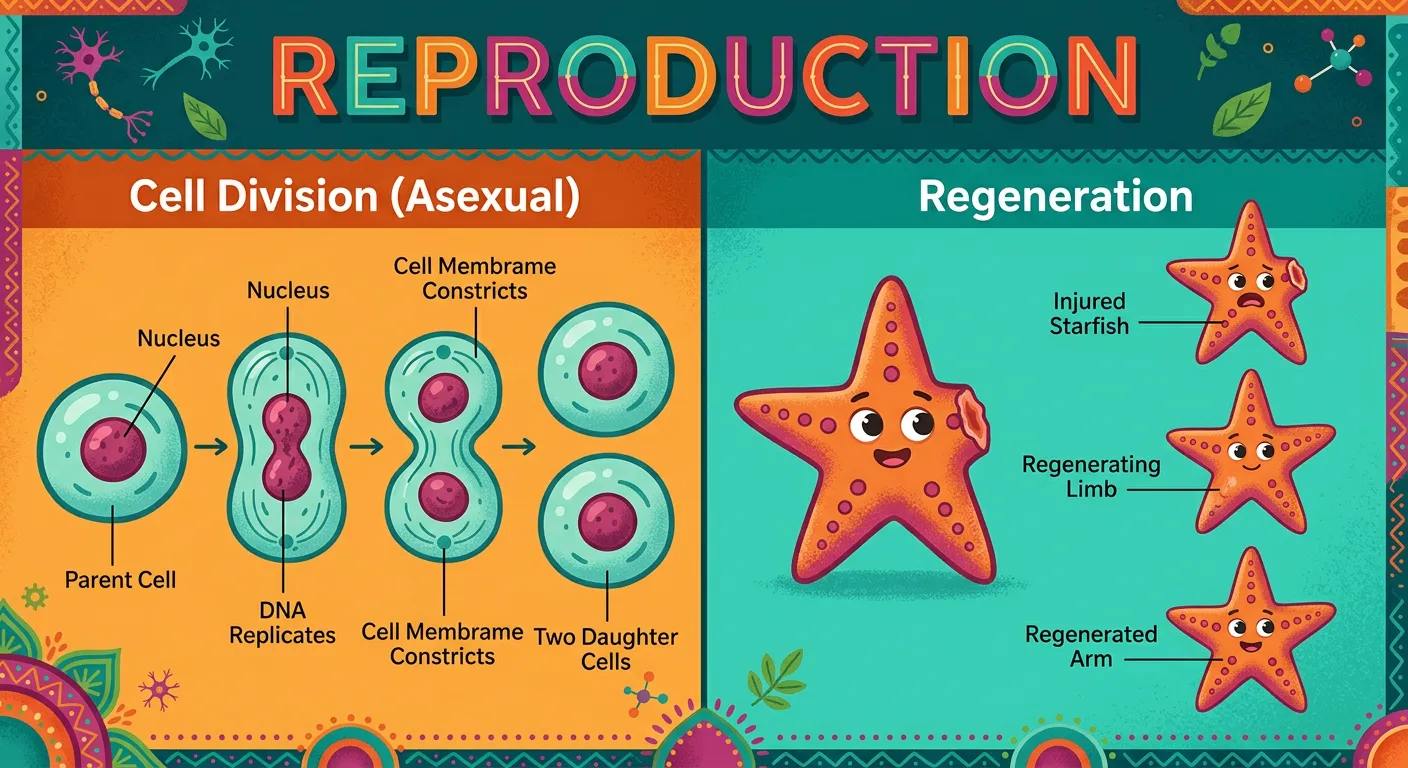
“Next, reproduction. Life begets life. Whether it’s a bacterial cell dividing or a starfish regenerating, reproduction ensures the continuation of species. Remember, for unicellular organisms, growth and reproduction are synonymous—two sides of the same coin. This is a classic NEET exam favorite!”
Reproduction is often the first thing people think of when defining what is living, but in the context of NEET biology, it is a tricky topic. Reproduction is a characteristic of life, but it is not a defining one. Why? Because there are several living organisms that do not reproduce—sterile worker bees, infertile human couples, and mules are prime examples. Since these organisms are undoubtedly 'living' despite their inability to reproduce, reproduction cannot be a universal defining feature of life.
However, it remains vital for the continuation of a species. In unicellular organisms like bacteria, unicellular algae, or Amoeba, reproduction is synonymous with growth. When these cells divide, they increase in number, which is essentially both growth and reproduction. This is a favorite concept for NEET examiners, who love to test your understanding of the link between cell division and population increase. Beyond this, we see various forms of reproduction: asexual (fission, budding, regeneration) and sexual. Note that 'regeneration' is not exactly reproduction in many organisms; it is simply a way to replace lost body parts. For example, a fragmented Planaria can regenerate into a full organism, but this is a specific case. As you progress to the 'Reproduction in Organisms' unit, you will see how these mechanisms vary. For your NEET preparation, remember: if a process is not seen in all living organisms, it cannot be a defining property. Focus on the exceptions—they are where the marks are won or lost in the exam hall.
04Metabolism: The Biochemical Essence of Life
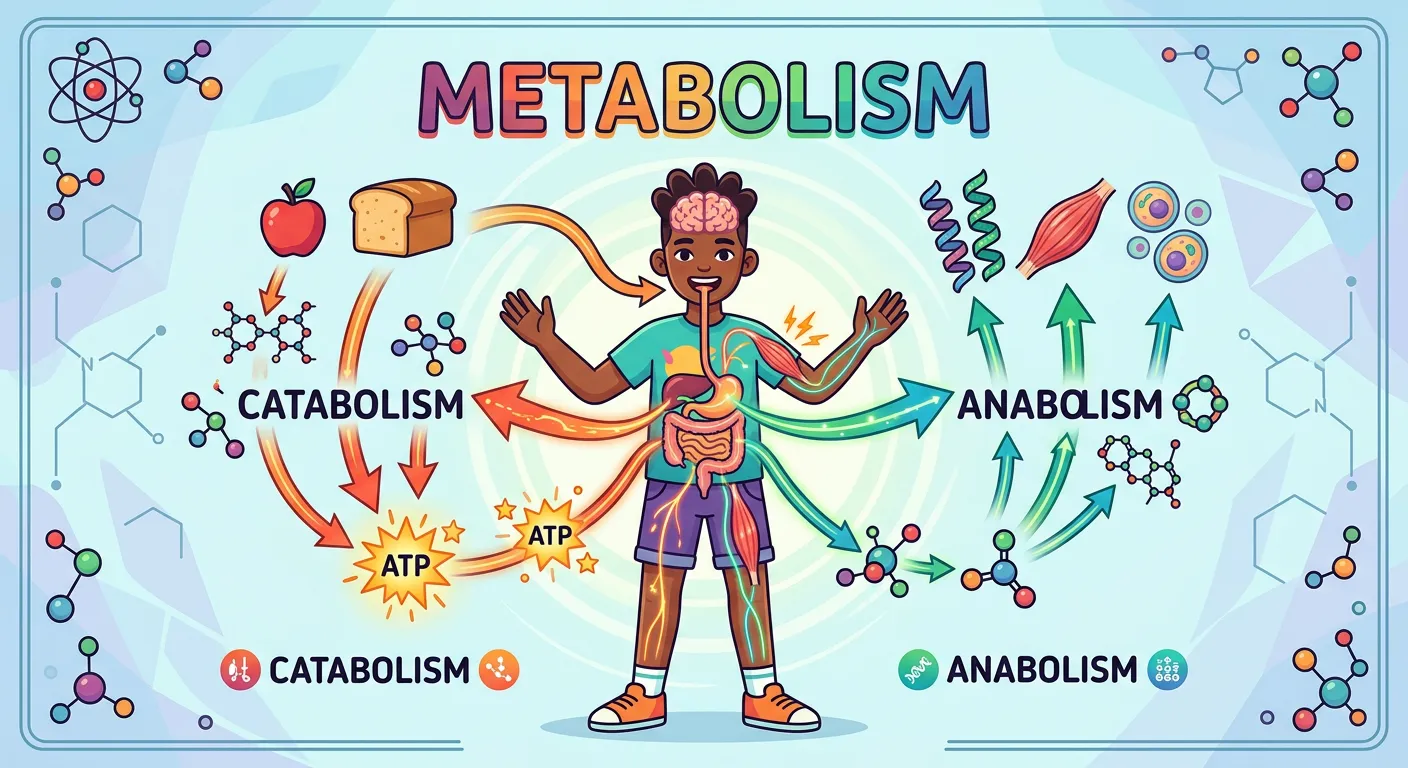
“Metabolism is the sum total of all chemical reactions in our body. Anabolism builds complex molecules, while catabolism breaks them down. No non-living object shows metabolism. Even a test-tube reaction is a living process, though the test-tube itself is not alive. Fascinating, right?”
Unlike growth and reproduction, metabolism is a truly defining feature of what is living. There are no exceptions. Metabolism is the sum total of all chemical reactions occurring within a living organism. Thousands of these reactions happen simultaneously in every cell, maintaining the state of homeostasis. We categorize these into two main types: Anabolism (building up complex molecules from simpler ones, like protein synthesis) and Catabolism (breaking down complex molecules, like cellular respiration).
In NEET, you must understand the 'test-tube' paradox. Can a metabolic reaction occur outside the body? Yes, it can, in an in-vitro, cell-free system. We call these 'living reactions' because they mimic the chemical processes of life. However, a test tube containing these chemicals is not, itself, a living organism. It lacks the cellular organization required to be categorized as 'living'. This is a high-yield concept for competitive exams. The critical takeaway is that while isolated metabolic reactions can occur in a controlled environment, the organism as a whole must be present for these reactions to be considered part of a 'living' life form. Metabolism is the biochemical essence that separates the biotic from the abiotic. As you study 'Biomolecules' and 'Respiration in Plants' later in the course, you will realize that metabolism is essentially the engine of life. Never get confused by the in-vitro setup; it is a laboratory representation of a biological process, not life itself. If a question asks for a defining property of life that has no exceptions, metabolism is your primary answer.
05Consciousness and the Phenomenon of Environmental Response
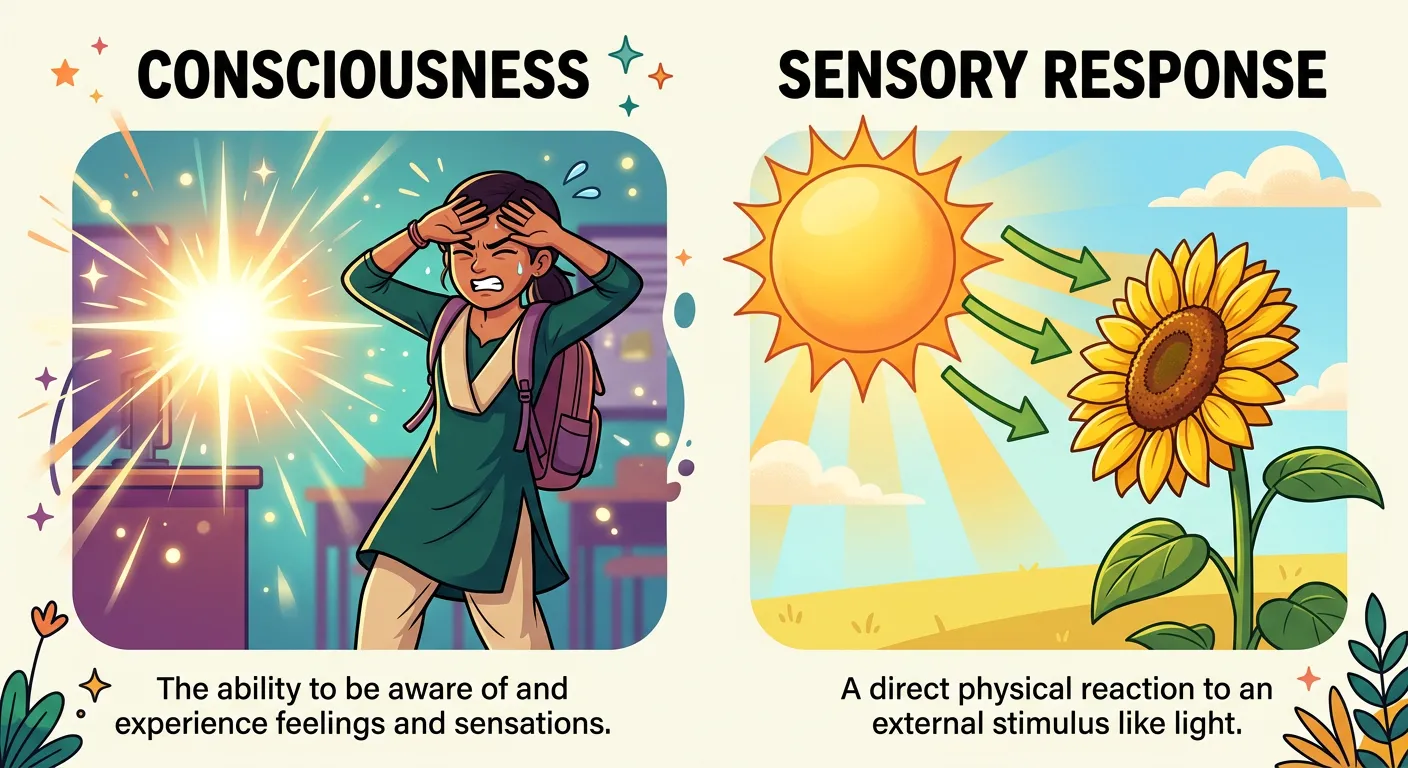
“Consciousness is the defining property of living organisms. We sense our environment, respond to light, temperature, and pollutants. Even the tiniest microbe reacts to chemical cues. Humans have self-consciousness, making us unique. It is the most complex and exciting feature of being alive!”
Consciousness is undoubtedly the most complex and exciting defining feature of what is living. It is the ability to sense the environment and respond to external stimuli—whether those stimuli are physical, chemical, or biological. From the simplest prokaryote-features-classification-neet-biology)-features-classification-neet-biology)-features-classification-neet-biology)-features-classification-neet-biology)-features-classification-neet-biology)-features-classification-neet-biology)-features-classification-neet-biology)-features-classification-neet-biology)-features-classification-neet-biology)-features-classification-neet-biology)-features-classification-neet-biology)-features-classification-neet-biology)-features-classification-neet-biology)-features-classification-neet-biology)-features-classification-neet-biology)-features-classification-neet-biology)-features-classification-neet-biology)-features-classification-neet-biology)-features-classification-neet-biology)-features-classification-neet-biology)-features-classification-neet-biology)-features-classification-neet-biology)-features-classification-neet-biology)-features-classification-neet-biology)-features-classification-neet-biology) to the most complex eukaryote, all living organisms are aware of their surroundings. Plants, for instance, respond to external factors like light, water, temperature, pollutants, and gravity (phototropism, geotropism, etc.).
When we talk about consciousness in the context of human beings, it is even more profound because we possess 'self-consciousness'. Humans are the only organisms aware of themselves. This makes us unique in the biosphere. For your NEET preparation, you must understand that consciousness is not just about having a complex nervous system; it is about the capacity for interaction with the environment. Even a single-celled organism detects chemical changes in its medium and moves accordingly. This behavior is a fundamental trait of life. Questions in NEET often focus on whether consciousness is a defining feature. The answer is an absolute 'yes'. It is present in all organisms, even those in a comatose state in a clinical setting—these patients are still living (they are clinically alive) because they exhibit metabolic activities and, though they may not respond to external stimuli like a healthy person, their cells are still maintaining biological function. Understanding the depth of consciousness will help you later when we cover 'Neural Control and Coordination' and 'Plant Physiology'. Remember, consciousness is the 'observer's' way of identifying the spark of life.
06Cellular Organization: The Structural Scaffold of Life
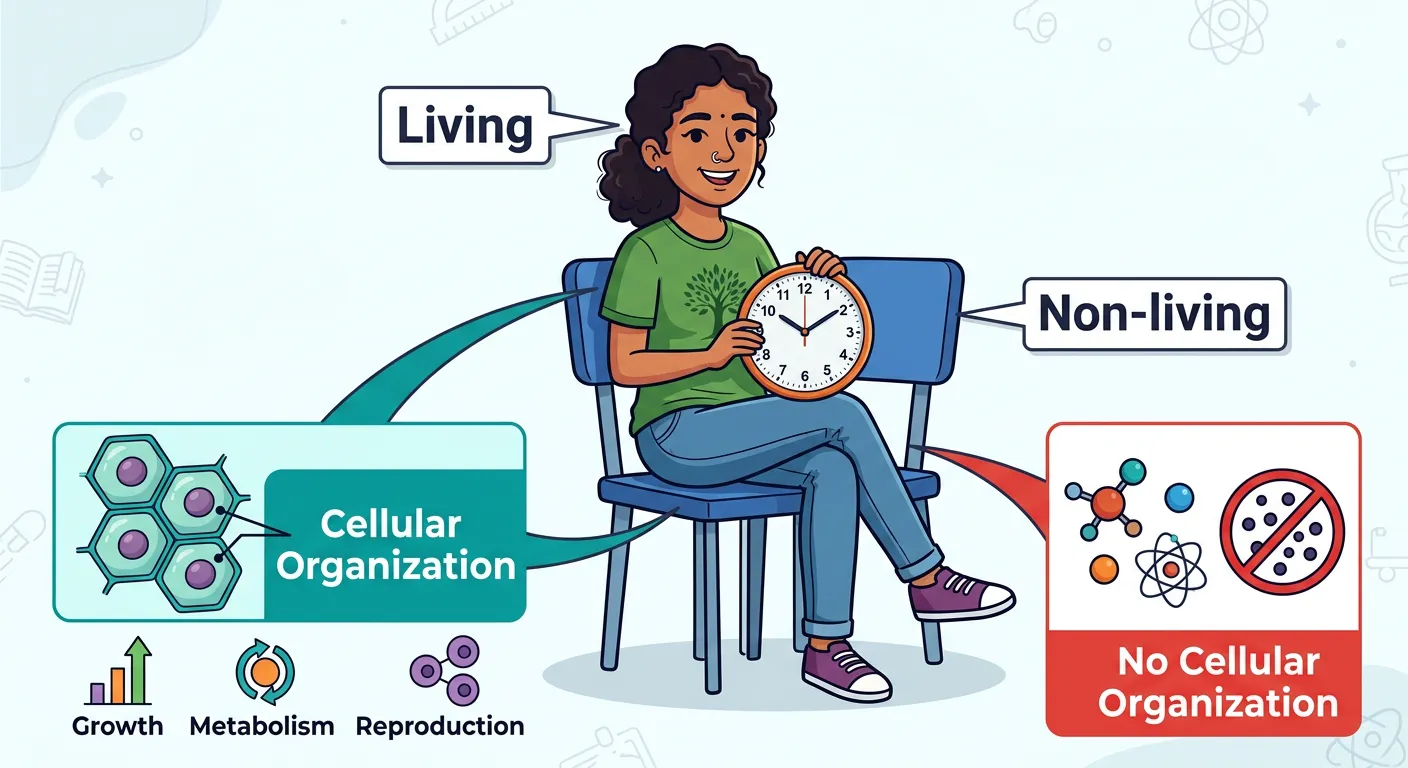
“Every living thing is built from cells. The cell is the basic unit of life, the structural and functional block of all existence. Without cellular organization, life simply cannot manifest. If it lacks cells, it’s just matter, not a living entity. Always remember this fundamental truth!”
Cellular organization is the fundamental structural basis of what is living. Every living organism, from the simplest bacterium to the most complex blue whale, is composed of cells. The cell is the structural and functional unit of life. It is the smallest entity that can independently carry out all life processes, including metabolism, reproduction (in some), and responsiveness. Without this organized structure, there is no life.
This is why we exclude viruses from being 'true' living organisms in many biological contexts. Viruses lack a cellular structure; they are essentially genetic material wrapped in a protein coat. They only exhibit 'living' characteristics when they hijack a host cell's machinery. For your NEET exam, this is a crucial distinction. Always look for the presence of cellular architecture when identifying a living system. Organization doesn't just stop at the cell; it extends from atoms to molecules, to cells, to tissues, organs, and organ systems. This hierarchy is what allows for 'emergent properties'—features that appear at a higher level of organization that were not present at the lower levels. For example, the property of consciousness is an emergent property of the complex neural interactions within the human brain, not just an isolated property of a single neuron. As you prepare for the unit on 'Cell: The Unit of Life', keep this structural scaffold in mind. It is the 'what' that allows all the 'hows' of biology to function. Without the cell, there is no life, only matter.
07Synthesizing the Living State: NEET Examination Takeaways
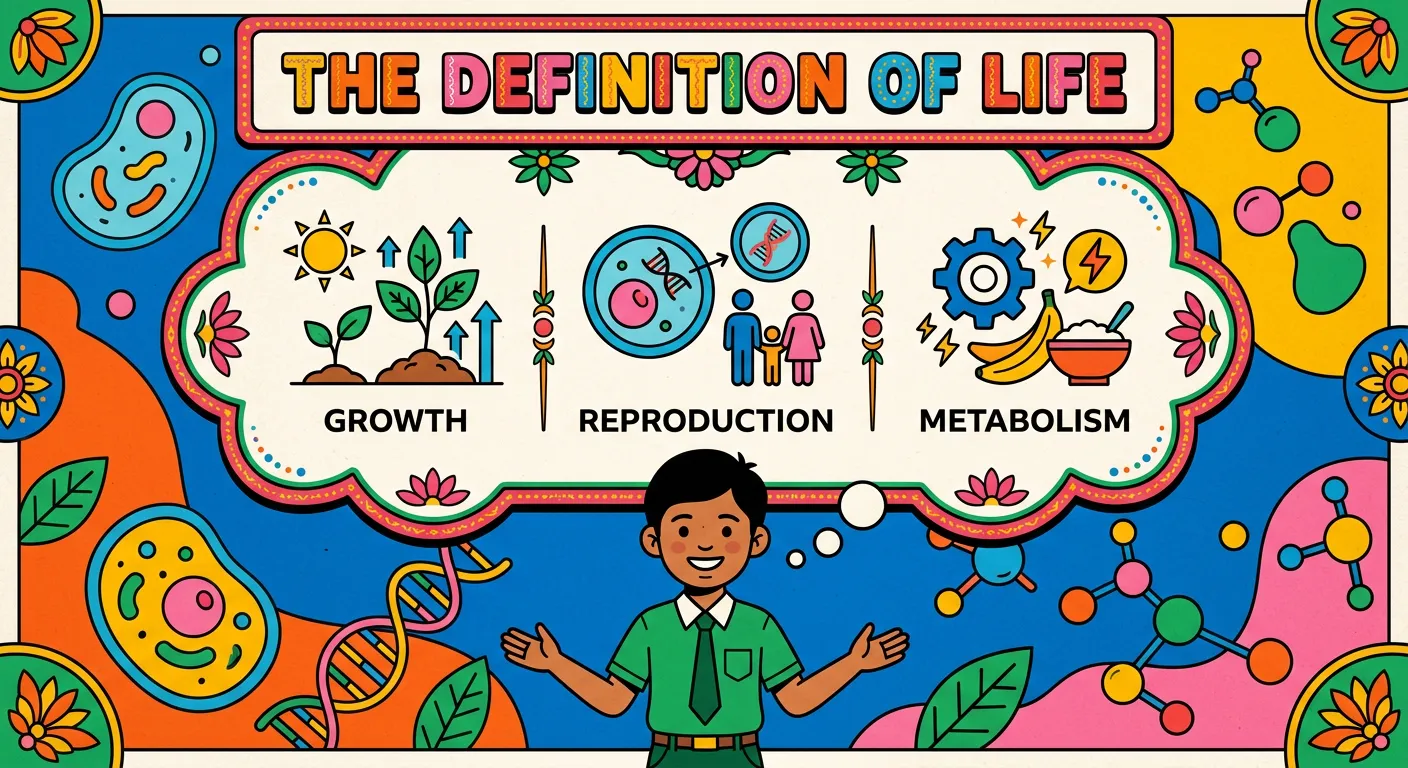
“So, what is living? It’s not just one thing; it’s a unique, complex organization of molecules exhibiting metabolism, growth, and consciousness. You are now equipped with the core concepts for your NEET prep! Keep revising, stay curious, and keep the spark of learning alive!”
As we conclude this introduction to what is living, let’s synthesize what we have learned to prepare for your NEET exam. We have established that while growth and reproduction are common traits, they are not defining ones due to the exceptions we’ve discussed. Metabolism, consciousness, and cellular organization are the holy trinity of defining characteristics for living things. Whenever you face a question on this topic, use the 'Exception Test': If a property is present in all living organisms and absent in all non-living ones, it is a defining feature.
Your strategy for this unit should be to focus on the NCERT text. The NEET exam is heavily based on these specific definitions and distinctions. Don't let yourself get distracted by complex biology outside the scope of your syllabus. Remember: growth = internal mass increase; reproduction = continuation of species; metabolism = chemical energy processing; consciousness = environmental interaction; and cell = structural unit. By mastering these five concepts, you are not just studying biology; you are building the mental framework required to understand complex physiological processes in later units. This chapter is the 'Introduction to the Introduction.' Keep your notes concise, focus on the differences between defining and characteristic features, and review the common mistakes we have listed. You are now prepared to transition into the next topic: the Diversity in the Living World. Stay curious, stay rigorous, and keep studying with the goal of mastery. Every point you secure in these foundation chapters provides the momentum you need for the more complex biological systems ahead. You have the tools—now go forth and apply them!
Recommended Reading
Explore related Biology topics to build deeper chapter connections for NEET.
- Kingdom Fungi · Topic 1.10
- Lichens · Topic 1.11
- Viruses and Viroids · Topic 1.12
- Algae · Topic 1.13
- Bryophytes · Topic 1.14
- Gymnosperms · Topic 1.16
- Jump to Key Terms (Quick Revision)
- Review Common NEET Mistakes
- Solve NEET Practice MCQs
- Read Topic FAQs
- Practice NEET MCQs
- Solve NEET PYQs
📚 Key Terms
⚠️ Common NEET Mistakes
- 1Mistaking reproduction as a 'defining' feature of life, forgetting the existence of sterile organisms.
- 2Confusing the 'in-vitro' metabolic reaction as a living organism itself.
- 3Failing to distinguish between internal growth (living) and external accretion (non-living).
- 4Ignoring the specific context of 'self-consciousness' vs. general 'consciousness'.
- 5Assuming all organisms reproduce through the same biological mechanism.
📝 NEET PYQ & Practice Questions
Test your understanding of What is Living with NCERT-aligned sample questions.
Which of the following statements is correct regarding "Metabolism" in the context of NEET Biology?
In NEET question papers, questions related to "What is Living" predominantly test:
Consider Catabolism associated with What is Living. What is the primary characteristic expected in NEET MCQs?
Master What is Living with NeetQ AI Tutor
Practice 50+ topic-wise MCQs, previous 15 years NEET questions, and get step-by-step doubt resolution instantly.
❓ Frequently Asked Questions
Why is reproduction not considered a 'defining' property of life in NEET?
Reproduction is not a defining property because it is not universal. Several living organisms, such as sterile worker bees, mules, and infertile human couples, are incapable of reproduction but are clearly alive.
Can a dead organism show metabolism? Explain.
No, a dead organism does not show metabolism. Metabolism is the sum total of all chemical reactions in a living cell. Once an organism dies, these organized metabolic pathways cease to function.
Are viruses considered living or non-living according to the cellular criteria?
According to the strict cellular criterion of life, viruses are considered non-living because they lack a true cellular structure and cannot perform metabolic activities independently.
How do unicellular organisms differ from multicellular ones in terms of growth?
In unicellular organisms, growth and reproduction are synonymous, as cell division results in an increase in the number of individuals. In multicellular organisms, growth and reproduction are distinct processes.
Is 'consciousness' present in plants? Justify with examples.
Yes, consciousness is present in plants. Plants exhibit consciousness by sensing and responding to external factors like light (phototropism), gravity (geotropism), water (hydrotropism), and chemicals.
Why is a test-tube reaction considered a 'living reaction' but not 'living'?
A test-tube reaction is a 'living reaction' because it involves biochemical processes that occur in living systems. However, the test tube is not 'living' because it lacks cellular organization and the complex regulation required for a living state.
Written By
NEET Content Strategist & Biology Expert
Sangita Kumari is a NEET educator and content strategist with over 6 years of experience teaching Biology, Chemistry, and Physics to Class 11 and 12 aspirants. She helps bridge the gap between traditional NCERT preparation and modern AI-powered learning. Her content is trusted by thousands of NEET aspirants across India.