🎬 Video Lesson Available
Watch the full 7-slide video lesson for Taxonomy and Systematics with AI teacher narration and visual explanations.
Taxonomy and Systematics — Learn Taxonomy and Systematics for NEET Biology.
01The Need for Organization: Introduction to Taxonomy

“Imagine entering a library where every book is tossed in a heap. Chaos, right? Taxonomy is the library science of biology. It is the art of identifying, naming, and classifying organisms into groups so we can understand the vast diversity of life on Earth systematically.”
Welcome to the starting line of your biological journey! When we look at the natural world, we see an staggering array of life—from microscopic bacteria to the massive blue whale. To a student preparing for NEET, this diversity can feel overwhelming. Imagine walking into a massive library where millions of books are just piled in a giant heap on the floor. Finding a specific book on human physiology would be impossible. This is exactly why we need taxonomy. It is the formal science of classification, providing the framework to identify, name, and categorize every living organism into a structured system. Without it, biological research would be a chaotic mess of local names and misunderstood descriptions.
Taxonomy isn't just about labeling; it’s about creating a universal language. When a scientist in India speaks about a specific medicinal plant, a researcher in Brazil should know exactly which species is being discussed. This clarity is essential for everything from ecology to medicine. In Class 11 Biology, we define taxonomy as the study of the principles and procedures of classification. It serves as the foundation for all other biological sciences because you cannot study an organism's function or evolution until you know exactly what that organism is. Think of it as the 'GPS' of biology, helping us navigate the complex web of life with precision.
As you dive into the topic of Taxonomy and Systematics, remember that these aren't just dry definitions. They represent our human attempt to mirror the order found in nature. For NEET, you must grasp the 'why' before the 'how.' We classify not just for convenience, but to reflect the inherent relationships between organisms. This section sets the stage for understanding how we transform raw biological data into a structured hierarchy that makes sense of the world's 1.7 to 1.8 million discovered species.
Quick Revision Points
- Taxonomy is the science of identification, nomenclature, and classification of organisms.
- It provides a universal system to manage the vast diversity of life (1.7–1.8 million species).
- The primary goal is to organize organisms into categories that reflect their similarities and differences.
- It prevents confusion caused by local or vernacular names across different regions and languages.
- The term 'Taxonomy' was originally coined by A.P. de Candolle.
NEET Exam Angle
- NCERT highlights the range of 1.7–1.8 million species; memorize this specific range as it frequently appears in objective questions.
- Understand the distinction between 'identification' and 'classification'—you must identify an organism's known traits before you can place it in a group.
- Taxonomy is often described as the 'fundamental branch of biology' in competitive exams because it precedes all other specialized studies.
02Binomial Nomenclature: The Universal ID Card
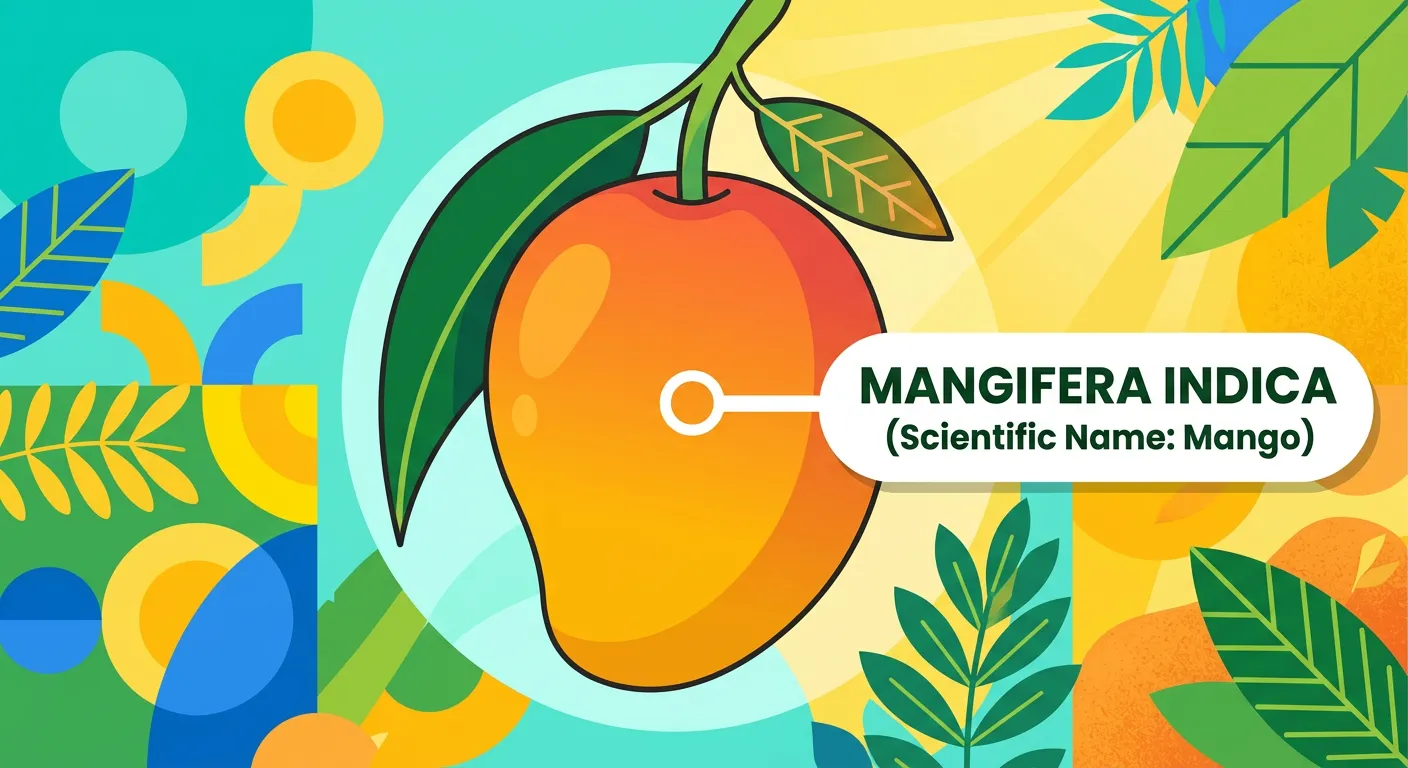
“Why call a mango a 'mango' here and an 'aam' somewhere else? To avoid confusion, we use Binomial Nomenclature. Developed by Carolus Linnaeus, it gives every organism a unique two-part scientific name: the Genus and the species. It is like an international ID card for every species!”
Why can’t we just use common names? In India, a mango is 'Aam'; in other places, it might be 'Manga' or 'Amra.' This linguistic diversity is beautiful but scientifically disastrous. To solve this, Carolus Linnaeus, the Father of Taxonomy, popularized Binomial Nomenclature. This system gives every organism a unique, two-part scientific name. The first part is the Generic name (Genus), and the second part is the Specific epithet (Species). It’s very much like your own name—the Genus is like your family name (surname), while the Species is your specific first name. This ensures that Mangifera indica means the same thing to a scientist in Tokyo as it does to one in New York.
There are strict international rules for this, governed by codes like the ICBN (for plants) and ICZN (for animals). For example, scientific names are usually in Latin because it is a 'dead language,' meaning it doesn't change over time. When printed, these names are italicized, and when handwritten, the Genus and species are underlined separately. The Genus always starts with a capital letter, while the specific epithet is in lowercase. These rules aren't just for decoration; they are the protocol that keeps biological data standardized globally. Mastering these rules is a rite of passage for every NEET aspirant.
Beyond the rules, Binomial Nomenclature tells us something about the organism’s identity. The specific epithet often describes a trait or the location where the species was found. For instance, in Solanum tuberosum (potato), 'tuberosum' refers to the tubers. By looking at the name, you already have a hint about the organism's biology. Linnaeus's contribution in Species Plantarum (1753) and Systema Naturae (1758) laid the groundwork for this system, which remains the gold standard nearly 300 years later.
Quick Revision Points
- Binomial Nomenclature was proposed by Carolus Linnaeus to provide a unique scientific name to every species.
- The name consists of two parts: Genus (first, capitalized) and Specific Epithet (second, lowercase).
- Names are derived from Latin and must be italicized when printed or underlined when handwritten.
- ICBN (International Code for Botanical Nomenclature) and ICZN (International Code for Zoological Nomenclature) provide the governing rules.
- The author's name (e.g., Linn.) may appear in abbreviated form after the specific epithet.
NEET Exam Angle
- Direct questions often ask for the correct format of a scientific name (e.g., Identifying that Mangifera indica Linn. is the correct way to write it).
- Be prepared for questions on the full forms of ICBN and ICZN.
- Remember that Latin is used specifically because it is a static, non-evolving language, ensuring long-term stability of names.
03The Taxonomic Workflow: Steps of Classification
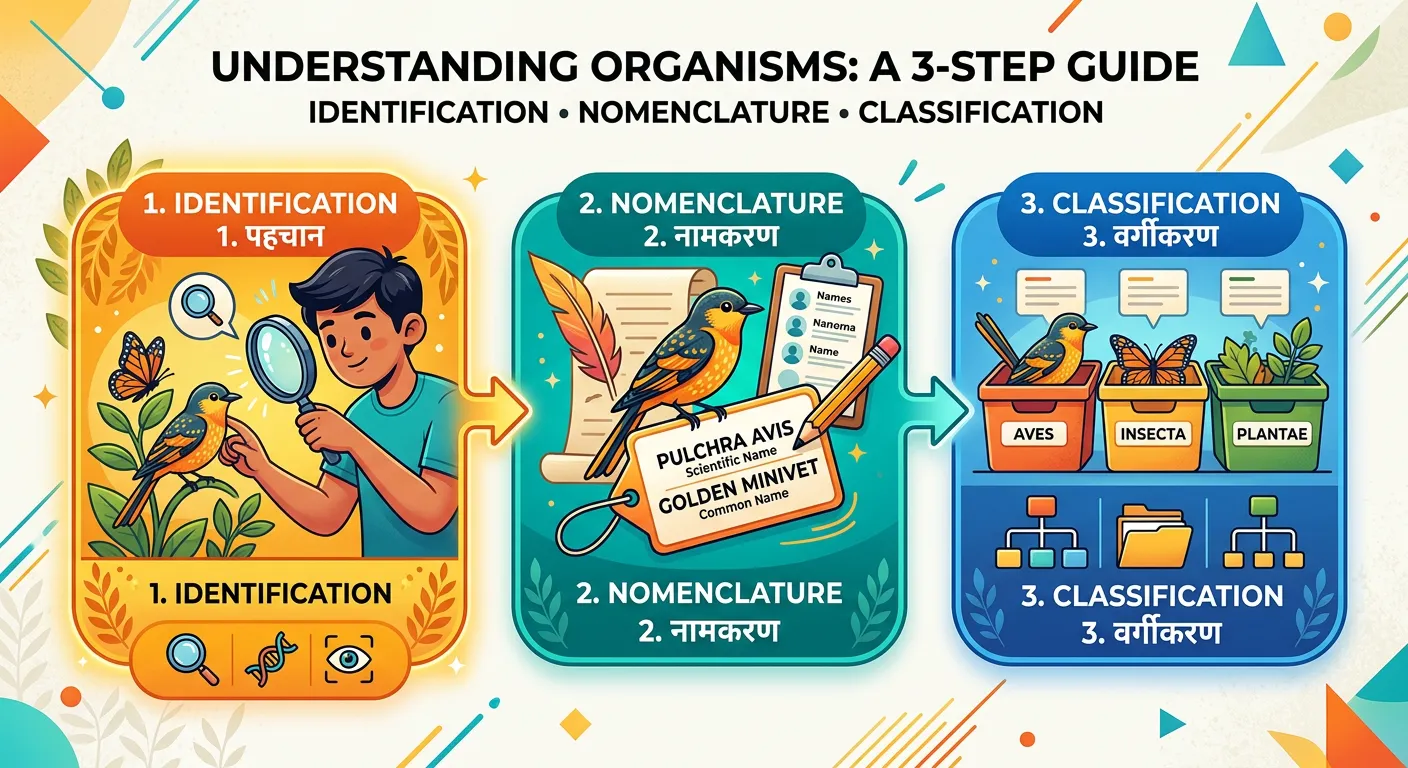
“Taxonomy isn't just naming. It follows three steps: first, we identify the organism's traits. Next, we give it a valid scientific name. Finally, we classify it into a group based on those traits. It is the essential workflow for every biologist studying life's complexity.”
Taxonomy is a process, not a one-time event. When a scientist discovers a new organism in the rainforest, they don't just pick a name out of a hat. There is a rigorous, three-step workflow that must be followed: Characterization, Identification, and finally, Nomenclature and Classification. First, we must study the 'Characterization'—this involves describing the morphological, anatomical, and even cellular traits of the organism. We look at the leaf shape, the number of legs, or the DNA sequence. We need a complete profile of what this organism looks like and how it functions.
Once we have the traits, we move to 'Identification.' This is the process of comparing the new organism with already known species. Think of it like matching a fingerprint to a database. If the organism matches an existing record, we know what it is. If it doesn't, we have likely found a new species. Only after these steps do we proceed to 'Nomenclature' (naming it according to the rules) and 'Classification' (placing it into the correct group). This systematic approach ensures that every new discovery adds to the body of knowledge rather than cluttering it with duplicates or errors.
| Process Step | Purpose | NEET Key Note |
|---|---|---|
| Characterization | Understanding external and internal features. | Includes cell structure and development. |
| Identification | Correctly determining the organism's known status. | Uses taxonomic keys and manuals. |
| Nomenclature | Assigning a standardized scientific name. | Must follow ICBN/ICZN rules. |
| Classification | Grouping based on observable similarities. | The final stage of basic taxonomy. |
For a NEET student, understanding this sequence is crucial. The exam often tests whether you know which step comes first. Remember: you cannot name something (Nomenclature) until you have correctly identified it, and you cannot identify it until you have described its traits (Characterization). It is a logical ladder of scientific discovery.
Quick Revision Points
- The four basic components of taxonomy are Characterization, Identification, Nomenclature, and Classification.
- Characterization focuses on describing both gross morphology and internal structure (anatomy/embryology).
- Identification involves recognizing an organism as being identical to or similar to an already known species.
- Classification is the grouping of organisms into categories (taxa) based on shared characteristics.
- Modern taxonomic studies also consider ecological information and developmental processes.
NEET Exam Angle
- Questions often ask for the correct sequence of taxonomic steps. (Correct order: Characterization -> Identification -> Nomenclature -> Classification).
- Note that 'Modern Taxonomy' differs from 'Classical Taxonomy' by including internal structures, developmental stages, and ecological data, not just external morphology.
- Pay attention to the term 'Taxa'—it represents a group of organisms at any level of the hierarchy.
04Taxonomic Hierarchy: Navigating the Ranks

“Meet the Taxonomic Hierarchy! We organize life into seven main ranks: Kingdom, Phylum, Class, Order, Family, Genus, and Species. Remember the mnemonic: 'King Philip Came Over For Good Soup.' As we go from Kingdom to Species, the number of common characteristics actually increases significantly.”
Life is organized in a nested hierarchy, much like a country is organized into states, then districts, then cities, and finally streets. In biology, we call this the 'Linnaean Hierarchy' or the Taxonomic Hierarchy. It consists of seven obligatory ranks: Kingdom, Phylum (for animals) or Division (for plants), Class, Order, Family, Genus, and Species. A famous mnemonic to remember this order is 'King Philip Came Over For Good Soup.' Each of these levels is called a 'Taxon' (plural: taxa). As you move from the top (Kingdom) down to the bottom (Species), the organisms become more similar to one another.
The Species is the most basic and fundamental unit of classification. Organisms in a species can interbreed and produce fertile offspring. As you move 'up' the ladder toward the Kingdom, the number of organisms in the group increases, but the number of shared characteristics decreases. For example, all animals in the Kingdom Animalia share very broad traits (like being multicellular heterotrophs), but two organisms in the same Genus (like a lion and a tiger) share almost everything except a few specific details. This inverse relationship is a major focus for NEET examiners.
| Rank | Example (Human) | Specificity Level |
|---|---|---|
| Kingdom | Animalia | Broadest / Lowest common traits |
| Phylum | Chordata | Shared body plan |
| Class | Mammalia | Shared reproductive/milk traits |
| Order | Primata | Shared structural traits |
| Family | Hominidae | Closely related lineages |
| Genus | Homo | Very high similarity |
| Species | sapiens | Most specific / Interbreeding group |
Understanding this hierarchy is like understanding the address of life. If you know an organism's Family, you automatically know its Order, Class, Phylum, and Kingdom. However, knowing the Kingdom doesn't tell you much about the specific Genus. This 'bottom-up' increase in similarity is the key to mastering classification questions in your exams.
Quick Revision Points
- The taxonomic hierarchy consists of 7 mandatory categories: Kingdom, Phylum/Division, Class, Order, Family, Genus, Species.
- Species is the 'Real basic unit' of classification.
- As we go from species to kingdom, the number of common characteristics decreases.
- A 'Taxon' represents a biological group at any level (e.g., 'Mammalia' is a taxon at the class level).
- Intermediate categories (like sub-species or sub-family) can also exist but aren't the primary seven.
NEET Exam Angle
- Focus on the trend: Higher the category, fewer the common characteristics. This is a high-yield conceptual question.
- Remember that 'Division' is used for plants, while 'Phylum' is used for animals.
- Be prepared to identify the correct ascending or descending order of these categories from a given list.
05Understanding Relationships: The Logic of Grouping

“Classification is all about relationships. Look at a house cat and a tiger; they share the same Family, Felidae. This tells us they have common ancestors. By grouping organisms, we uncover the evolutionary connections that link all living things on our planet together.”
Why do we put a house cat (Felis catus) and a leopard (Panthera pardus) into the same Family, Felidae? It isn't just because they both have whiskers. Classification is a reflection of biological relationships. When we group organisms, we are essentially saying that these creatures share a common blueprint. For instance, dogs and wolves share the same Family (Canidae), while cats, lions, and tigers share the Family Felidae. Interestingly, both these families belong to the same Order, Carnivora, because they share the primary characteristic of being flesh-eaters with specific tooth structures.
This grouping logic helps scientists predict the characteristics of an organism. If you discover a new species that belongs to the Family Felidae, you can immediately predict it will have retractable claws and a specific skull shape, even before you study it in detail. This predictive power is what makes taxonomy so useful for conservation and medicine. If one plant in a Genus contains a medicinal compound, there is a high chance that other species in the same Genus might contain similar useful chemicals. Taxonomy, therefore, is not just a filing system; it's a map of shared biological resources.
| Organism | Common Name | Family | Order |
|---|---|---|---|
| Felis catus | House Cat | Felidae | Carnivora |
| Panthera leo | Lion | Felidae | Carnivora |
| Canis familiaris | Dog | Canidae | Carnivora |
| Ursus arctos | Brown Bear | Ursidae | Carnivora |
As seen in the table above, even though a cat and a bear look very different, their classification in the Order Carnivora reveals their shared evolutionary history as predators. For NEET, you should be familiar with common examples like these, particularly the ones mentioned in the NCERT textbook regarding Mango, Wheat, Man, and Housefly. These examples demonstrate how morphological similarities are used to build the hierarchy.
Quick Revision Points
- Classification is based on shared characteristics that reflect evolutionary relationships.
- Related genera are grouped into Families; related families are grouped into Orders.
- The Order Carnivora includes diverse families like Felidae (cats) and Canidae (dogs).
- Shared features become more generalized as we move to higher taxonomic categories.
- The goal of classification is to reveal the 'unity in diversity' among living beings.
NEET Exam Angle
- Questions often focus on the examples provided in the NCERT table (Man, Housefly, Mango, Wheat). Know their Family, Order, Class, and Phylum/Division by heart.
- Understand that families are characterized on the basis of both vegetative and reproductive features (especially in plants).
- Be aware that 'Solanaceae' and 'Convolvulaceae' are placed in the same Order 'Polymoniales' primarily based on floral characters.
06Systematics: Adding the Dimension of Time
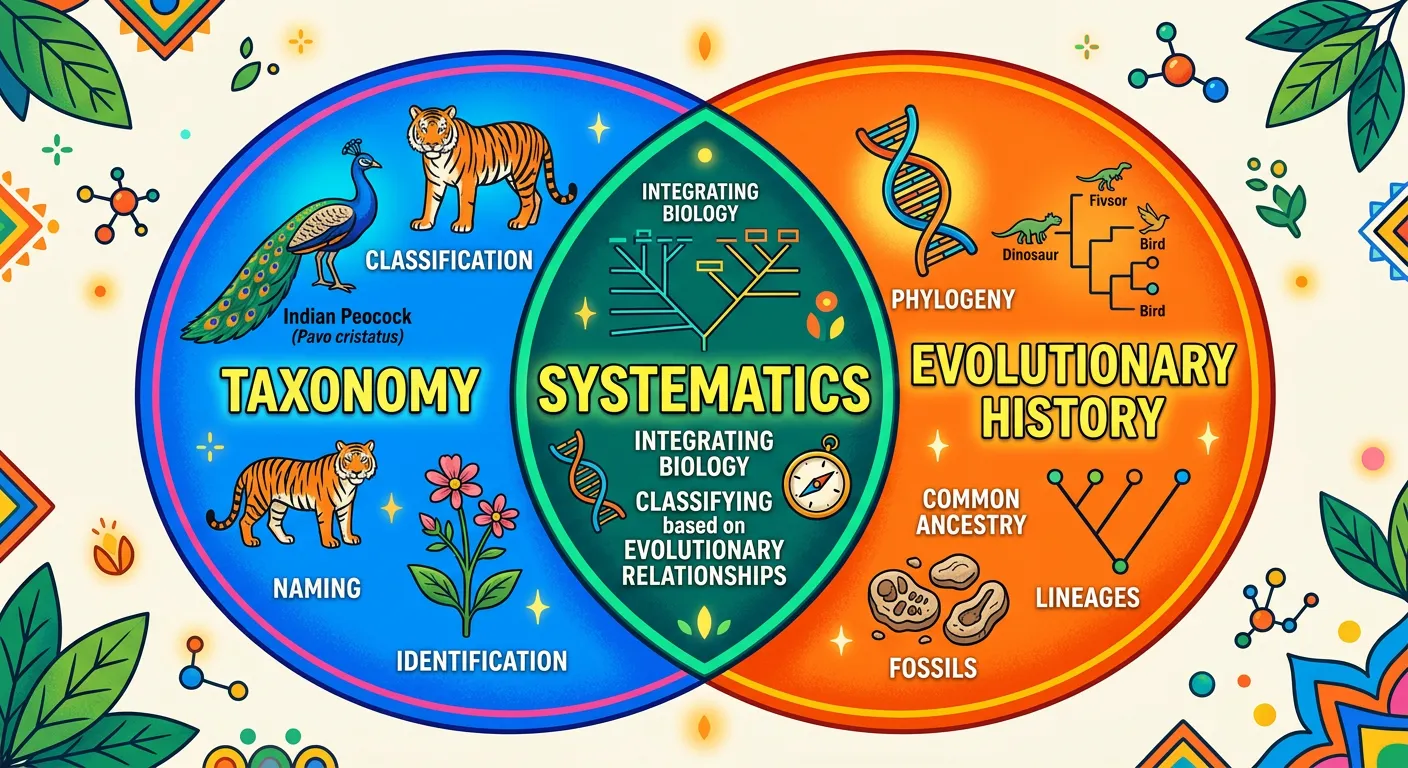
“Systematics is the next level up. It includes taxonomy but adds evolutionary relationships to the mix. It tells us not just what an organism is, but its entire history and 'family tree.' Think of it as mapping the ancestral path of every living thing.”
While taxonomy focuses on naming and grouping, Systematics takes it a step further. The word 'Systematics' comes from the Latin word 'systema,' which means the orderly arrangement of organisms. However, in modern biology, Systematics is synonymous with the study of 'Phylogeny'—the evolutionary history of organisms. If taxonomy is like taking a photograph of organisms today and organizing them, systematics is like looking at the entire family tree over millions of years. It asks: 'Who is the ancestor of whom?'
Carolus Linnaeus used the title Systema Naturae for his famous publication, but the scope of systematics has expanded greatly since his time. Modern systematics doesn't just look at how an organism looks (morphology); it looks at its DNA, its fossil record, and its embryonic development to determine its place in the 'Tree of Life.' This is why we say systematics includes taxonomy plus evolutionary relationships. It is the most comprehensive way to study diversity because it accounts for how life has changed over time. For a NEET aspirant, distinguishing between these two terms is vital for high-level conceptual questions.
| Feature | Taxonomy | Systematics |
|---|---|---|
| Primary Focus | Naming and Classification. | Evolutionary relationships (Phylogeny). |
| Components | ID, Nomenclature, Classification. | Taxonomy + Evolutionary History. |
| Goal | Organize diversity for study. | Map the ancestral path of life. |
| Key Term | Taxon (Category). | Clade (Evolutionary group). |
In the 20th century, the term 'New Systematics' (or Biosystematics) was introduced by Julian Huxley. This approach moved away from just looking at dead specimens in a museum to looking at living populations, genetics, and ecology. This transition from 'Classical' to 'Modern' is a favorite topic for exam setters who want to test your depth of understanding regarding biological history.
Quick Revision Points
- Systematics is the study of the diversity of organisms and all their comparative and evolutionary relationships.
- The term is derived from the Latin 'systema' (orderly arrangement).
- Taxonomy is a branch of systematics; systematics = Taxonomy + Phylogeny.
- Linnaeus used Systema Naturae as the title of his landmark book.
- New Systematics considers evolutionary history and genetic data alongside morphological traits.
NEET Exam Angle
- Differentiate between the terms 'Taxonomy' and 'Systematics' based on the inclusion of evolutionary relationships (Phylogeny).
- Remember the name of Linnaeus's book Systema Naturae as it is a common PYQ.
- Identify that modern taxonomic studies are essentially 'phylogenetic' in nature, meaning they aim to reflect evolutionary descent.
07Mastering the Foundation: From Basics to ACE-ing NEET
“You have mastered the basics! Taxonomy and Systematics are the foundation of your NEET biology journey. By mastering how we classify life, you are ready to explore the specific chapters of diversity that follow. Stay curious, keep classifying, and let’s ace that NEET exam together!”
You have successfully navigated the foundational concepts of Taxonomy and Systematics! These topics are more than just introductory chapters; they are the tools you will use in every other unit of Biology. Whether you are studying the classification of plants, the diversity of animals, or the kingdom of Monera, the rules of nomenclature and the structure of the taxonomic hierarchy remain your constant guides. By mastering these basics, you've built a solid platform for the more complex biological concepts that follow.
To excel in NEET, consistency is your best friend. Don't just memorize the names; understand the logic behind why a lion is in the same Genus as a leopard (Panthera) but in a different Genus than a house cat (Felis). Revisit the hierarchy mnemonic and practice applying the rules of nomenclature until they become second nature. Most students lose marks not on the difficult concepts, but on the simple ones—like forgetting to underline a scientific name or confusing the order of 'Family' and 'Order' in the hierarchy.
As you move forward, keep a 'diversity notebook' where you list the classification of common organisms mentioned in your NCERT. These small habits turn a good student into a top ranker. Taxonomy and Systematics might seem like the 'library science' of biology, but remember that even the most exciting adventure starts with a good map. You now have that map. Keep your curiosity alive, stay systematic in your revision, and let’s move on to conquering the rest of the Diversity in the Living World unit together!
Quick Revision Points
- Taxonomy and systematics provide the 'Map of Life' necessary for all biological study.
- Memorization of the hierarchy (KPCOFGS) is essential for solving ranking questions.
- Binomial nomenclature rules are non-negotiable and must be followed precisely.
- Understanding evolutionary relationships (Systematics) is the goal of modern classification.
- Regularly practice the NCERT examples (Human, Mango, Wheat, Housefly).
NEET Exam Angle
- Always check the options carefully for italics or underlines in naming questions.
- Pay close attention to the distinction between 'Division' and 'Phylum' in matching-type questions.
- Focus on 'Common characters' trends—this is arguably the most repeated conceptual question from this subtopic.
- Use the mnemonic 'King Philip...' to quickly double-check your hierarchy order during the exam to avoid silly mistakes under pressure.
Recommended Reading
Explore related Biology topics to build deeper chapter connections for NEET.
- What is Living · Topic 1.1
- Kingdom Fungi · Topic 1.10
- Lichens · Topic 1.11
- Viruses and Viroids · Topic 1.12
- Algae · Topic 1.13
- Bryophytes · Topic 1.14
- Jump to Key Terms (Quick Revision)
- Review Common NEET Mistakes
- Solve NEET Practice MCQs
- Read Topic FAQs
- Practice NEET MCQs
- Solve NEET PYQs
📚 Key Terms
⚠️ Common NEET Mistakes
- 1Writing the specific epithet starting with a capital letter (it must always be lowercase).
- 2Forgetting to underline the genus and species separately when handwriting scientific names.
- 3Confusing the order of 'Order' and 'Family' in the taxonomic hierarchy.
- 4Assuming that 'Taxonomy' and 'Systematics' are exactly the same thing (Systematics includes evolutionary history).
- 5Incorrectly believing that common characteristics increase as we go higher in the hierarchy (they actually decrease).
📝 NEET PYQ & Practice Questions
Test your understanding of Taxonomy and Systematics with NCERT-aligned sample questions.
Which of the following statements is correct regarding "Taxon" in the context of NEET Biology?
In NEET question papers, questions related to "Taxonomy and Systematics" predominantly test:
Consider Phylogeny associated with Taxonomy and Systematics. What is the primary characteristic expected in NEET MCQs?
Master Taxonomy and Systematics with NeetQ AI Tutor
Practice 50+ topic-wise MCQs, previous 15 years NEET questions, and get step-by-step doubt resolution instantly.
❓ Frequently Asked Questions
Who is known as the Father of Taxonomy?
Carolus Linnaeus is known as the Father of Taxonomy because he developed the Binomial Nomenclature system and established the taxonomic hierarchy.
What is the basic unit of classification?
The species is the basic and fundamental unit of classification, representing a group of organisms that can interbreed and produce fertile offspring.
How does Taxonomy differ from Systematics?
Taxonomy focuses on the identification, naming, and classification of organisms, whereas Systematics includes taxonomy plus the study of evolutionary relationships (phylogeny).
What happens to the number of common characteristics as we move from Species to Kingdom?
The number of common characteristics decreases as we move from Species to Kingdom. Conversely, they increase as we move from Kingdom to Species.
Why are scientific names written in Latin?
Latin is used because it is a 'dead language,' meaning it does not evolve or change over time, ensuring that scientific names remain stable and universal.
What are the four essential processes of taxonomy?
The four processes are Characterization, Identification, Nomenclature, and Classification.
Written By
NEET Content Strategist & Biology Expert
Sangita Kumari is a NEET educator and content strategist with over 6 years of experience teaching Biology, Chemistry, and Physics to Class 11 and 12 aspirants. She helps bridge the gap between traditional NCERT preparation and modern AI-powered learning. Her content is trusted by thousands of NEET aspirants across India.