🎬 Video Lesson Available
Watch the full 7-slide video lesson for Binomial Nomenclature with AI teacher narration and visual explanations.
Binomial Nomenclature — Master Binomial Nomenclature for NEET Class 11. Learn rules by Carolus Linnaeus, formatting guidelines, and examples like Mangifera indica to score high.
01The Necessity of a Universal Naming System in Biological Taxonomy

“Welcome, future doctors! Imagine going to a market where a fruit is called 'Aam' here, but 'Mango' elsewhere. Confusion, right? To solve this, scientists created Binomial Nomenclature—a universal system to name organisms, ensuring that one organism has exactly one scientific name recognized across the entire world.”
In the vast and diverse world of biology, communication is the primary bridge between discovery and global knowledge. Imagine the profound chaos within the international scientific community if every researcher relied solely on their native language or regional dialect to describe a specimen. In India, a specific succulent fruit is known as 'Aam'; in English-speaking nations, it is 'Mango'; in various other parts of the world, it is referred to as 'Manga', 'Amra', or 'Amb'. While these vernacular names are culturally significant and linguistically rich, they pose a massive hurdle for scientific accuracy. They change every few hundred miles, lack a standardized structure, and offer no clues regarding the evolutionary relationships or biological characteristics of the organism.
Furthermore, many common names are factually misleading. For instance, a 'Starfish' is an echinoderm and not a fish, a 'Silverfish' is a wingless insect, and a 'Jellyfish' is a cnidarian. Relying on such nomenclature would lead to significant errors in classification and research. To eliminate this linguistic ambiguity, biologists realized the imperative need for a standardized, universal naming protocol that would remain constant regardless of the observer's language or location. This realization birthed the concept of biological nomenclature, ensuring that each species has a unique, globally recognized name.
Binomial Nomenclature became the definitive solution to this taxonomic 'Tower of Babel'. By assigning a unique, two-part scientific name to every known species, scientists ensured that one organism has exactly one name recognized from Tokyo to Toronto. This system serves as the bedrock of systematic biology, facilitating precise communication. When a scientist in Brazil publishes research on Mangifera indica, a botanist in Russia or a student in India knows exactly which plant is being discussed without the need for cumbersome translations. This 'one organism, one name' philosophy prevents the duplication of records, minimizes confusion in scientific literature, and provides a stable framework for cataloging the millions of species that constitute our planet's biodiversity.
Quick Revision Points
- Vernacular names are localized and vary significantly across different languages, causing scientific confusion.
- Common names are often biologically inaccurate (e.g., Sea horse is a fish, but Starfish is not).
- Binomial Nomenclature provides a unique, universally accepted scientific name for every organism.
- Standardization is essential for peer-reviewed research and global taxonomic classification.
- The system ensures that no two different species share the same scientific name globally.
NEET Exam Angle
- Questions frequently explore why common names are rejected in formal taxonomy (Answer: Lack of universality and scientific precision).
- Be prepared for Assertion-Reasoning questions regarding the 'necessity' of a dead language like Latin in preventing nomenclature shifts.
| Feature | Common Name | Scientific Name |
|---|---|---|
| Scope | Local/Regional | Universal/Global |
| Language | Any local dialect | Latin/Latinized |
| Precision | Low (Multiple names for one species) | High (One name for one species) |
| Biological Info | Usually absent | Indicates Genus and Species |
02Carolus Linnaeus and the Two-Component Naming Framework
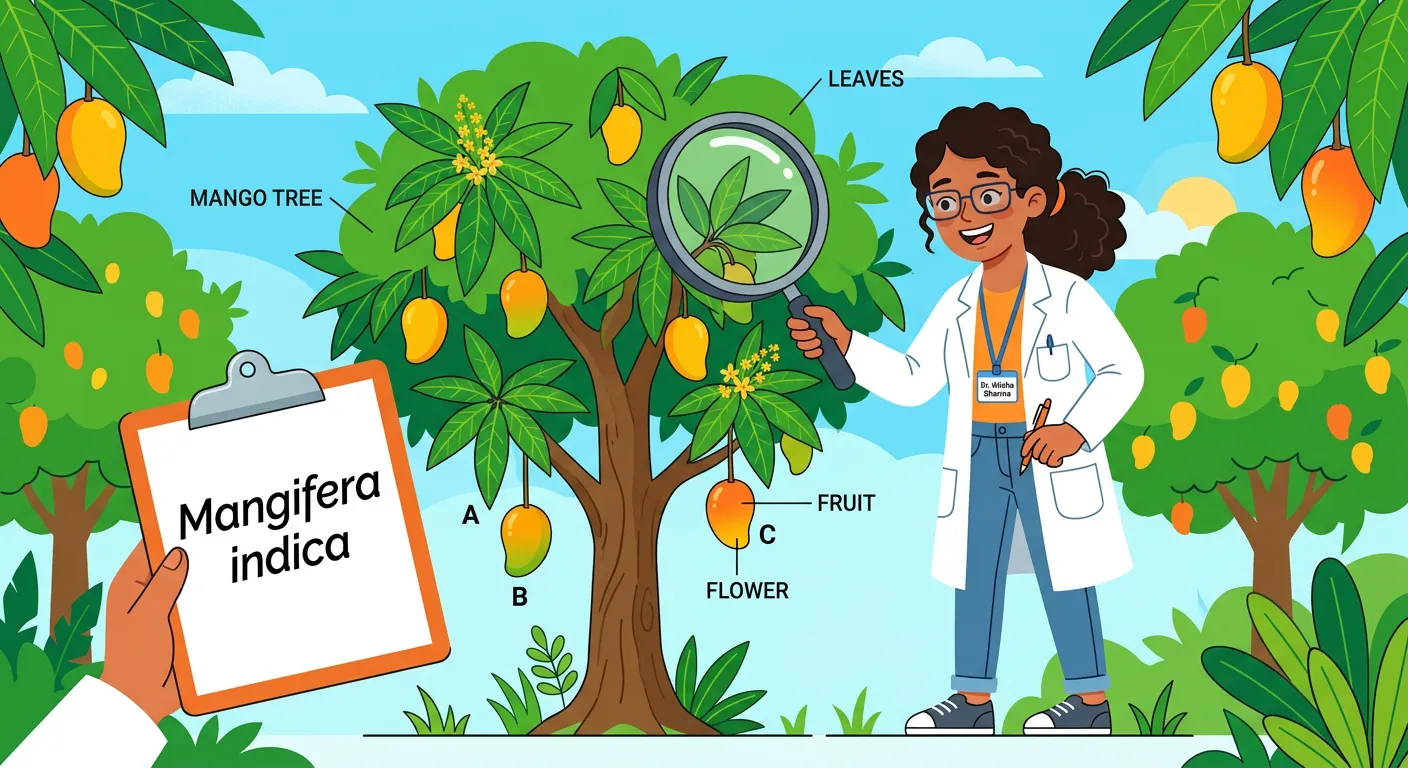
“Meet the legend behind this: Carolus Linnaeus! He proposed that every scientific name should have two components: the Generic name and the Specific epithet. Think of it like your name—'Mangifera' is the genus, or the surname, and 'indica' is the species, or your unique first name.”
The credit for revolutionizing the way we categorize life goes to the 18th-century Swedish botanist Carolus Linnaeus. Widely hailed as the 'Father of Modern Taxonomy', Linnaeus recognized that the existing systems of his time were failing the scientific community. Before his intervention, organisms were often described using 'polynomial' names—long, descriptive Latin phrases that acted more like a physical summary than a name. For example, a rose might be named Rosa sylvestris alba cum rubore, folio lucido, which was not only difficult to memorize but also highly impractical for documentation.
Linnaeus proposed a streamlined system where every scientific name consists of exactly two distinct components. This framework was first introduced in his seminal works: Species Plantarum (1753), which focused on botanical classification, and the 10th edition of Systema Naturae (1758), which extended the system to the animal kingdom. This transition from complex polynomials to simple binomials allowed for a more structured and hierarchical approach to biodiversity.
In the Linnaean framework, the first part of the name is the 'Generic name' (representing the Genus), and the second part is the 'Specific epithet' (representing the Species). A helpful analogy for NEET students is the 'Surname-First Name' structure. The Genus is like a surname—it identifies a group of closely related species that share common ancestral traits. The Specific epithet is like a unique first name that identifies a particular individual species within that group. In the case of Mangifera indica, 'Mangifera' is the genus that encompasses several mango-like species, while 'indica' specifically isolates the common Indian mango. This two-word structure is elegant, provides a wealth of information regarding evolutionary grouping, and remains the standard for all biological research today.
Quick Revision Points
- Carolus Linnaeus is the founder of the modern Binomial Nomenclature system.
- The two components are: 1. Generic Name (Genus) and 2. Specific Epithet (Species).
- Linnaeus transitioned biology from cumbersome polynomial descriptions to streamlined binomials.
- Significant works: Species Plantarum (1753) for plants and Systema Naturae (1758) for animals.
- The Genus represents a higher taxonomic category, while the Species is the most fundamental unit.
NEET Exam Angle
- Remember the specific years of Linnaeus’s major publications as they are common in historical biology questions.
- Understand the hierarchy: The Generic name is always placed first, functioning as the group identifier.
| Organism | Generic Name | Specific Epithet |
|---|---|---|
| Mango | Mangifera | indica |
| Human | Homo | sapiens |
| Potato | Solanum | tuberosum |
| Lion | Panthera | leo |
03The Golden Rules of Capitalization in Scientific Names
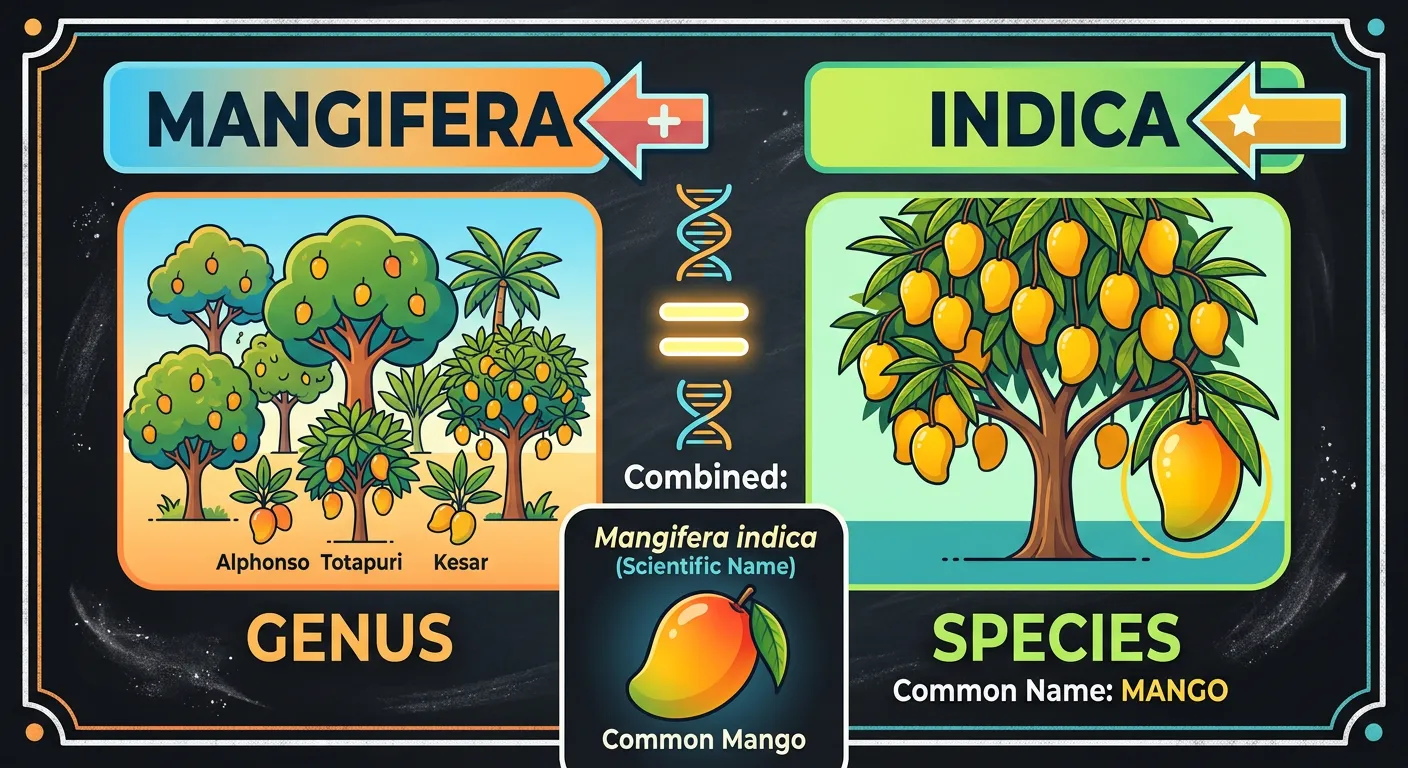
“The first word, the Genus, always starts with a capital letter. The second word, the species, starts with a small letter. It’s a simple rule, but it’s the golden rule for your NEET exams! Mangifera indica—capital M, small i. Easy, right?”
In the world of competitive exams like NEET, precision is the difference between a top rank and a missed opportunity. [Binomial Nomenclature](/neet/biology/taxonomy-and-systematics) is not just about the words themselves, but how they are visually presented. One of the most fundamental and strictly enforced rules concerns capitalization. Every scientific name must follow a specific case format that immediately distinguishes the genus from the species. The rule is absolute: the first letter of the Generic name must always be a capital letter, while the Specific epithet must always begin with a lowercase letter.
This distinction is not merely a matter of style; it is a rigid requirement of the International Codes of Nomenclature. Even if a species is named after a world-renowned scientist or a famous geographical location, the specific epithet remains lowercase. Let’s re-examine our primary example: Mangifera indica. Notice that the 'M' in Mangifera is capitalized, signaling its status as the genus, while the 'i' in indica is small. Many students lose marks because they intuitively want to capitalize the second word, especially if it sounds like a proper noun. For example, writing 'Mangifera Indica' is a scientific error and would be marked incorrect in any official biological context.
In the high-pressure environment of a NEET exam, examiners frequently use this rule to create 'distractor' options. You might encounter four choices where the spelling is identical, but only one correctly follows the capitalization protocol. Training your eyes to scan for the 'Capital-Lowercase' pattern is a vital skill. Whether it is Homo sapiens, Pisum sativum, or Azadirachta indica, the pattern never changes. Mastering this 'Golden Rule' ensures that you secure easy marks on nomenclature questions and demonstrates your attention to the minute details that define biological science. Always remember: Genus starts BIG, species starts small.
Quick Revision Points
- The Generic name (Genus) always begins with a Capital letter.
- The Specific epithet (Species) always begins with a lowercase letter.
- This rule is independent of the name's origin (geographical or personal).
- Correct format: Homo sapiens (H is capital, s is small).
- Incorrect formats: homo sapiens, Homo Sapiens, or HOMO SAPIENS.
NEET Exam Angle
- Identifying the 'technically correct' written name is a high-frequency MCQ type.
- Pay close attention to the second word; examiners love to capitalize it in distractor options to mimic proper nouns.
| Scientific Name | Capitalization Status | Validity |
|---|---|---|
| Mangifera Indica | Incorrect (Species is capitalized) | Invalid |
| mangifera indica | Incorrect (Genus is lowercase) | Invalid |
| Mangifera indica | Correct (Capital G, Small s) | Valid |
| MANGIFERA INDICA | Incorrect (All caps) | Invalid |
04Typography and Formatting: Italics vs. Underlining Protocols
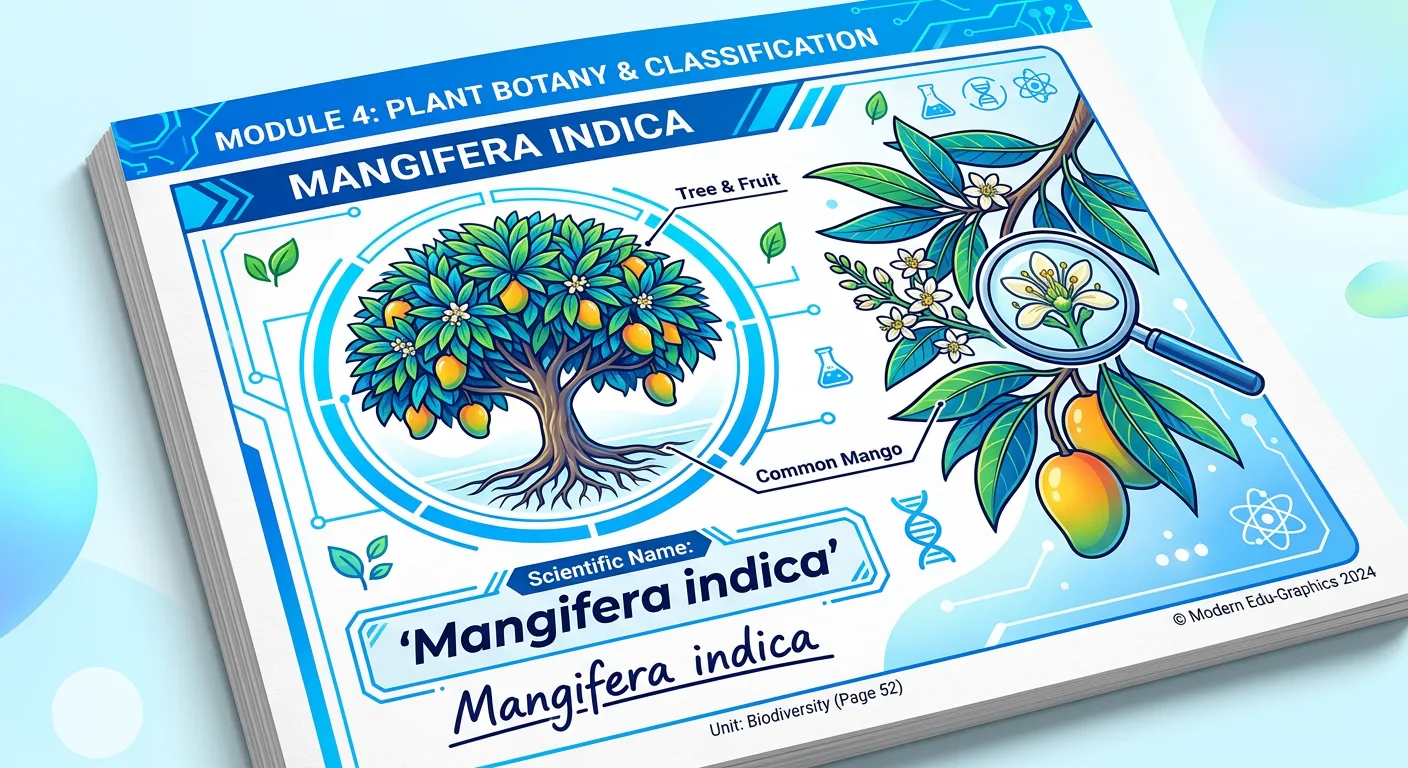
“How do we write these names? When printed, they must be in italics to show their Latin origin. But when you write them by hand in your notes? You must underline both words separately! This is a classic question that often appears in the NEET paper.”
Since scientific names are historically derived from Latin or are 'Latinized', they must be typographically distinguished from the surrounding text. Latin was chosen as the universal language of science because it is a 'dead language'. This means that its rules, vocabulary, and grammar are no longer evolving, providing a static and stable foundation for a naming system that must last centuries. To signal this Latin origin, there are strict formatting rules that vary depending on whether the name is printed or handwritten.
When a scientific name is printed in textbooks, journals, or digital exam papers, it must always appear in italics. For example, Panthera leo. This italicization serves as a visual flag, alerting the reader that they are looking at a formal biological designation rather than standard descriptive text. It is a mark of professional scientific communication. However, a common question arises: how do we follow this rule when writing by hand, such as in a biology practical record or during class notes? Since human handwriting cannot reliably replicate italics, the protocol changes: both the Generic name and the Specific epithet must be underlined separately.
Note the emphasis on 'separately'. Drawing a single, continuous line under both words (e.g., <u>Mangifera indica</u>) is technically incorrect. The correct way is to underline the genus, leave a gap, and then underline the species (e.g., <u>Mangifera</u> <u>indica</u>). This separate underlining mimics the function of italics and confirms that each part of the binomial is a distinct taxonomic unit. In NEET papers, images of handwritten names are often used to test this specific knowledge. Students are expected to identify the correct underlining style. Always look for that crucial gap between the two words; it is a small detail that carries significant weight in botanical and zoological codes.
Quick Revision Points
- Biological names are Latin or Latinized to ensure linguistic stability and global neutrality.
- Printed scientific names must always be in italics.
- Handwritten scientific names must be underlined to indicate their Latin origin.
- Underlining must be performed separately for the Genus and the Species.
- Using a continuous line is a standard error that violates nomenclature rules.
NEET Exam Angle
- Distinguishing between correctly and incorrectly underlined names is a staple MCQ.
- Watch out for 'continuous underlining'—this is the most frequent trap in formatting questions.
| Medium | Example Format | Why? |
|---|---|---|
| Printed (Digital/Books) | Panthera leo | Italics denote Latin origin |
| Handwritten (Notes) | <u>Panthera</u> <u>leo</u> | Underlining substitutes for italics |
| Incorrect Handwritten | <u>Panthera leo</u> | Continuous line is non-standard |
05Author Citation: Crediting the Descriptive Authority

“Want to give credit where it's due? We write the author's name at the end of the scientific name in an abbreviated form. For instance, Mangifera indica Linn. The 'Linn.' tells us it was Linnaeus who first described this species. Respect for the scientist, respect for the species!”
To make a scientific name complete and legally valid under international taxonomic codes, we often include what is known as the 'Author Citation'. This refers to the name of the scientist who first described the species and published its description according to the established rules of nomenclature. The author's name appears at the very end of the binomial name, immediately following the specific epithet. However, unlike the genus and species, the author's name is written in an abbreviated form and remains in standard Roman text—it is never italicized or underlined.
Consider the full, formal scientific name of the mango: Mangifera indica Linn. In this instance, 'Linn.' is the standard abbreviation for Linnaeus. This tells the global scientific community that Carolus Linnaeus was the authority who first provided the formal biological description for this specific species. This citation acts as a permanent historical link between the organism and the original scientific literature. For NEET aspirants, understanding the formatting of this citation is critical. The author's name follows the specific epithet directly, usually without a comma. While advanced systematics might include the date of publication (e.g., Mangifera indica Linn., 1753), for the purpose of the NEET exam, identifying the abbreviated name at the end is the priority.
Furthermore, the author citation is not part of the Latin name itself; it is a reference. This is why it is not subject to the rules of Latinization or italicization. If a name is reclassified into a different genus by a later scientist, the original author's name is sometimes placed in parentheses. However, the most common example you will encounter is the direct citation. In a multiple-choice question, if you are asked to select the 'most complete' or 'most scientifically accurate' version of a name, the option that includes the correctly formatted author citation (Mangifera indica Linn.) is the winner. This level of detail demonstrates a professional understanding of biological taxonomy.
Quick Revision Points
- Author citation appears after the specific epithet at the end of the name.
- It indicates the scientist who first validly published the species description.
- The author's name is usually abbreviated (e.g., 'Linn.' or 'L.' for Linnaeus).
- The abbreviation is written in Roman type (not italics) and is never underlined.
- Example: Mangifera indica Linn. represents the complete formal designation.
NEET Exam Angle
- Questions often ask for the 'most correct' name; check for the author citation as the deciding factor.
- Understand that 'Linn.' is a reference to the authority, not part of the binomial pair.
- Note that while the species is lowercase, the 'L' in Linn. is capitalized as it is a proper name.
| Name Version | Status | Reason |
|---|---|---|
| Mangifera indica | Correct | Standard binomial |
| Mangifera indica Linn. | Incorrect | Author name should not be in italics |
| Mangifera indica Linn. | Most Correct | Complete binomial with author citation |
| Mangifera indica, Linn | Incorrect | Unnecessary comma used in standard citation |
06Universal Application Across Kingdoms: Botany and Zoology
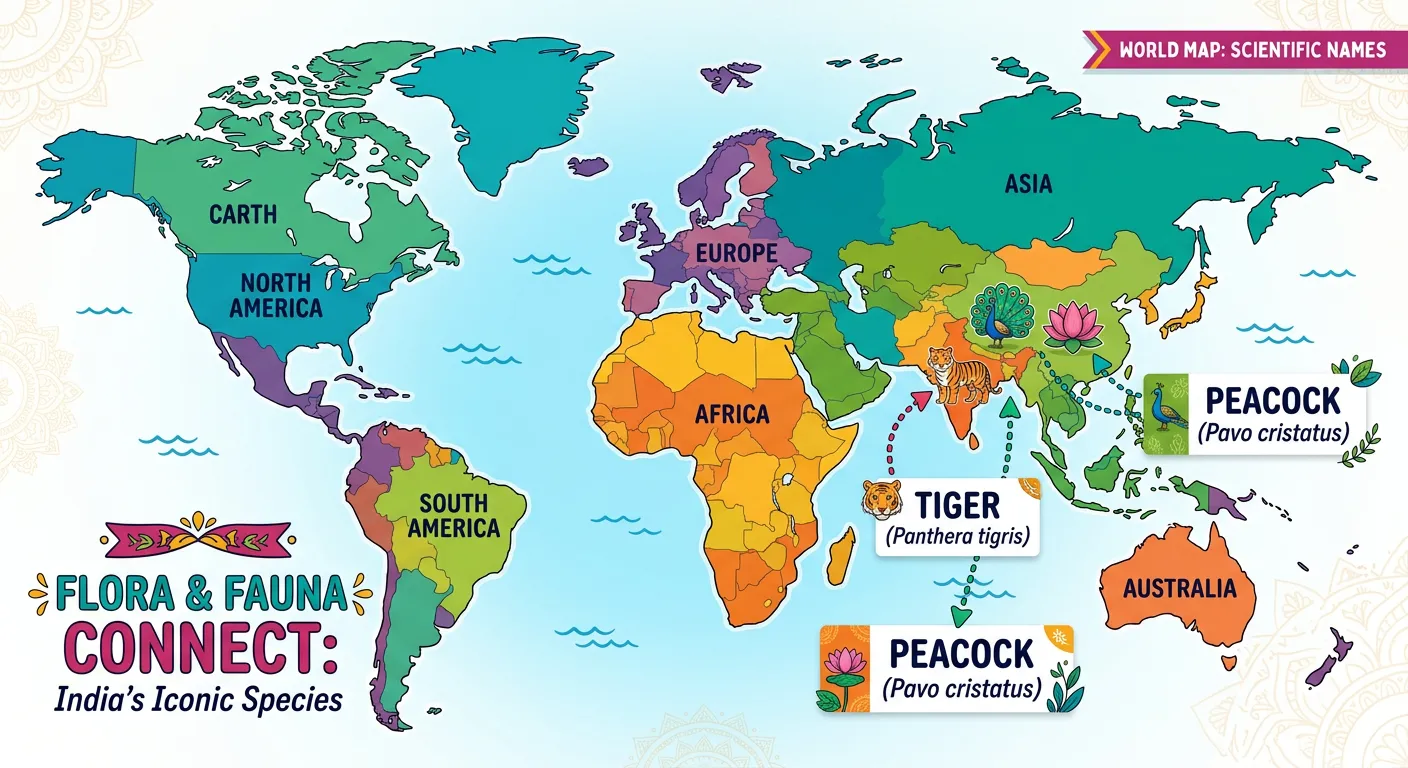
“These names aren't just for plants; they are for animals too! Whether it’s our national animal, Panthera tigris, or the national flower, Nelumbo nucifera, the rules remain the same everywhere. Latinized names ensure that a scientist in Delhi talks perfectly with a researcher in London.”
While Mangifera indica is the textbook classic, the rules of Binomial Nomenclature are applied universally across all domains of life, from microscopic bacteria to the blue whale. To maintain this global catalog, specific international organizations oversee the naming rules for different kingdoms. For the plant kingdom, we follow the ICBN (International Code of Botanical Nomenclature). For animals, the governing body is the ICZN (International Code of Zoological Nomenclature). These organizations ensure that every new species discovery follows Linnaean principles and that no two different organisms share the same name, preventing catastrophic taxonomic overlaps.
Whether you are studying India’s national animal (Panthera tigris) or the national flower (Nelumbo nucifera), the rules remain identical: two components, Latin origin, specific capitalization, and distinctive italics. However, there are subtle differences between the codes. One interesting nuance is the use of 'tautonyms'—names where the Generic name and the Specific epithet are identical. Tautonyms are permitted under the ICZN for animals (e.g., Naja naja for the Indian Cobra or Gorilla gorilla for the western gorilla). Conversely, the ICBN for plants strictly forbids them. You will never see a plant named Mangifera mangifera. This level of standardization allows a researcher in a laboratory in Delhi to collaborate seamlessly with a colleague in London or New York.
By speaking the same 'taxonomic language', the global scientific community can bridge geographical and linguistic gaps to focus on conservation and research. Other codes also exist, such as the ICNB for Bacteria and the ICTV for viruses, although viruses follow slightly different naming conventions. For your NEET preparation, focusing on the ICBN and ICZN is paramount, as their full forms and basic jurisdiction are frequent exam topics. Understanding these organizations helps you appreciate the legalistic and rigorous framework that supports the study of biodiversity.
Quick Revision Points
- ICBN: International Code of Botanical Nomenclature (Rules for naming plants).
- ICZN: International Code of Zoological Nomenclature (Rules for naming animals).
- These bodies prevent the duplication of names and ensure taxonomic stability.
- Tautonyms (same genus and species name) are allowed in Zoology (Rattus rattus) but forbidden in Botany.
- The rules apply consistently across bacteria, fungi, plants, and animals.
NEET Exam Angle
- Full forms of ICBN and ICZN are frequently asked in the 'Living World' chapter.
- Be aware of the tautonym rule difference; it is a common 'trick' question used to test depth of knowledge.
| Organization | Focus | Example |
|---|---|---|
| ICBN | Plants | Solanum melongena (Brinjal) |
| ICZN | Animals | Felis catus (Cat) |
| ICNB | Bacteria | Bacillus subtilis |
| ICTV | Viruses | SARS-CoV-2 (different rules apply) |
07Synthesizing Binomial Nomenclature for NEET Competitive Advantage

“And that’s Binomial Nomenclature! Two words, specific rules, universal acceptance. You’ve just mastered a key pillar of Taxonomy. Keep this logic clear in your head, and you'll crush those tricky NEET questions with ease. Stay curious, stay sharp, and keep learning, future doctors!”
As we conclude our study of Binomial Nomenclature, it is essential to view it as the 'grammar' of biology rather than just a list of names. This topic is high-yield for NEET because it rewards students who possess high attention to detail. A single misplaced capital letter or a missing underline in a practical record can result in a loss of marks. In the competitive landscape of medical entrance exams, these 'easy' chapters are where you build the foundation of your score, ensuring you have the time and confidence to tackle more complex physiological or genetic problems later.
To prepare effectively, practice by writing out the names of common organisms found in your NCERT textbook. For example, Triticum aestivum (wheat), Musca domestica (housefly), Oryza sativa (rice), and Homo sapiens. Pay close attention to how these names appear in Assertion-Reasoning questions. An assertion might state, 'Biological names are generally in Latin and written in italics,' with a reason stating, 'Latin is a dead language, ensuring the stability of names over time.' In this case, both are correct, and the reason correctly explains the assertion.
Also, keep the 'Principle of Priority' in mind—the first validly published name of a species is the one that is officially recognized. If a scientist discovers that an organism was named twice, the older name takes precedence. Stay sharp, focus on the formatting rules, and remember that these systematic names are the first step in the broader Taxonomic Hierarchy. You have now built a solid foundation in taxonomy—use this logical precision to conquer the more complex chapters of the living world. The consistency you learn here will serve you well throughout your medical career, where precise terminology is a matter of life and death.
Quick Revision Points
- Mastery of nomenclature rules is a high-yield, 'easy win' for NEET candidates.
- Always verify the 4 pillars: 1. Two words, 2. Capital Genus, 3. Small species, 4. Italics/Underline.
- Use NCERT-specific examples for practice (Musca domestica, Triticum aestivum).
- Binomial nomenclature is the first essential pillar of the field of Systematics.
- Logical precision is key to solving technical Assertion-Reasoning questions.
NEET Exam Angle
- Match-the-following questions often link common names to their NCERT binomials.
- Be prepared for questions on the 'Principle of Priority' regarding valid publications.
- Final Tip: If a question asks for the most accurate name and an option includes 'Linn.' correctly formatted, it is usually the preferred choice.
Recommended Reading
Explore related Biology topics to build deeper chapter connections for NEET.
- What is Living · Topic 1.1
- Kingdom Fungi · Topic 1.10
- Lichens · Topic 1.11
- Viruses and Viroids · Topic 1.12
- Algae · Topic 1.13
- Bryophytes · Topic 1.14
- Jump to Key Terms (Quick Revision)
- Review Common NEET Mistakes
- Solve NEET Practice MCQs
- Read Topic FAQs
- Practice NEET MCQs
- Solve NEET PYQs
📚 Key Terms
⚠️ Common NEET Mistakes
- 1Capitalizing the first letter of the specific epithet (e.g., writing Mangifera Indica instead of Mangifera indica).
- 2Underlining the entire scientific name with a single continuous line instead of two separate lines.
- 3Forgetting to italicize the name when it is typed or printed in a digital document.
- 4Assuming that 'Linn.' or other author citations should be italicized along with the scientific name.
- 5Using local names in a scientific context where universal standardized names are required.
📝 NEET PYQ & Practice Questions
Test your understanding of Binomial Nomenclature with NCERT-aligned sample questions.
Which of the following statements is correct regarding "Binomial Nomenclature" in the context of NEET Biology?
In NEET question papers, questions related to "Binomial Nomenclature" predominantly test:
Consider Specific Epithet associated with Binomial Nomenclature. What is the primary characteristic expected in NEET MCQs?
Master Binomial Nomenclature with NeetQ AI Tutor
Practice 50+ topic-wise MCQs, previous 15 years NEET questions, and get step-by-step doubt resolution instantly.
❓ Frequently Asked Questions
Why are biological names generally in Latin and written in italics?
Biological names are in Latin because it is a 'dead language' that does not change over time, providing a stable global standard. They are italicized in print to indicate their Latin origin and distinguish them from the rest of the text.
What is the difference between ICBN and ICZN in terms of naming rules?
ICBN (International Code of Botanical Nomenclature) governs plant naming and forbids tautonyms (e.g., the genus and species name cannot be the same). ICZN (International Code of Zoological Nomenclature) governs animal naming and allows tautonyms (e.g., Naja naja).
Can a specific epithet be capitalized if it is named after a person?
No. According to modern nomenclature rules, the specific epithet must always start with a small letter, regardless of whether it is derived from a person's name or a geographical location.
Is it mandatory to underline the genus and species separately in handwritten work?
Yes, when handwritten, the Generic name and the Specific epithet must be underlined separately. This is a specific rule to indicate their status as two distinct components of a Latinized name.
What does the abbreviation 'Linn.' signify at the end of a scientific name?
'Linn.' is an author citation indicating that Carolus Linnaeus was the scientist who first described the species and published its name.
What happens if two different species are accidentally given the same name?
The 'Principle of Priority' is applied, which states that the first validly published name is the one that is officially recognized. The later name is considered a 'junior synonym' and is discarded.
Written By
NEET Content Strategist & Biology Expert
Sangita Kumari is a NEET educator and content strategist with over 6 years of experience teaching Biology, Chemistry, and Physics to Class 11 and 12 aspirants. She helps bridge the gap between traditional NCERT preparation and modern AI-powered learning. Her content is trusted by thousands of NEET aspirants across India.