🎬 Video Lesson Available
Watch the full 7-slide video lesson for Biodiversity with AI teacher narration and visual explanations.
Biodiversity — Master Biodiversity for NEET: Understand genetic, species, and ecological diversity, latitudinal gradients, and why these concepts matter for your exam.
01Defining Biodiversity: The Essential Foundation of Ecosystem Stability
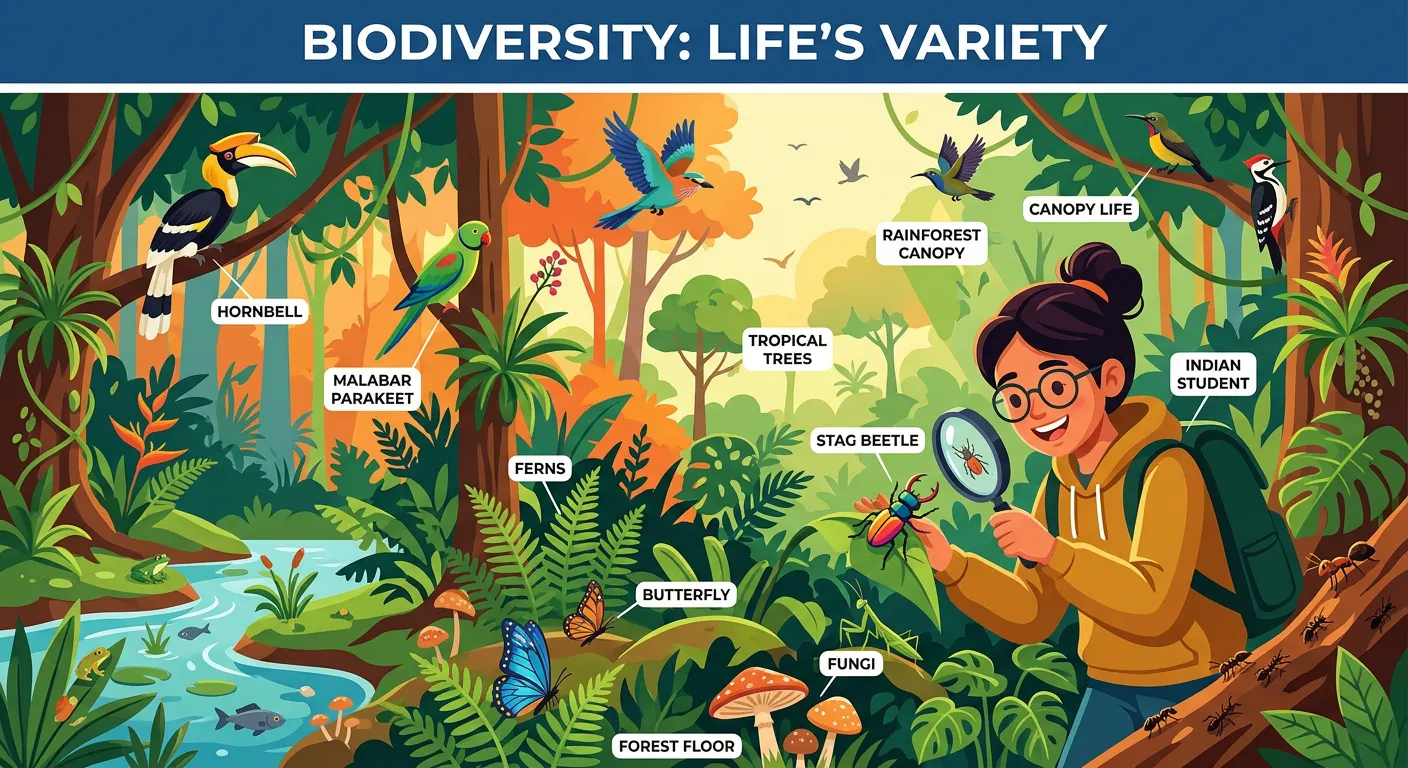
“Welcome, NEET warriors! Think of biodiversity as the ultimate buffet of life. From the tiny ants in your garden to the majestic tigers in our forests, it is the incredible variety of life forms on Earth. It is not just about numbers; it is about our planet's stability.”
Biodiversity, or biological diversity, represents the cumulative variety of all living organisms at every conceivable level—from the microscopic genetic material within a cell to the vast, interconnected biomes of our planet. It is not merely a census of how many different species inhabit a forest; it is the fundamental architecture that grants the biosphere its resilience. Think of the biosphere as a complex, self-regulating machine. When we discuss biodiversity, we are essentially analyzing the components that keep this machine running smoothly, ensuring that nutrient cycles, atmospheric regulation, and energy flows remain constant even in the face of environmental stress. The scope of biodiversity is vast, categorized into three levels: genetic, species, and ecological diversity, all of which contribute to the holistic health of the planet.
In the context of your NEET syllabus, biodiversity is the absolute foundation upon which your understanding of Class 12 ecology rests. An ecosystem with low diversity is inherently fragile; like a buffet with only one dish, it lacks the 'functional redundancy' required to survive a disturbance. A highly diverse ecosystem, conversely, acts like a multi-course banquet where if one resource becomes scarce, others remain to sustain the system. This stability is the bedrock of life on Earth. Without this diversity, ecosystems would collapse under the slightest environmental pressure. By studying this, you are not just learning facts; you are understanding the survival mechanisms of our world.
Quick Revision Points
- Biodiversity encompasses total life forms from genes to biomes.
- It acts as an insurance policy for the biosphere against environmental fluctuations.
- Stability is directly correlated with functional variety, not just raw counts.
- Biosphere homeostasis depends on the intricate interactions between species.
NEET Exam Angle
- Focus on the distinction between numerical species richness and functional stability.
- Understand that biodiversity is the prerequisite for the 'Organisms and Populations' unit in Class 12.
| Level of Organization | Significance | Focus Area |
|---|---|---|
| Genetic | Adaptive Potential | Allelic Variation |
| Species | Functional Redundancy | Community Stability |
| Ecological | Niche Diversity | Landscape Resilience |
02Genetic Diversity: The Allelic Blueprint for Evolutionary Adaptation
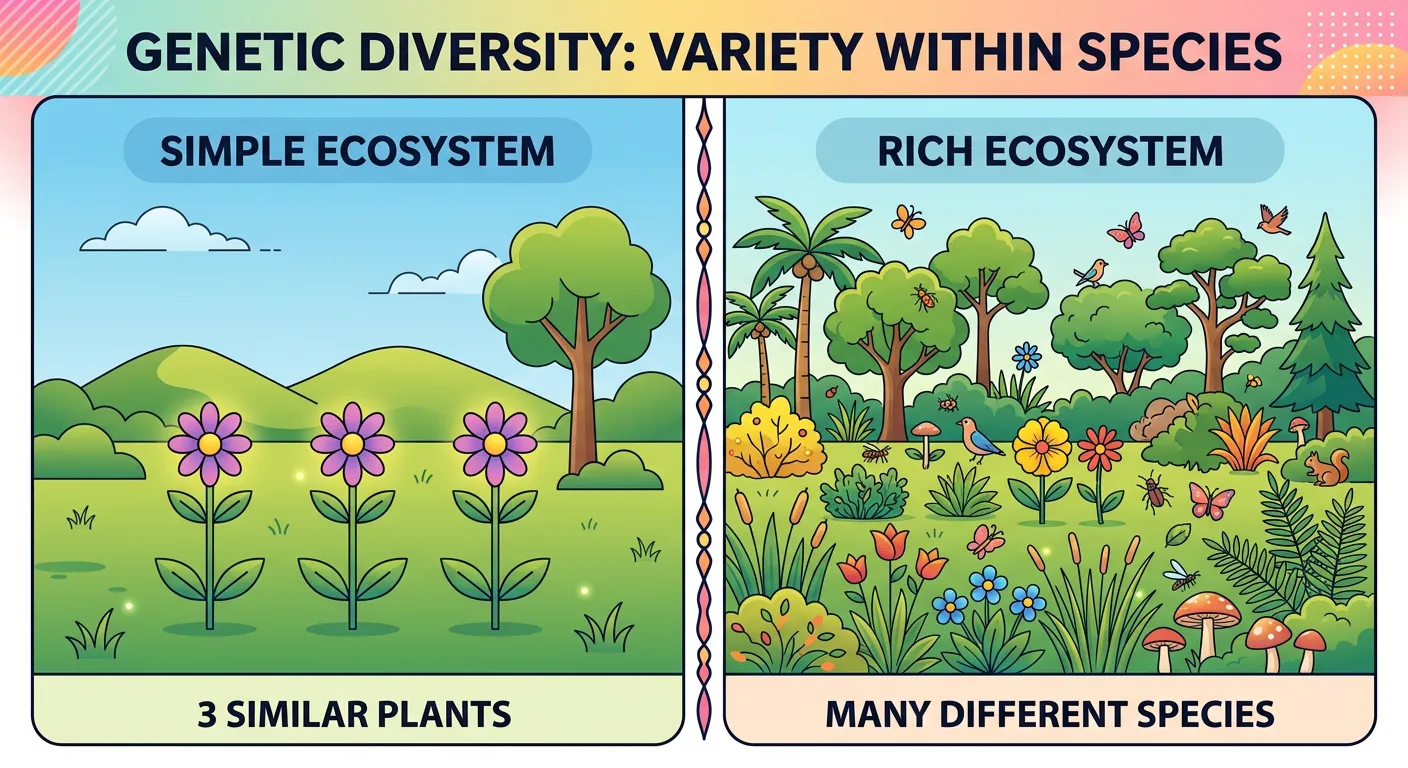
“First up, Genetic Diversity! Ever wonder why humans look different? That is because of different alleles! Take the mango; we have over a thousand varieties in India. This variation allows species to adapt to changing environments, which is essential for survival and evolution.”
Genetic diversity acts as the biological engine of evolution. At the most fundamental level, it refers to the variation in alleles—different versions of the same gene—within a single species. This variation is why no two individuals of a species are identical, except for genetically identical clones. From a survival standpoint, this diversity is what prevents entire populations from being wiped out by a single disease or environmental shift. If every organism in a population were genetically identical, a single pathogen or sudden climate change could potentially eliminate the entire group. Diversity provides the raw material for natural selection to act upon, ensuring that some individuals possess traits that allow them to survive and reproduce.
Consider the classic NCERT example of Rauwolfia vomitoria, a medicinal plant found in the Himalayan ranges. Its genetic diversity is expressed not just in morphology, but in the potency and concentration of the active chemical compound 'reserpine'. Another excellent example is the staggering array of over 1,000 genetically distinct mango varieties in India, and more than 50,000 genetically different strains of rice. This immense genetic reservoir ensures that we have crops adapted to various soil types, climates, and pest pressures. For a NEET aspirant, it is vital to remember that genetic diversity is not just about physical traits; it is about the potential for future adaptation in a changing world. A high degree of allelic variation is the primary indicator of a species' ability to persist through geological time scales, making it a critical topic for your competitive preparation.
Quick Revision Points
- Defined as the total genetic information contained in all individuals of a species.
- Mediated through allelic variation within a population.
- Rauwolfia vomitoria demonstrates variation in the chemical compound reserpine.
- High genetic diversity is a prerequisite for long-term evolutionary survival.
NEET Exam Angle
- Memorize the Rauwolfia vomitoria example as it is a favorite for assertion-reason questions.
- Differentiate between phenotypic plastic responses and genotypic variation.
| Species Name | Diversity Type | Significance |
|---|---|---|
| Rauwolfia vomitoria | Genetic | Reserpine concentration variance |
| Mangifera indica | Genetic | Over 1000 varieties in India |
| Oryza sativa | Genetic | Over 50,000 rice strains in India |
03Species Diversity and Ecosystem Resilience: The Western Ghats Example
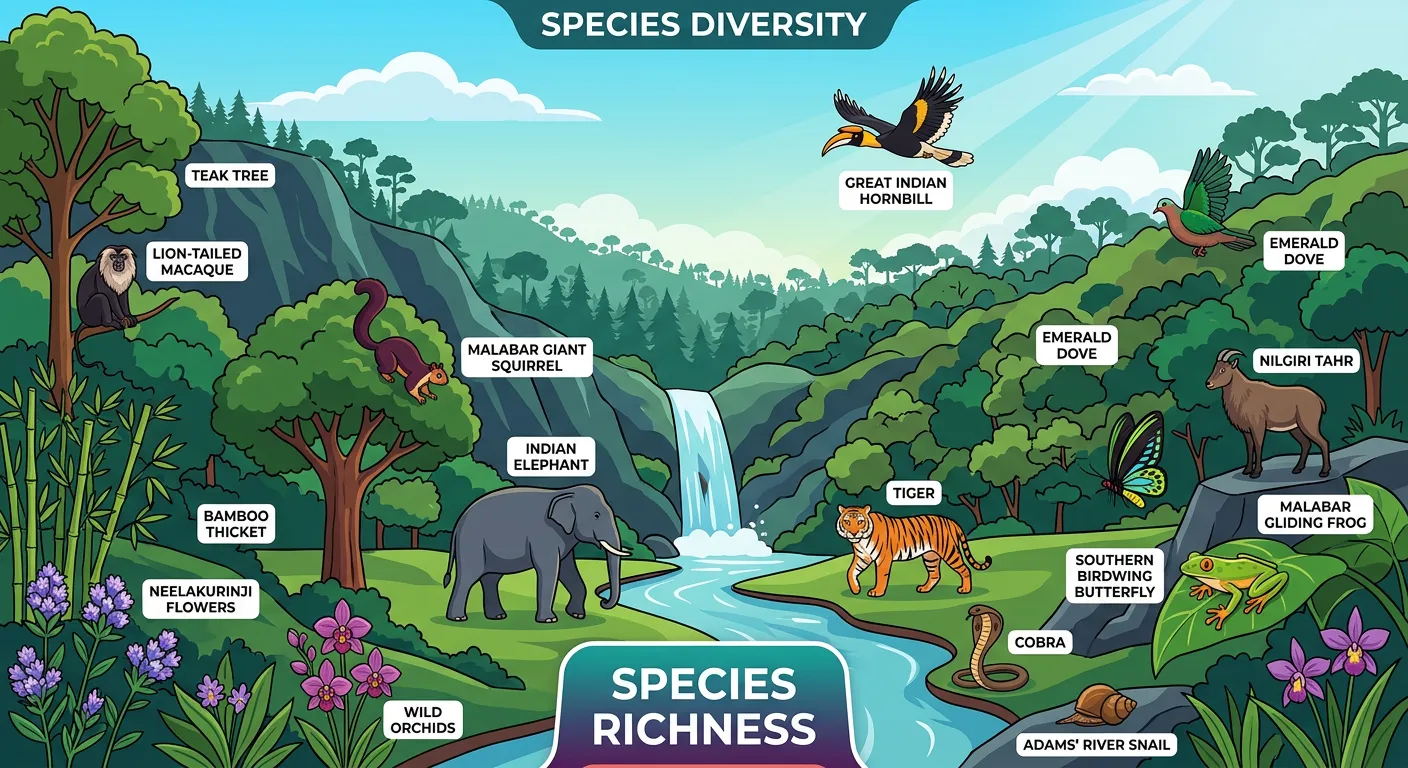
“Next is Species Diversity, which refers to the variety of species in a specific region. The Western Ghats have a much higher species diversity compared to a desert. More species mean a more resilient ecosystem. It’s like having a team with diverse skills to tackle any problem!”
Species diversity is the metric we use to quantify the variety of species within a specific geographic region. It is calculated based on two primary factors: species richness, which is the total count of different species present, and species evenness, which is the relative abundance of each species in the community. When you compare a high-biodiversity region like the Western Ghats to a resource-poor biome like a desert, you see a massive disparity in species richness. The Western Ghats, being a high-rainfall, tropical environment, supports a much wider array of niches, allowing for a higher density and complexity of life compared to the relatively sparse desert ecosystem.
In an ecosystem, species do not just exist side-by-side; they interact constantly. They compete for resources, act as predators or prey, and form intricate symbiotic relationships. This is where the 'Team Skills' analogy becomes particularly useful. Imagine an ecosystem as a professional sports team. If your team only has strikers, they cannot defend their goal. If they only have defenders, they cannot score points. You need a diversity of 'skills' (niches) to succeed as a unit. Similarly, species redundancy ensures that if one primary producer or a specific pollinator is lost, others can step in to fill the gap. This functional redundancy is the secret weapon behind a resilient, stable ecosystem. High species diversity acts as a safety net, ensuring that even if one element fails, the entire biological network remains functional. For NEET students, mastering this relationship between richness, evenness, and community stability is essential for answering complex ecological questions accurately.
Quick Revision Points
- Species diversity involves species richness and species evenness.
- The Western Ghats have significantly higher species diversity than deserts.
- High diversity fosters niche differentiation.
- Functional redundancy allows ecosystems to maintain stability after disturbance.
NEET Exam Angle
- Be prepared to compare and contrast biodiversity between tropical regions like the Western Ghats and arid zones.
- Understand the link between trophic stability and species interactions.
| Concept | Definition | Example |
|---|---|---|
| Species Richness | Total count of species | High in Tropics |
| Species Evenness | Relative abundance | Balanced in stable systems |
| Niche | Functional role of a species | Pollinator vs. Decomposer |
04Ecological Diversity: India as a Mega-diverse Landscape
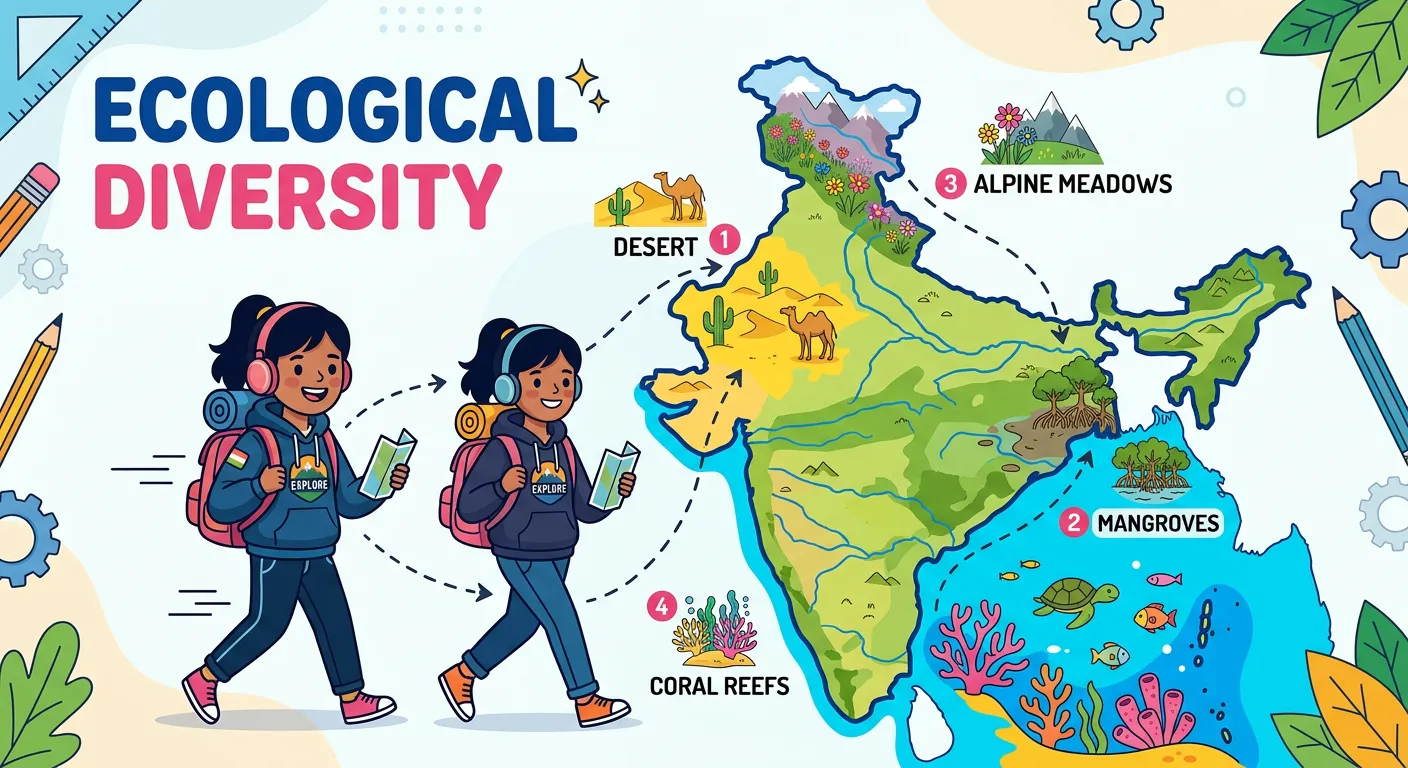
“Ecological diversity is the variety of habitats. India is a mega-diverse nation because we have deserts, rain forests, mangroves, coral reefs, and alpine meadows. Each of these landscapes supports a unique set of organisms. It is like having different rooms in one big, beautiful house.”
Ecological diversity, often referred to as ecosystem diversity, concerns the variation in the habitats, niches, and biological communities found in a given region. A country that possesses a vast range of ecosystems—from frozen alpine meadows to scorching deserts, humid rain forests, intricate mangroves, and vibrant coral reefs—is fundamentally more capable of supporting a high level of overall biodiversity. India is recognized globally as one of the 12 mega-diverse nations because of this intense topographical and climatic heterogeneity. It is this variety of landscapes that allows for the coexistence of countless species, each perfectly adapted to its specific environment.
Each of these habitats provides unique niches—the specific roles that organisms play within their environment. For instance, the specialized physiological adaptations required for an organism to survive in an alpine meadow are vastly different from those found in a salt-marsh mangrove ecosystem. This landscape-level variation creates significant 'evolutionary pressure' that drives speciation, as populations adapt to the specific conditions of their distinct 'room' in the house of nature. For students, understanding this is key to grasping why India's diverse geography is a treasure trove for biologists. By having such a wide variety of biomes, India preserves a broader spectrum of life forms, making it a critical focus for international conservation efforts. You should be able to categorize these ecosystems and recognize how climatic variability directly dictates the variety of life present within them. This geographical diversity is not just a feature of our country; it is a global asset in maintaining the biological equilibrium of the planet.
Quick Revision Points
- Ecological diversity relates to habitat and community variance.
- India is a 'mega-diverse' nation due to its vast climatic variations.
- Topographical heterogeneity is a primary driver of high biodiversity indices.
- Habitat diversity directly correlates to the number of available ecological niches.
NEET Exam Angle
- Memorize the list of Indian ecosystems (deserts, rain forests, mangroves, etc.) as they are common elements in 'which of the following' type questions.
- Connect the concept of 'niche' to the 'Ecological Diversity' level.
| Habitat | Key Characteristic | Biodiversity Potential |
|---|---|---|
| Tropical Rainforest | High rainfall, year-round heat | Very High |
| Alpine Meadow | Low temperature, extreme winds | Moderate |
| Coral Reef | High nutrient complexity | Extremely High |
| Mangroves | Intertidal, brackish water | High |
05Global Biodiversity Estimates: Why Insects Rule the Earth
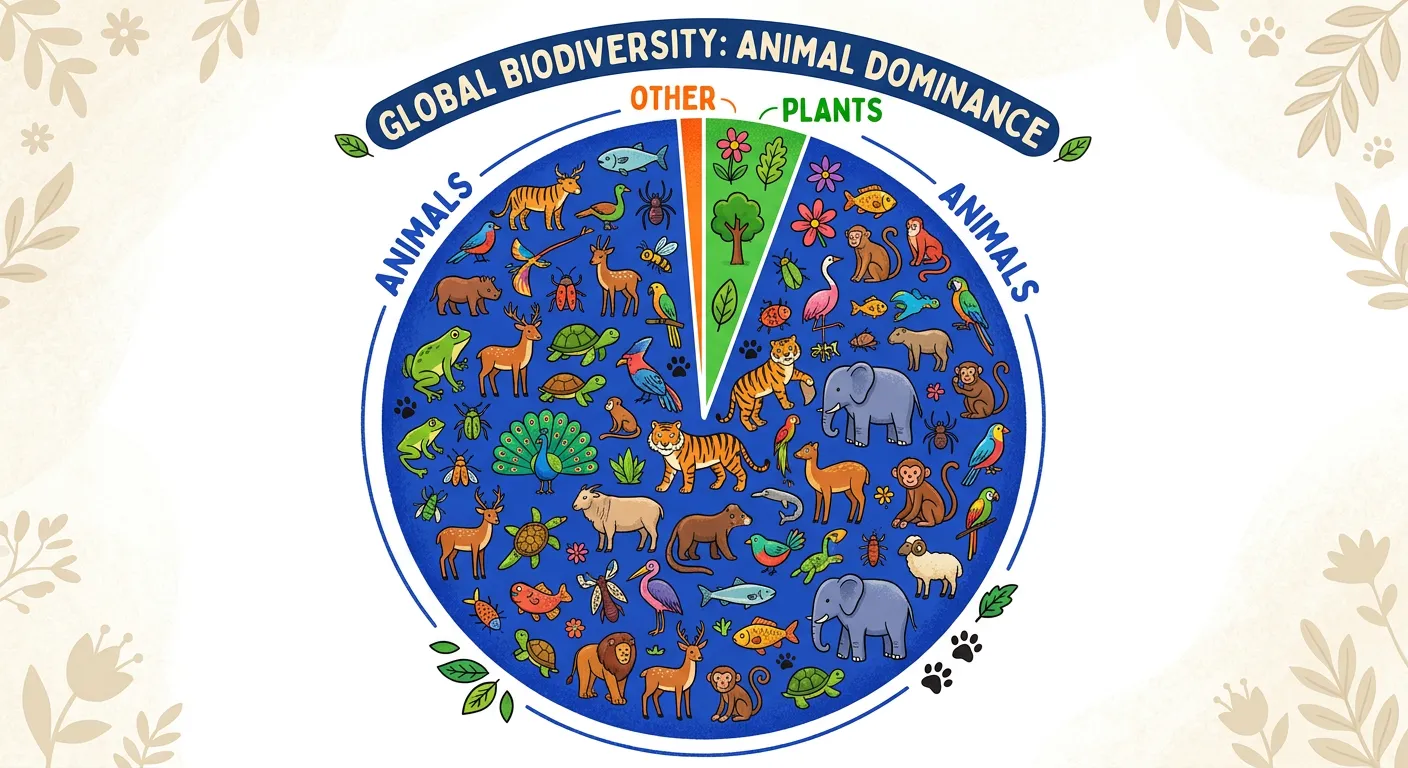
“Did you know there are more than 1.7 to 1.8 million species described so far? But many remain hidden! Animals are the clear winners here, outnumbering plants significantly. Insects are the most diverse group—if you look at every ten animals on this planet, seven are insects!”
Current scientific estimates suggest that approximately 1.7 to 1.8 million species have been formally described and classified on Earth. However, this is widely considered by the scientific community to be a massive underestimate of the true total. Thousands of species in deep-sea habitats, inaccessible canopy environments, and complex soil ecosystems remain undiscovered and uncatalogued. When we analyze the current taxonomic breakdown, one group stands out above all others: the animals. Within the animal kingdom, the insects dominate both in sheer numerical count and in the staggering variety of their forms, making them the most successful group on our planet.
There is a well-cited statistical rule you must remember for the exam: out of every ten animals recorded on Earth, seven are insects. This dominance is not accidental; it is the result of millions of years of highly successful evolution, adaptation to almost every available terrestrial niche, and high reproductive rates that allow for rapid colonization. While plants are incredibly diverse, animals—specifically the phylum Arthropoda—show a much higher level of taxonomic richness. As a NEET aspirant, you should recognize that when we talk about biodiversity, the statistical heavy lifting is being done by insects and various microorganisms, many of which are yet to be named. This 'cryptic diversity' represents a major frontier in modern biology. Understanding the numerical dominance of insects is crucial for contextualizing the distribution of life. It challenges the common perception that vertebrates represent the bulk of biological diversity, reminding us that the 'small things' running the world are the ones that truly define our planet's species counts.
Quick Revision Points
- Global described species count: 1.7 to 1.8 million.
- Animals are the most diverse group; within them, Insecta dominates.
- Statistical rule: 7 out of 10 animals are insects.
- Many species remain undiscovered, especially in deep-sea and microbial domains.
NEET Exam Angle
- Understand the hierarchy of taxonomic dominance (Insects > Plants).
- Remember that the 1.7-1.8 million figure is a 'described' statistic, not the total estimated biodiversity.
| Taxonomic Group | Diversity Status | Key Feature |
|---|---|---|
| Animalia | Highest (Global) | Dominated by Arthropoda |
| Insecta | Highest (within Animals) | 7/10 animals are insects |
| Plantae | Significant diversity | Lower richness than animals |
06Latitudinal Gradients: Decoding the Tropical Biodiversity Hotspots
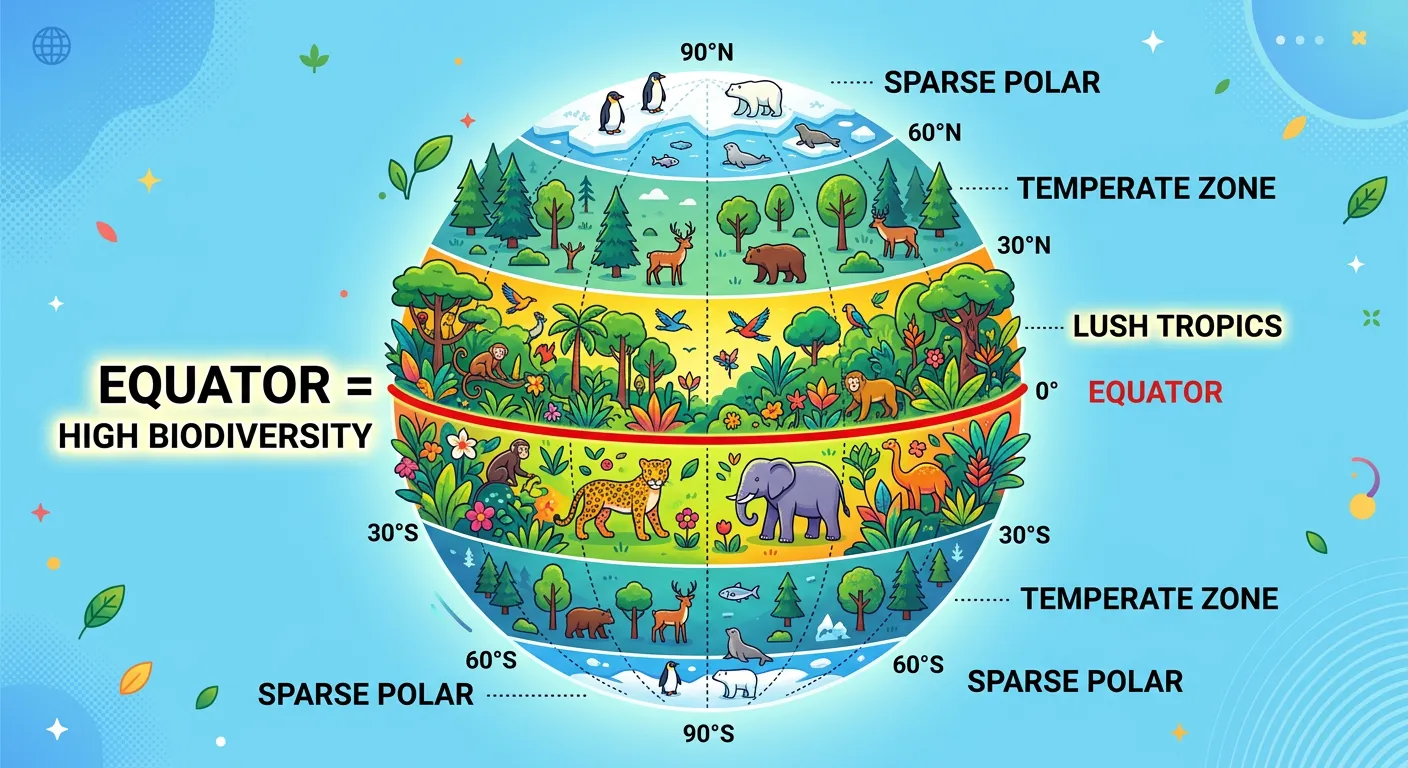
“Why is the Amazon so full of life while Antarctica is so empty? It is the Latitudinal Gradient! Biodiversity is highest at the tropics because of stable temperatures and more sunlight. Evolution loves the warm, predictable climate of the tropics, making it the world's most crowded biological hotspot.”
The distribution of species across the surface of the Earth is not uniform; it follows a very clear and observable pattern known as the latitudinal gradient. As you move from the polar regions toward the equator, species richness increases dramatically. The tropics—the region spanning the area between the Tropic of Cancer and the Tropic of Capricorn—are the undisputed biodiversity hotspots of our planet. This is not a coincidence; it is driven by stable climatic conditions, consistent solar energy availability, and significantly less seasonal variation compared to temperate or polar regions. This environment allows for stable, long-term ecological evolution that the harsher, more volatile regions simply cannot match.
In the Amazon rainforest, for example, the climate is relatively predictable year-round, allowing species to specialize and evolve highly complex interactions. In contrast, the polar regions have undergone harsh, unpredictable changes, including recent ice ages, which acted as an evolutionary 'bottleneck' for life. The tropics have remained relatively undisturbed for millions of years, acting as both a 'cradle' for the birth of new species (speciation) and a 'museum' where ancient, rare lineages can persist. This stability is the key factor that allows tropical ecosystems to support significantly higher energy flux and, consequently, a much higher level of biodiversity than their polar counterparts. For your exams, it is vital to understand that temperature, light intensity, and time (lack of glacial disruption) are the primary abiotic drivers of this gradient. The tropics provide the perfect conditions for life to flourish and diversify, making them the ultimate laboratories of evolution on Earth.
Quick Revision Points
- Biodiversity peaks at the equator (tropics) and declines toward the poles.
- Tropical stability allows for long-term evolutionary speciation.
- Solar energy availability is higher and more consistent in the tropics.
- Polar regions suffer from harsh, erratic climates that limit biodiversity.
NEET Exam Angle
- Focus on the 'Tropics as Cradles' concept: why the tropics are better for speciation.
- Understand that temperature and light are the primary abiotic drivers of this gradient.
| Region | Biodiversity | Primary Driver |
|---|---|---|
| Tropical | Highest | Stable climate/High solar energy |
| Temperate | Moderate | Seasonal fluctuation |
| Polar | Lowest | Harsh/Unpredictable climate |
07The Economic and Ecological Imperative of Biodiversity Conservation
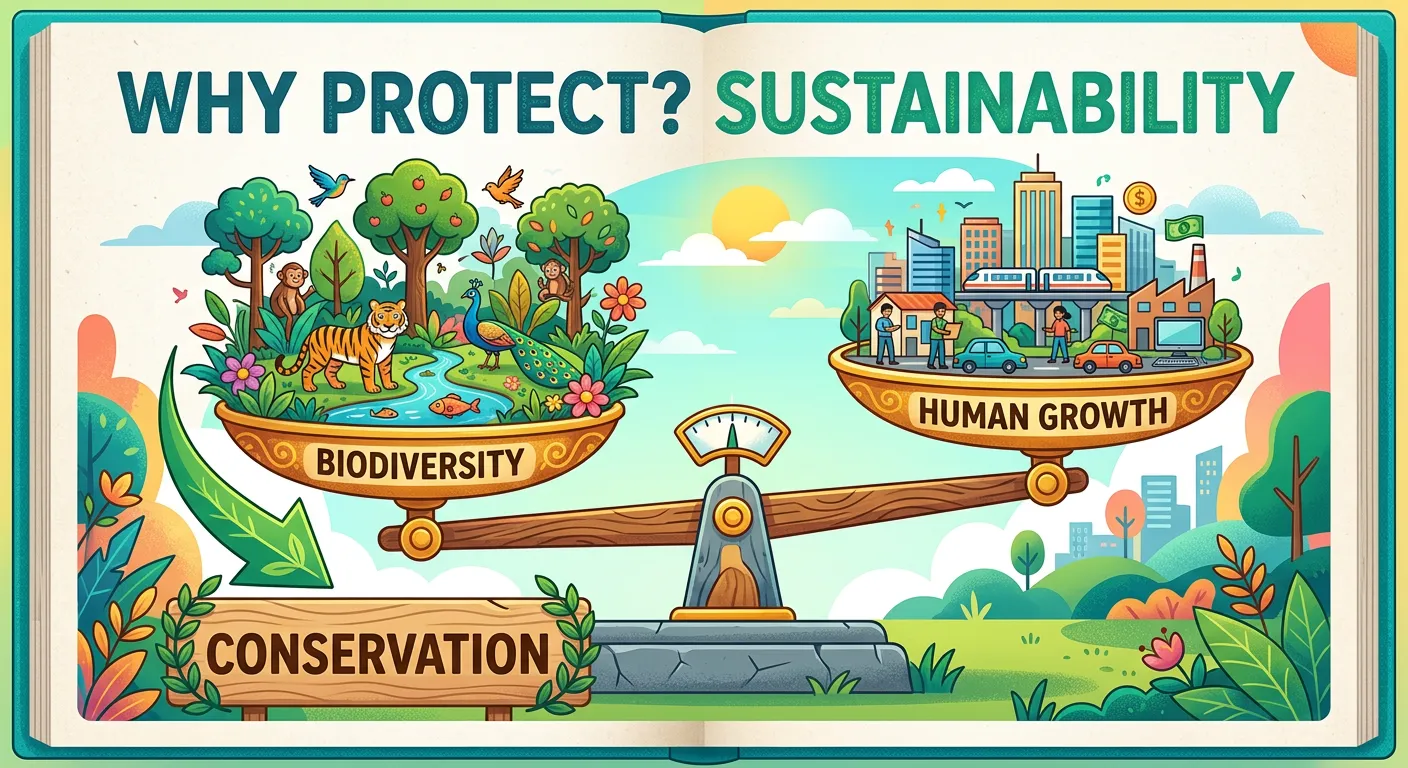
“Why should we care? Biodiversity provides our food, medicine, and oxygen. It is the invisible backbone of our economy and health. As NEET aspirants, remember that protecting nature isn't just for biology; it is for our survival. Let's keep the balance of life steady!”
Biodiversity is far more than just a biological curiosity for study; it is the absolute foundation of modern human civilization. We derive our entire food supply, the vast majority of our life-saving pharmaceutical medicines, and the essential necessities of life—clean water, breathable oxygen, and fertile soil—from complex ecosystem services. When we lose biodiversity, we are not just losing 'interesting' species; we are systematically dismantling the invisible backbone of our own global economy and personal health. The 'Invisible Backbone' theory suggests that even if we cannot perceive the immediate, direct value of a specific insect or plant, its removal can cause a catastrophic ripple effect that destabilizes the entire food chain, threatening food security and environmental stability.
As future medical professionals and dedicated scientists, your role in conservation is paramount. You are not just studying biology to pass an exam; you are learning the intricate mechanisms that sustain life so that you can become knowledgeable stewards of these finite resources. The economic argument for conservation—often called the 'utility value'—is just as strong as the ethical argument for preservation. Every time a species goes extinct, a unique genetic code, a potential cure for a future disease, or a vital ecosystem function is lost forever, with no possibility of recovery. Conservation is not a luxury or an optional hobby; it is a fundamental necessity for the long-term survival of the human species. Understanding these values is crucial for your career as you will be the ones balancing human development with the preservation of the natural world. Protecting the diversity of life on Earth is the most significant challenge of the modern era.
Quick Revision Points
- Ecosystem services include food, medicine, oxygen, and nutrient cycling.
- Biodiversity is the economic and ethical backbone of human societies.
- Loss of biodiversity equals the loss of future medical and nutritional potential.
- NEET aspirants are future stewards of biological resources.
NEET Exam Angle
- Understand the concept of 'Ecosystem Services' as it connects to Class 12 environmental biology.
- Be prepared to link individual species conservation to overall ecosystem stability.
| Value Type | Description | Example |
|---|---|---|
| Utilitarian | Direct product/benefit | Food, Medicines, Oxygen |
| Ecological | Indirect system support | Nutrient cycling, Pollination |
| Ethical | Moral right to exist | Stewardship of species |
Recommended Reading
Explore related Biology topics to build deeper chapter connections for NEET.
- What is Living · Topic 1.1
- Kingdom Fungi · Topic 1.10
- Lichens · Topic 1.11
- Viruses and Viroids · Topic 1.12
- Algae · Topic 1.13
- Bryophytes · Topic 1.14
- Jump to Key Terms (Quick Revision)
- Review Common NEET Mistakes
- Solve NEET Practice MCQs
- Read Topic FAQs
- Practice NEET MCQs
- Solve NEET PYQs
📚 Key Terms
⚠️ Common NEET Mistakes
- 1Confusing 'Species Richness' (count of species) with 'Species Evenness' (relative proportion of species).
- 2Assuming that only plant diversity is important; forgetting that insects dominate global taxonomic richness.
- 3Misinterpreting the latitudinal gradient by assuming higher species richness at the poles.
- 4Thinking that 'described species' (1.7-1.8 million) is the total number of species existing on Earth.
- 5Neglecting the role of abiotic factors like solar energy in driving tropical biodiversity.
📝 NEET PYQ & Practice Questions
Test your understanding of Biodiversity with NCERT-aligned sample questions.
Which of the following statements is correct regarding "Genetic Diversity" in the context of NEET Biology?
In NEET question papers, questions related to "Biodiversity" predominantly test:
Consider Ecological Diversity associated with Biodiversity. What is the primary characteristic expected in NEET MCQs?
Master Biodiversity with NeetQ AI Tutor
Practice 50+ topic-wise MCQs, previous 15 years NEET questions, and get step-by-step doubt resolution instantly.
❓ Frequently Asked Questions
What is the difference between Genetic and Species diversity?
Genetic diversity refers to the variation in alleles within a single species, which helps it adapt. Species diversity refers to the variety of different species (richness and evenness) present within a specific region or ecosystem.
Why is the biodiversity highest in the tropical regions?
Tropical regions provide a stable climate, abundant solar energy, and long periods of environmental predictability, which favor high rates of speciation and allow for a larger number of specialized ecological niches compared to the poles.
How does the diversity of insects compare to other animal groups?
Insects are the most diverse group within the animal kingdom. Statistically, for every ten animals described on Earth, approximately seven are insects, highlighting their immense taxonomic success and adaptation.
What is meant by the term 'Mega-diverse' nation in the Indian context?
A mega-diverse nation, like India, possesses a vast variety of ecosystems, including forests, deserts, mangroves, and coral reefs, which support a disproportionately high level of global biodiversity.
How does biodiversity influence the stability of an ecosystem?
Biodiversity enhances ecosystem resilience through functional redundancy. A diverse ecosystem can better withstand environmental disturbances because multiple species perform similar roles, ensuring that the system's core functions persist.
Why are there more described animal species than plant species in the world?
Animals, particularly arthropods and insects, have evolved highly specialized behaviors, complex life cycles, and diverse adaptations that allow them to occupy more ecological niches than plants, leading to higher taxonomic richness.
Written By
NEET Content Strategist & Biology Expert
Sangita Kumari is a NEET educator and content strategist with over 6 years of experience teaching Biology, Chemistry, and Physics to Class 11 and 12 aspirants. She helps bridge the gap between traditional NCERT preparation and modern AI-powered learning. Her content is trusted by thousands of NEET aspirants across India.