🎬 Video Lesson Available
Watch the full 7-slide video lesson for Kingdom Fungi with AI teacher narration and visual explanations.
Kingdom Fungi — Master the 4 major groups of Kingdom Fungi: Phycomycetes, Ascomycetes, Basidiomycetes, and Deuteromycetes for NEET. Learn mycelium types, spores, and examples.
01General Characteristics of Kingdom Fungi: The Ultimate Recyclers
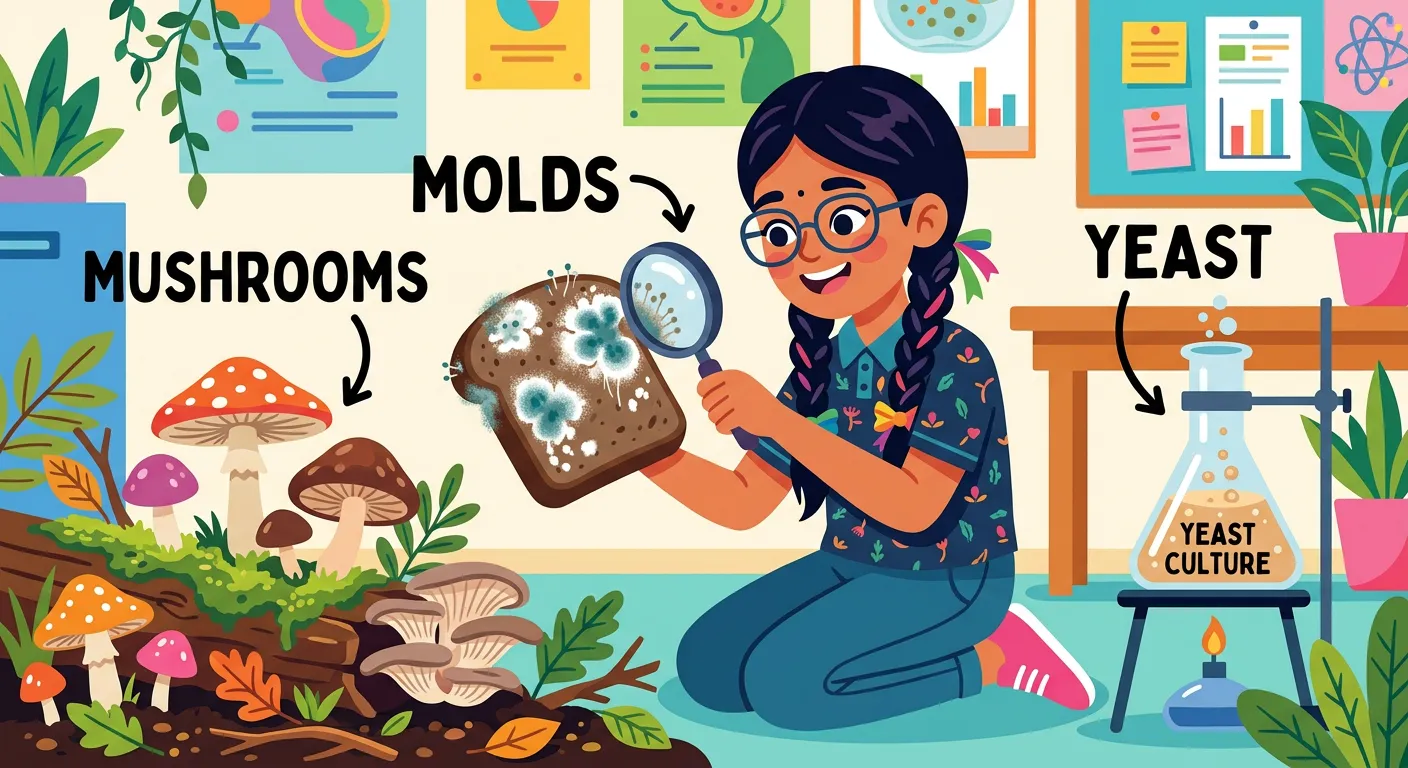
“Welcome, future doctors! Think of Kingdom Fungi as nature's ultimate recyclers. From the yeast in your mother's fluffy idli batter to the mushrooms in your curry, fungi are everywhere! They are heterotrophic, meaning they don't make their own food. Today, we classify them into four major groups.”
Kingdom Fungi constitutes a unique kingdom of heterotrophic organisms that exhibit an extraordinary diversity in morphology and habitat. Unlike plants, they do not possess chlorophyll and cannot perform photosynthesis. Instead, they obtain their nutrition through absorption. Most fungi are saprophytes, meaning they absorb soluble organic matter from dead substrates. Others are parasites, relying on living plants and animals for survival. This ecological role as decomposers is critical for nutrient cycling in ecosystems, particularly in the breakdown of complex organic substances like cellulose and lignin, which few other organisms can digest.
Beyond their nutritional roles, fungi also live as symbionts. You will find them in association with algae as lichens and with the roots of higher plants as mycorrhiza. Structurally, except for unicellular yeasts, fungi are filamentous. Their body consists of long, slender, thread-like structures called hyphae, and the network of these hyphae is termed mycelium. A key diagnostic feature for NEET is the composition of the fungal cell wall, which is made of chitin—a tough, nitrogen-containing polysaccharide—and other polysaccharides. This chemical signature distinguishes them from the cellulose-rich walls of plants.
| Type of Nutrition | Mechanism of Action | Typical Examples |
|---|---|---|
| Saprophytic | Secretion of enzymes to decompose dead organic matter. | Mucor, Yeast |
| Parasitic | Obtaining nutrients directly from a living host. | Albugo, Puccinia |
| Symbiotic | Mutually beneficial relationship with another species. | Lichens, Mycorrhiza |
Quick Revision Points
- Fungi are cosmopolitan, occurring in air, water, soil, and on animals and plants.
- They prefer to grow in warm and humid places, explaining why food spoils faster in summer/monsoon.
- Reproduction occurs via vegetative means (fragmentation, fission, budding), asexual spores, or sexual spores.
- The sexual cycle involves three steps: Plasmogamy (fusion of protoplasm), Karyogamy (fusion of nuclei), and Meiosis in the zygote resulting in haploid spores.
- The cell wall contains chitin, also known as fungal cellulose.
NEET Exam Angle
- Focus on the chemical composition of the cell wall (chitin/N-acetylglucosamine) as it is a frequent MCQ topic.
- Understand the difference between coenocytic hyphae (continuous tubes with multi-nucleated cytoplasm) and septate hyphae (with cross-walls).
- Note the sequence of the sexual cycle: Plasmogamy → Karyogamy → Meiosis.
02Phycomycetes: Understanding Algal Fungi and Coenocytic Mycelium
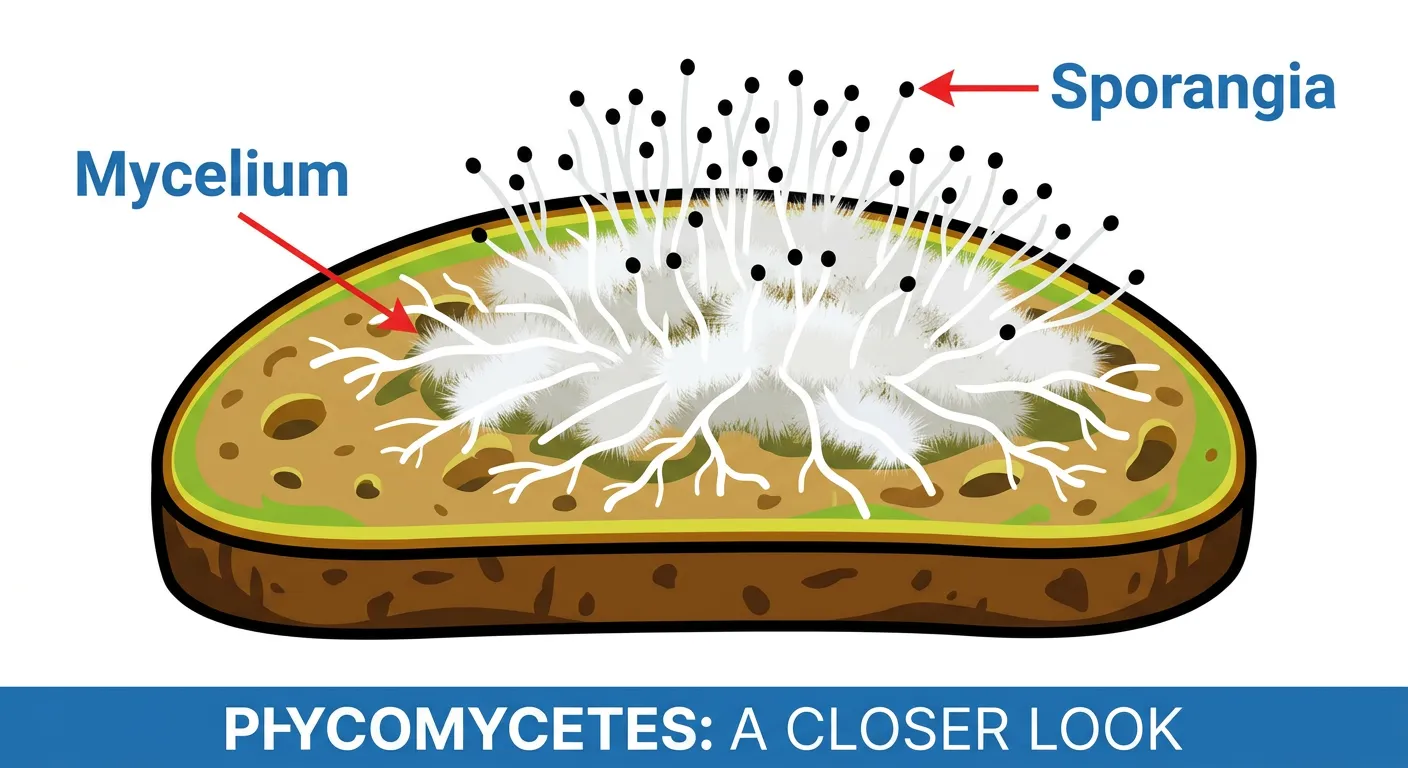
“First, the Phycomycetes, or 'Algal Fungi'. Picture them as fuzzy cotton candy growing on rotting bread or damp wood. Their body, the mycelium, is coenocytic—meaning it’s one big cell with many nuclei floating inside. They reproduce via motile zoospores or non-motile aplanospores. Think of Mucor or Rhizopus!”
Members of Phycomycetes are primarily found in aquatic habitats and on decaying wood in moist and damp places. They are also frequently found as obligate parasites on plants. These are often called 'lower fungi' or 'algal fungi' because of their structural similarities to certain algae, such as the aquatic nature of many members. The most distinguishing feature of this group is the mycelium, which is aseptate and coenocytic. This means the hyphae are not divided by cross-walls (septa), resulting in a continuous tube-like structure filled with multinucleated cytoplasm—a concept you will also encounter when studying the syncytium in animal tissues. Because they lack septa, nutrients and organelles can move rapidly throughout the mycelium, allowing for very fast growth under ideal conditions like those found on a damp slice of bread.
Asexual reproduction in Phycomycetes takes place by motile zoospores or by non-motile aplanospores. These spores are produced endogenously within a structure called the sporangium. This internal production is a primitive characteristic compared to the external spores seen in higher fungi. Sexual reproduction occurs through the fusion of two gametes, leading to the formation of a zygospore. These gametes can be identical in morphology (isogamous) or different (anisogamous or oogamous). If you observe Rhizopus (the common bread mould) under a microscope, you will see the black, pin-head-like sporangia that release thousands of spores into the air, facilitating its rapid spread in kitchens and bakeries. Understanding these reproductive nuances is vital for distinguishing Phycomycetes from more advanced fungal classes in your NEET preparation.
| Spore Type | Mobility | Production Site |
|---|---|---|
| Zoospores | Motile (Flagellated) | Endogenous (Sporangium) |
| Aplanospores | Non-motile | Endogenous (Sporangium) |
| Zygospores | Diploid Resting Spore | Result of Syngamy |
Quick Revision Points
- Habitat: Aquatic, moist wood, or obligate parasites on plants.
- Mycelium: Aseptate and coenocytic (no cross-walls).
- Asexual spores: Zoospores (motile) and aplanospores (non-motile).
- Sexual reproduction: Formation of zygospores through gametic fusion.
- Key examples: Mucor (mould), Rhizopus (the bread mould), and Albugo (the parasitic fungus on mustard).
NEET Exam Angle
- Identification of Rhizopus as 'Bread Mould' is a common match-the-following question.
- Be prepared for questions regarding the 'endogenous' nature of spores in this class; this is a high-yield distinction from other groups.
- Remember Albugo specifically as the parasite that causes white rust on mustard leaves, often appearing as white pustules.
03Ascomycetes: The Biology of Sac Fungi and Economic Importance
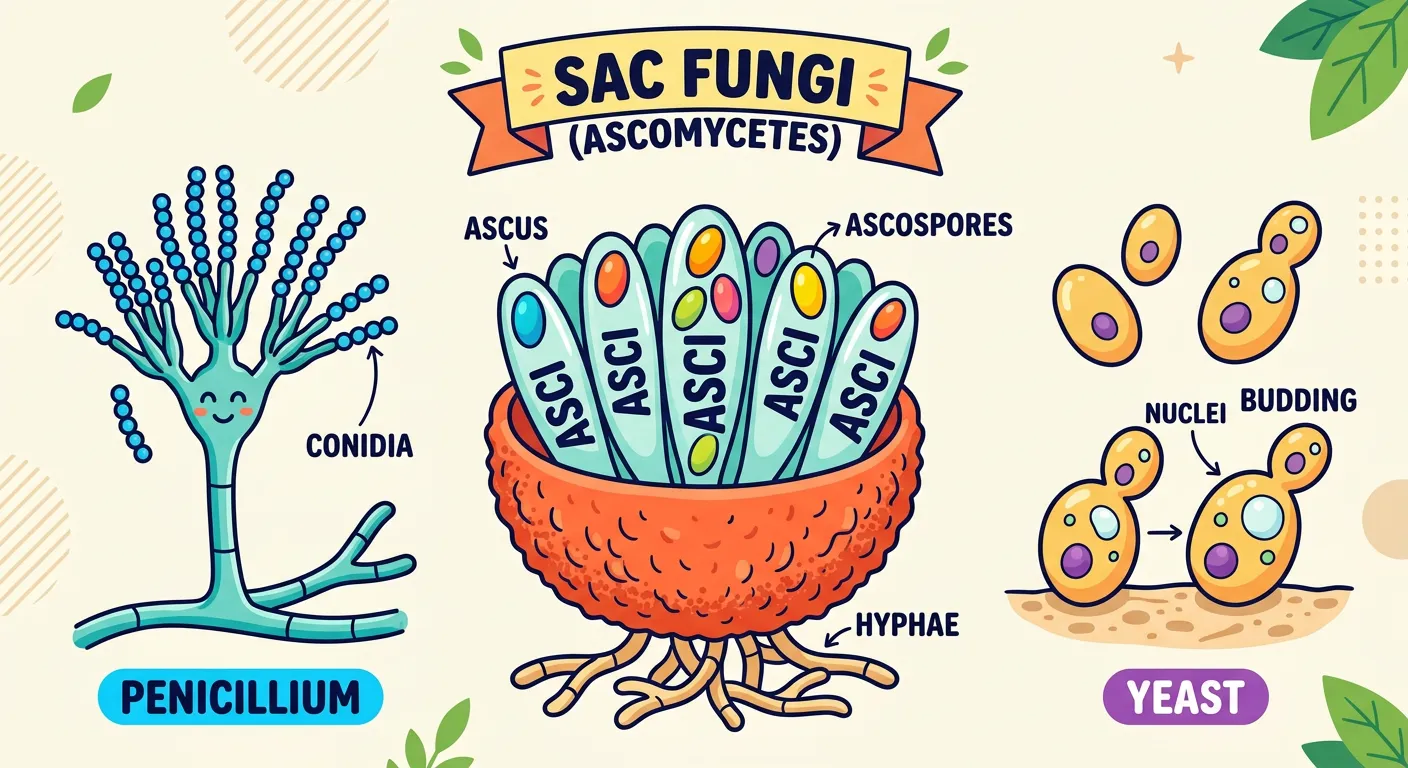
“Next, the Ascomycetes, the 'Sac Fungi'. They can be unicellular, like yeast, or multicellular, like Penicillium. Their defining feature? They form spores inside a sac-like structure called an 'ascus'. They are economically vital—some give us antibiotics, while others, like Morels, are considered delicious delicacies.”
Commonly known as 'sac fungi,' the Ascomycetes represent a massive and diverse group of over 64,000 species. They are mostly multicellular, like the antibiotic-producing Penicillium, but some are uniquely unicellular, such as Yeast (Saccharomyces), which is essential for the brewing and baking industries. These fungi are saprophytic, decomposers, parasitic, or coprophilous (growing on dung). Their mycelium is branched and septate, which is a significant evolutionary step up from the coenocytic structure seen in Phycomycetes. The septa in Ascomycetes often have a simple pore that allows for regulated cytoplasmic and organellar movement, providing better structural integrity.
Asexual reproduction occurs through conidia, which are produced exogenously on special hyphae called conidiophores. These conidia are usually dispersed by wind and, upon germination, produce new mycelium. Sexual spores, called ascospores, are produced endogenously in sac-like structures known as asci (singular: ascus). These asci are arranged in different types of complex fruiting bodies called ascocarps, which can be cup-shaped, flask-shaped, or completely closed. Many members of this group are of great economic and scientific value. For instance, Neurospora crassa is used extensively in biochemical and genetic work, earning it the title 'the Drosophila of the plant kingdom.' Furthermore, this group includes the famous Morels and Truffles, which are edible and considered highly expensive delicacies globally. This dual nature—ranging from microscopic yeasts to gourmet truffles—makes Ascomycetes a fascinating subject for study.
| Spore Type | Origin | Structure |
|---|---|---|
| Conidia | Exogenous | Chains on conidiophores |
| Ascospores | Endogenous | Inside sac-like ascus |
Quick Revision Points
- Mycelium is branched and septate (has cross-walls).
- Asexual spores (Conidia) are produced exogenously on conidiophores.
- Sexual spores (Ascospores) are produced endogenously in asci.
- Ascocarps are the fruiting bodies where asci are grouped.
- Important examples: Aspergillus, Claviceps, Neurospora, Yeast, Penicillium, Morels, and Truffles.
NEET Exam Angle
- Neurospora's role in genetics is a favorite question; remember it is used for 'One Gene One Enzyme' hypothesis studies.
- Distinction: Ascospores are endogenous while Conidia are exogenous. This is a common trap in MCQ options.
- Morels and Truffles are highlighted as edible delicacies—don't confuse them with poisonous mushrooms from other classes.
04Basidiomycetes: The World of Club Fungi and Mushrooms
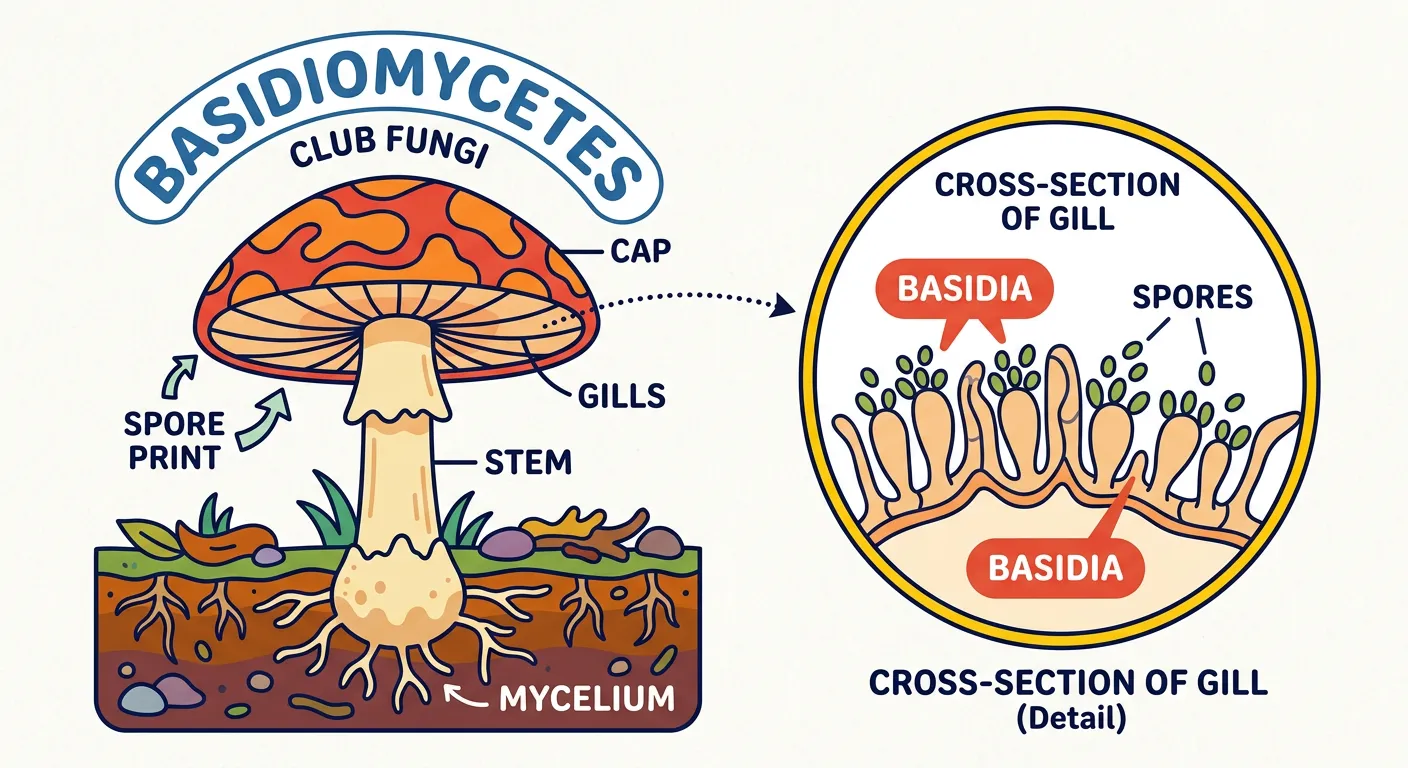
“Meet the Basidiomycetes, or 'Club Fungi'—the mushrooms you see popping up after the monsoon rains! They grow in soil, on logs, or as parasites like rust and smut. They produce spores on a club-shaped structure called a 'basidium'. Remember, these are the showstoppers of the fungal world!”
Basidiomycetes include the most familiar fungi encountered in nature: mushrooms, bracket fungi, and puffballs. They grow in soil, on logs, tree stumps, and in living plant bodies as parasites, famously causing devastating diseases like rusts and smuts. The mycelium in this group is branched and septate, often forming a complex network underground that can survive for many years. A fascinating characteristic of Basidiomycetes is that asexual spores are generally not found, and vegetative reproduction by fragmentation is the common mode of multiplication. This differs significantly from the spore-heavy asexual cycles of Ascomycetes.
Furthermore, specialized sex organs are completely absent in this group. Instead, plasmogamy is brought about by the fusion of two somatic cells or vegetative hyphae of different strains or genotypes. The resulting structure is dikaryotic (n+n), which eventually gives rise to the basidium. This dikaryotic phase is often very long-lived, representing the dominant stage of the life cycle in many species. Within the basidium, karyogamy and meiosis occur to produce four haploid basidiospores. Crucially, basidiospores are produced exogenously on the basidium, typically on tiny stalks called sterigmata. The basidia are arranged in large, often visible fruiting bodies called basidiocarps, which we commonly identify as 'mushrooms.' This class is responsible for some of the most devastating agricultural pathogens, such as wheat rust caused by Puccinia graminis and smut caused by Ustilago. Understanding their unique 'n+n' phase is essential for grasping fungal evolution.
| Fungal Disease | Pathogen | Type |
|---|---|---|
| Mushroom | Agaricus | Edible/Non-edible saprophyte |
| Smut | Ustilago | Parasitic (Affects grains) |
| Rust | Puccinia | Parasitic (Wheat rust) |
Quick Revision Points
- Includes mushrooms, puffballs, and bracket fungi.
- No asexual spores; vegetative reproduction by fragmentation is key.
- Sex organs are absent; plasmogamy occurs via somatic cell fusion.
- Dikaryotic phase (n+n) is prominent and often very long-lived.
- Basidiospores are produced exogenously (on the outside) of the basidium.
NEET Exam Angle
- Pay close attention to the dikaryotic phase (n+n) and its occurrence in Ascomycetes and Basidiomycetes.
- Remember the exogenous nature of basidiospores; this contrasts with the endogenous ascospores of Ascomycetes.
- Common NEET examples: Agaricus (Mushroom), Ustilago (Smut), and Puccinia (Rust fungus).
05Deuteromycetes: The Mystery of Fungi Imperfecti and Mineral Cycling
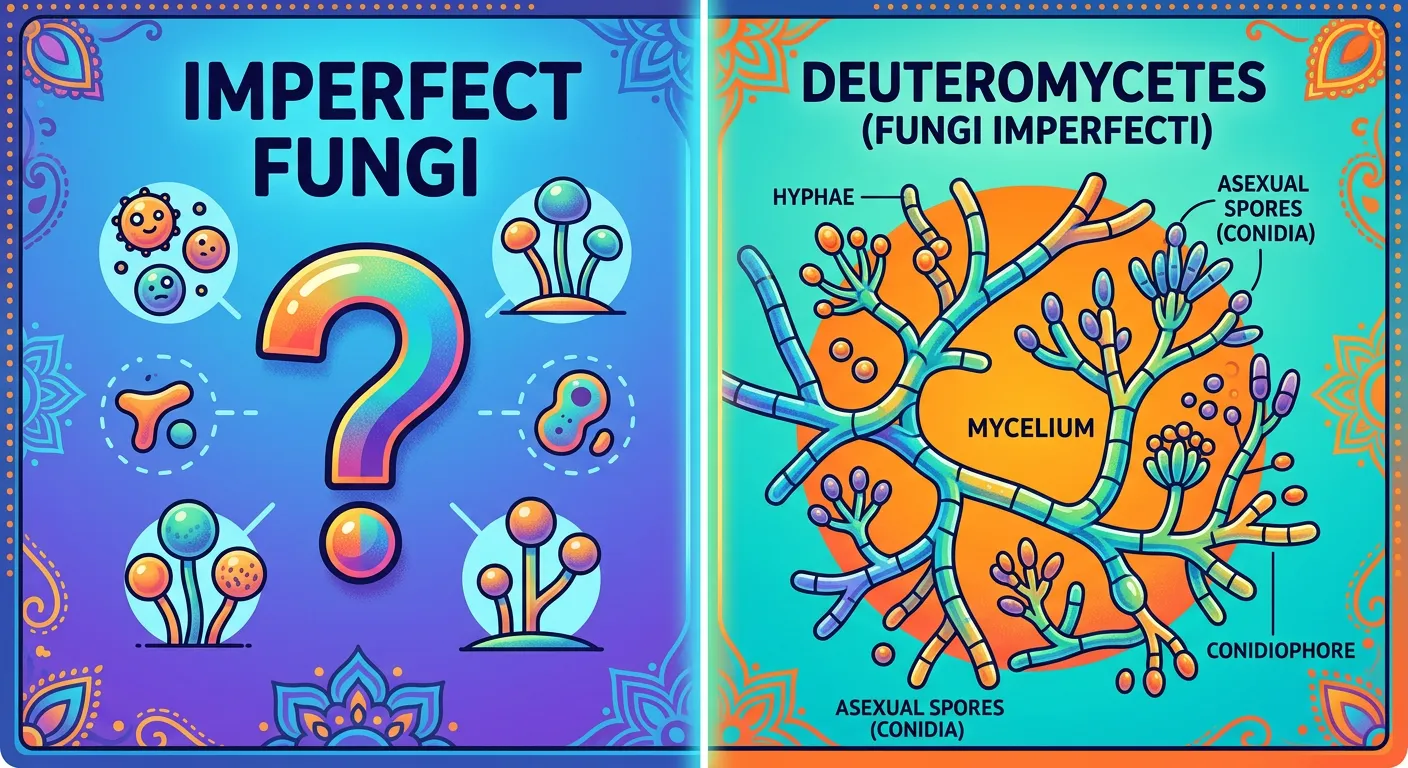
“Finally, the Deuteromycetes, the 'Fungi Imperfecti'. Why imperfect? Because we only know their asexual phases! If we ever discover their sexual reproduction stage, they get promoted to other classes. They are the mysterious ones, mostly decomposers that help cycle minerals in our Indian forest ecosystems.”
Deuteromycetes are known as the 'imperfect fungi' because we have only discovered their asexual or vegetative phases. The 'perfection' in fungal taxonomy refers to the sexual stage; thus, lacking a known sexual cycle makes them 'imperfect.' Once the sexual stages of these fungi are identified, they are typically moved into either Ascomycetes or Basidiomycetes, where they belong based on their sexual characteristics. It is very common for the asexual stage to have a name in Deuteromycetes while the sexual stage (once discovered) has another name in a different class, leading to some historical confusion in naming. This taxonomic fluidity is a unique feature of the group, acting as a temporary 'waiting room' for mycologists.
They reproduce only by asexual spores known as conidia, similar to those found in Ascomycetes. The mycelium of Deuteromycetes is septate and branched. Ecologically, they play a massive role as decomposers of litter and are vital for mineral cycling in forest and grassland ecosystems. Without them, the recycling of carbon, nitrogen, and phosphorus would be significantly hindered. Many members are saprophytes or parasites, but it is their ability to break down complex organic matter and release minerals back into the soil that makes them indispensable to the biosphere. For a NEET student, this group represents the 'mystery box' of fungal classification. Notable examples include Alternaria, which causes early blight of potato, and Trichoderma, which is widely used in biological control and for the production of the immunosuppressant drug Cyclosporin A. This illustrates that even 'imperfect' fungi have profound perfect impacts on human medicine and agriculture.
Quick Revision Points
- Known as 'Fungi Imperfecti' due to the absence of known sexual stages.
- Once a sexual stage is found, the fungus is reclassified into its correct group.
- Reproduction is strictly through asexual conidia.
- Mycelium is branched and septate.
- Key roles: Litter decomposition and mineral cycling.
- Key examples: Alternaria, Colletotrichum, and Trichoderma.
NEET Exam Angle
- Why are they called 'Imperfect'? Because the sexual stage is missing. This is the most basic yet common question.
- Note the examples carefully: Alternaria (early blight) and Trichoderma (biological control). Colletotrichum causes red rot of sugarcane.
- Questions often link Deuteromycetes to mineral cycling—ensure you associate 'decomposition of litter' with this class.
06Comparative Analysis: Distinguishing the Four Major Fungal Classes
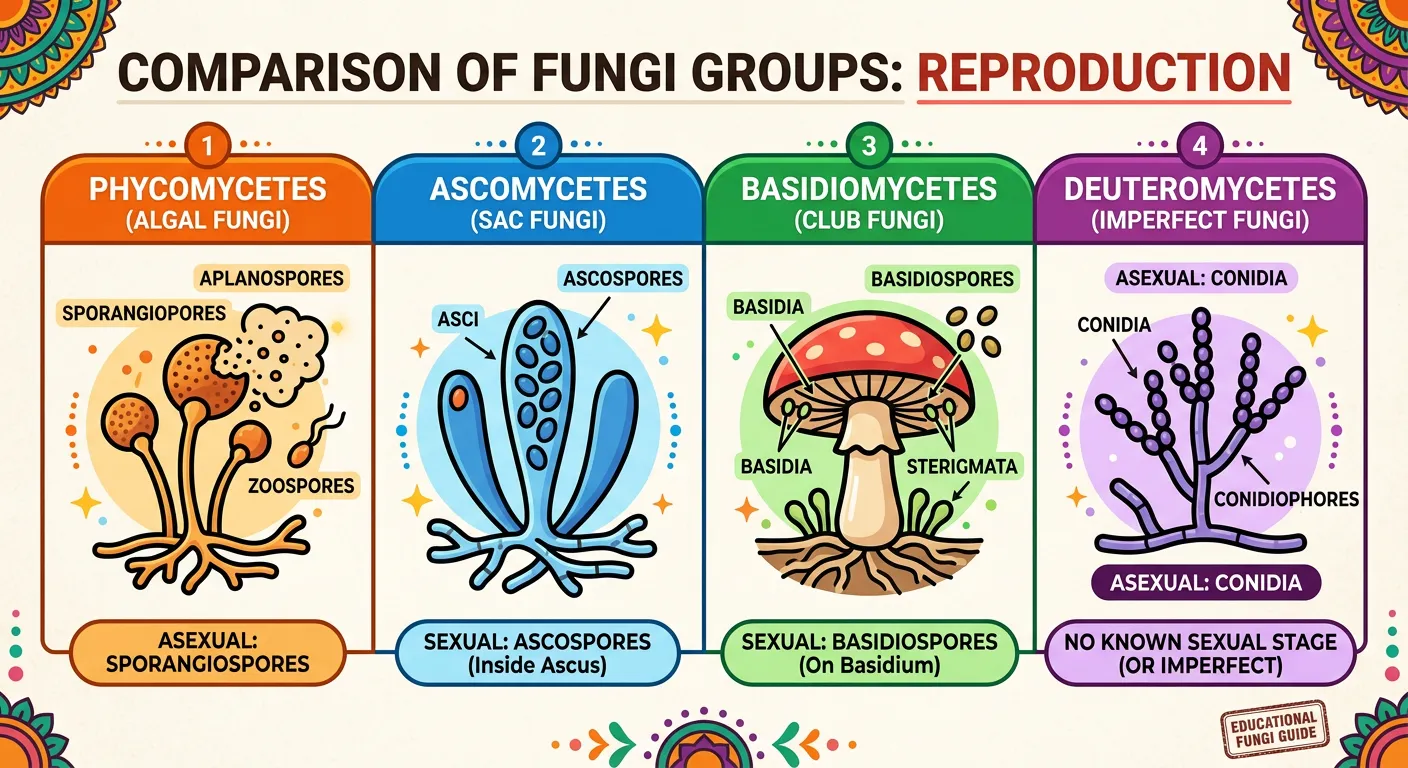
“Let’s summarize! Phycomycetes are the cottony ones, Ascomycetes are the sac-spore producers, Basidiomycetes are our familiar mushrooms, and Deuteromycetes are the mystery group. Mastering these groups is like decoding nature’s secret manual. Keep these differences in mind; they are hot favorites for your NEET exam!”
To master the Kingdom Fungi for NEET, you must be able to contrast the four classes side-by-side using specific morphological and reproductive benchmarks. The primary criteria for classification are the morphology of the mycelium, the mode of spore formation, and the type of fruiting bodies. While Phycomycetes stand alone with their coenocytic (non-septate) mycelium, the other three classes share the more advanced septate mycelium. However, they differ drastically in how they handle their sexual cycle and the duration of their nuclear phases. Ascomycetes and Basidiomycetes both exhibit a 'dikaryophase'—a condition where two nuclei persist per cell (n+n) before eventually fusing. This is an evolutionary adaptation that allows for genetic recombination to be delayed and potentially managed more complexly than in Phycomycetes.
Another crucial comparison point is the physical location of spore production, often a point of confusion for students. In Phycomycetes, asexual spores are endogenous (inside a sporangium). In Ascomycetes, asexual conidia are exogenous, but sexual ascospores are endogenous (inside an ascus). In Basidiomycetes, both asexual spores (if present) and sexual basidiospores are typically exogenous. This 'In-and-Out' pattern of spores is a recurring theme in tricky MCQ options. Use the table below as your ultimate cheat sheet for last-minute revision. Comparing these groups allows you to see the transition from aquatic, simple fungi to terrestrial, complex organisms like mushrooms.
| Feature | Phycomycetes | Ascomycetes | Basidiomycetes | Deuteromycetes |
|---|---|---|---|---|
| Mycelium | Aseptate/Coenocytic | Septate/Branched | Septate/Branched | Septate/Branched |
| Asexual Spore | Zoospore/Aplanospore | Conidia (Exo) | Generally absent | Conidia (Exo) |
| Sexual Spore | Zygospore | Ascospore (Endo) | Basidiospore (Exo) | Absent/Unknown |
| Examples | Mucor, Albugo | Yeast, Penicillium | Agaricus, Puccinia | Alternaria |
Quick Revision Points
- Only Phycomycetes have coenocytic hyphae; all other classes are septate.
- The dikaryon stage is a unique feature of Ascomycetes and Basidiomycetes.
- Endogenous spores: Zoospores, Aplanospores, Ascospores.
- Exogenous spores: Conidia, Basidiospores.
- Yeast is the only unicellular exception in the otherwise filamentous Ascomycetes.
NEET Exam Angle
- Use mnemonics for examples: 'RAM' (Rhizopus, Albugo, Mucor) for Phycomycetes and 'ACT' (Alternaria, Colletotrichum, Trichoderma) for Deuteromycetes.
- Focus on the location of karyogamy and meiosis—usually occurring in the ascus for Ascomycetes and basidium for Basidiomycetes.
- Be aware that sexual reproduction is the definitive basis for the modern classification system.
07Mastering Fungal Diversity: Strategic Preparation for NEET Success

“Great job! You’ve just mastered the classification of Fungi. Remember, nature is the best teacher. Keep observing, keep questioning, and keep your concepts clear. You are one step closer to that white coat. See you in the next lesson, future doctors! Happy studying!”
As you conclude your study of Kingdom Fungi, it is essential to synthesize this information with other chapters in the Biology syllabus. Fungi are not just isolated biological entities; they are major players in human welfare, ecology, and biotechnology. From the production of antibiotics in 'Microbes in Human Welfare' to their role in the '[Five Kingdom Classification](/neet/biology/five-kingdom-classification-rh-whittaker-neet-biology)' by R.H. Whittaker, fungi cross multiple syllabus boundaries. When preparing for NEET, always keep your NCERT textbook open. The diagrams of Mucor, Aspergillus, and Agaricus are frequently used in 'identify the following' type questions. Pay attention to labels like 'sporangiophore' or 'conidiophore' and the specific shape of the fruiting bodies.
Consistency and conceptual clarity are your best tools. Many students struggle with the terminology—plasmogamy, karyogamy, and dikaryon. Remember that plasmogamy is the 'fusion' of the cytoplasm, while karyogamy is the 'fusion' of the nuclei. The significant time delay between these two steps in Ascomycetes and Basidiomycetes is what creates the dikaryotic phase (n+n), which is a unique fungal phenomenon not seen in other kingdoms. Use flashcards for the examples, as the scientific names of rusts, smuts, and bread molds are essentially free marks if you can recall them correctly. Additionally, don't forget the symbiotic relationships: Lichens (Fungus + Algae) and Mycorrhiza (Fungus + roots of Pinus). These are frequently tested in the context of ecology and plant physiology. A student who can link Fungi to its role in the ecosystem as a decomposer and its role in human medicine will be much better prepared for the analytical questions that characterize the modern NEET exam. Keep practicing the previous year questions, as the patterns of classification remain consistent year after year.
Quick Revision Points
- Re-read the section on Yeast; it is unicellular and reproduces by budding, making it a common exception to the filamentous rule.
- Focus on the ecological importance: Fungi as recyclers through mineralization.
- Memorize the 'Drosophila of the plant kingdom' label for Neurospora crassa.
- Practice labeling the fruiting bodies: Ascocarps vs. Basidiocarps.
- Remember that fungal classification is based on the morphology of mycelium and sexual reproductive characteristics.
NEET Exam Angle
- Look at previous year papers: Questions on the 'dikaryophase' and 'exogenous vs endogenous spores' appear almost every two years.
- Understand the symbiotic relationships: Lichens and Mycorrhiza are frequently tested as examples of mutualism.
- Clarify the difference between Zygospore (Sexual spore of Phycomycetes) and Zoospore (Asexual motile spore). Many students confuse these during the high pressure of the exam.
Recommended Reading
Explore related Biology topics to build deeper chapter connections for NEET.
- What is Living · Topic 1.1
- Lichens · Topic 1.11
- Viruses and Viroids · Topic 1.12
- Algae · Topic 1.13
- Bryophytes · Topic 1.14
- Gymnosperms · Topic 1.16
- Jump to Key Terms (Quick Revision)
- Review Common NEET Mistakes
- Solve NEET Practice MCQs
- Read Topic FAQs
- Practice NEET MCQs
- Solve NEET PYQs
📚 Key Terms
⚠️ Common NEET Mistakes
- 1Confusing the location of spores: Remember that ascospores are internal (endogenous) while basidiospores are external (exogenous).
- 2Assuming all fungi are multicellular: Yeast is a critical unicellular exception often tested in NEET.
- 3Mistaking the order of the sexual cycle: It is always Plasmogamy → Karyogamy → Meiosis.
- 4Forgetting that Phycomycetes are the only major group with coenocytic mycelium; all others are septate.
- 5Confusing asexual 'conidia' (exogenous) with sexual 'ascospores' (endogenous) in Ascomycetes.
📝 NEET PYQ & Practice Questions
Test your understanding of Kingdom Fungi with NCERT-aligned sample questions.
Which of the following statements is correct regarding "Coenocytic" in the context of NEET Biology?
In NEET question papers, questions related to "Kingdom Fungi" predominantly test:
Consider Ascus associated with Kingdom Fungi. What is the primary characteristic expected in NEET MCQs?
Master Kingdom Fungi with NeetQ AI Tutor
Practice 50+ topic-wise MCQs, previous 15 years NEET questions, and get step-by-step doubt resolution instantly.
❓ Frequently Asked Questions
Why are Deuteromycetes called 'Fungi Imperfecti'?
They are called 'imperfect' because their sexual reproduction stages are unknown. They are classified based solely on their asexual and vegetative phases (reproduction via conidia).
What is the difference between exogenous and endogenous spores in Fungi?
Endogenous spores (like ascospores and sporangiospores) are produced inside a sac or structure. Exogenous spores (like conidia and basidiospores) are produced on the outside of the supporting structure.
Which group of fungi has a coenocytic and aseptate mycelium?
Phycomycetes are the only group characterized by a coenocytic and aseptate mycelium (lacking cross-walls).
Can you name a unicellular fungus belonging to the Ascomycetes group?
Yeast (Saccharomyces) is a unicellular fungus belonging to the Ascomycetes, despite the group being largely multicellular.
How does the dikaryotic phase differ between Ascomycetes and Basidiomycetes?
Both exhibit a dikaryophase (n+n), but in Basidiomycetes, this phase is typically more prolonged and involves the formation of complex basidiocarps like mushrooms.
What are the asexual spores of Phycomycetes called?
The asexual spores are motile zoospores or non-motile aplanospores, both produced endogenously in the sporangium.
Written By
NEET Content Strategist & Biology Expert
Sangita Kumari is a NEET educator and content strategist with over 6 years of experience teaching Biology, Chemistry, and Physics to Class 11 and 12 aspirants. She helps bridge the gap between traditional NCERT preparation and modern AI-powered learning. Her content is trusted by thousands of NEET aspirants across India.