🎬 Video Lesson Available
Watch the full 7-slide video lesson for Kingdom Protista with AI teacher narration and visual explanations.
Kingdom Protista — Master Kingdom Protista for NEET Class 11. Learn about Chrysophytes, Dinoflagellates, Euglenoids, Slime Molds, and Protozoans with expert insights and PYQs.
01Defining Kingdom Protista: The Eukaryotic Gateway and Biological Dumping Ground
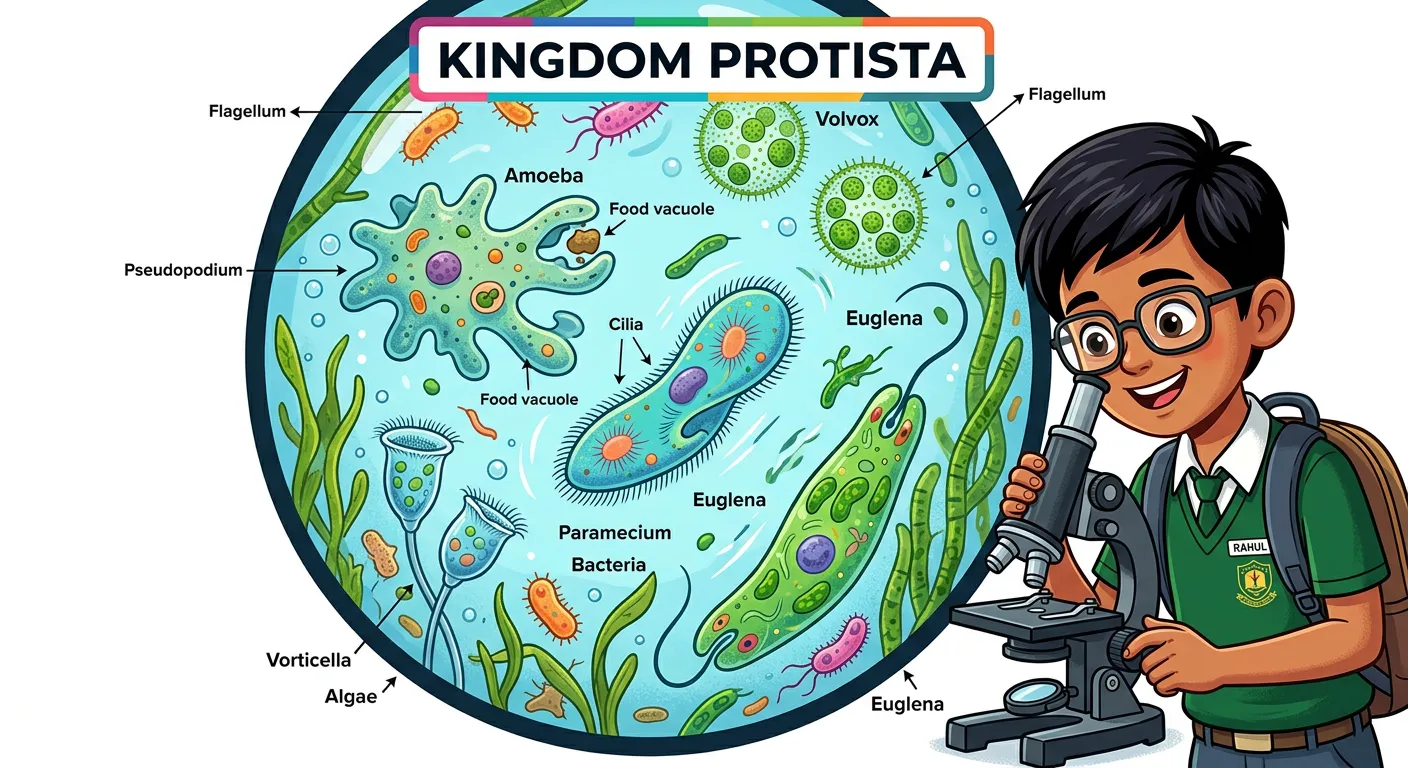
“Welcome to the Kingdom of Protista, the 'dumping ground' of biology! Think of them as the misfit geniuses of the microscopic world. They are eukaryotic, mostly aquatic, and act like a chaotic, diverse neighborhood where plants, animals, and fungi-like creatures all live together under one roof.”
Kingdom Protista is often described by biologists as the 'taxonomic dumping ground.' This isn't a critique of its complexity, but rather a reflection of its incredible diversity. In R.H. Whittaker’s Five Kingdom [Classification](/neet/biology/five-kingdom-classification-rh-whittaker-neet-biology), Protista serves as a crucial bridge between the simple prokaryotic Monerans and the more complex multicellular organisms like Plants, Animals, and Fungi. If an organism is eukaryotic (has a nucleus) and unicellular, it almost certainly belongs here. However, the boundaries of this kingdom are notoriously fuzzy; what one biologist might classify as a photosynthetic protist, another might view as a primitive plant. This ambiguity stems from the fact that Protista is a paraphyletic group, meaning it doesn't contain all the descendants of its common ancestor, leading to a mix of evolutionary lineages that are still being debated today.
Most protists are primarily aquatic, thriving in oceans, freshwater ponds, and even damp soil. They represent the first major evolutionary leap toward compartmentalization. Unlike Monerans, protists possess a well-defined nucleus and membrane-bound organelles like mitochondria and chloroplasts. This structural upgrade allowed them to become much more efficient at processing energy and reacting to their environment. Some species possess locomotory structures like whip-like flagella or hair-like cilia, which exhibit the complex 9+2 microtubule arrangement characteristic of eukaryotes, enabling them to navigate their watery worlds with precision.
Because they are eukaryotes, their cellular machinery is remarkably similar to ours. They have a complex cytoskeleton, perform mitosis, and in many cases, engage in sexual reproduction involving cell fusion and zygote formation. Understanding Protista is fundamental for any NEET aspirant because it explains how life transitioned from the 'simple' bacterial cell to the complexity of the human body. They essentially 'invented' the eukaryotic lifestyle that dominates the visible world today.
Quick Revision Points
- Protista includes all unicellular eukaryotes regardless of their mode of nutrition.
- They act as a phylogenetic link between Monera and the higher kingdoms (Plantae, Fungi, Animalia).
- Primary habitat is aquatic, though they can exist in various moist environments.
- Possess a well-defined nucleus and membrane-bound organelles like mitochondria.
- Locomotion is facilitated by cilia, flagella, or pseudopodia.
NEET Exam Angle
- Boundary Ambiguity: Questions often focus on why the boundaries of Protista are not well-defined. Answer: Because it includes both plant-like and animal-like unicellular organisms.
- Linkage: Protista is the link between Prokaryotes and multicellular Eukaryotes.
- Cell Type: Always remember they are Eukaryotic; this is a common trap in 'Statement Type' questions.
| Feature | Monera (Bacteria) | Protista (Protists) |
|---|---|---|
| Cell Type | Prokaryotic | Eukaryotic |
| Nucleus | Absent (Nucleoid) | Present (Well-defined) |
| Membrane-bound Organelles | Absent | Present |
| Locomotory Structure | Simple Flagella | Complex Cilia/Flagella (9+2) |
02Metabolic Versatility: Nutritional Strategies and Evolutionary Adaptations
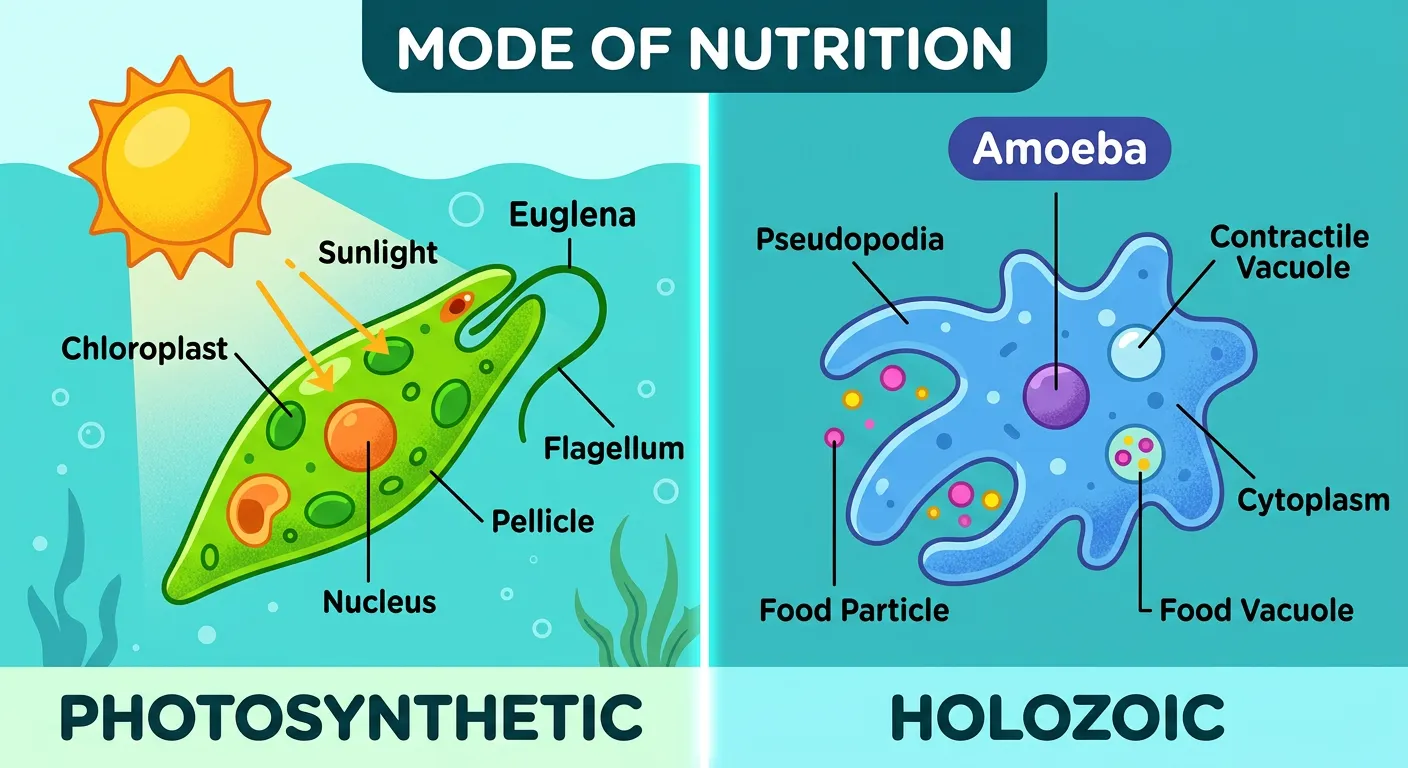
“Protists are the ultimate multi-taskers! They don't stick to one job. Some are photosynthetic, making their own food like plants, while others are holozoic, hunting like animals. It's like having a chef and a delivery driver in the same organism—they adapt to survive anything!”
When it comes to survival, Protists are the ultimate multi-taskers of the biological world. Their nutritional strategies are so varied that they can behave like plants, animals, or fungi depending on the species. Photosynthetic protists, such as diatoms and dinoflagellates, are the primary producers of the aquatic ecosystem, harvesting solar energy to create organic matter. It is estimated that these tiny organisms are responsible for nearly half of the global oxygen production and carbon fixation. Without them, the marine food web would essentially collapse, leading to a catastrophic decline in global biodiversity.
On the other end of the spectrum, we have holozoic protists. These are the 'hunters' of the microscopic world, engulfing prey just like animals through a process of ingestion into food vacuoles. Some are saprophytic, absorbing nutrients from dead organic matter—a strategy they share with fungi. Perhaps the most fascinating are the mixotrophs, like Euglena. These organisms are biological 'hybrid cars'; they photosynthesize when light is available but turn into opportunistic predators when the sun goes down, using their flagella to hunt smaller organisms. This extreme adaptability is a key reason why protists have survived for billions of years across wildly different and often harsh environments.
Reproduction in Kingdom Protista is equally flexible. Most reproduce asexually through binary fission or budding to rapidly increase their population in favorable conditions. This allow for exponential growth when resources are abundant. However, when environmental stress hits—such as a lack of nutrients or changes in temperature—many switch to sexual reproduction. This involves the fusion of cells and the formation of a diploid zygote, introducing genetic variation that helps the species adapt and evolve. This duality—simple rapid growth vs. complex genetic reshuffling—makes them a fascinating study in evolutionary survival and fitness.
Quick Revision Points
- Photosynthetic: Capture light energy (Diatoms, Dinoflagellates).
- Holozoic: Ingest food particles or smaller organisms (Protozoans).
- Saprophytic: Feed on decaying organic matter (Slime molds).
- Mixotrophic: Combine autotrophic and heterotrophic modes (Euglenoids).
- Reproduction: Both asexual (fission) and sexual (zygote formation) occur.
NEET Exam Angle
- Mixotrophy in Euglena: This is a high-yield concept. Focus on how Euglena behaves in the absence of light.
- Nutritional Comparison: Match-the-column questions often pair the organism group with its nutritional mode (e.g., Slime Molds - Saprophytes).
- Zygote Formation: Note that Protists were among the first to develop sexual reproduction mechanisms.
03Chrysophytes: The Golden-Brown Architects and Diatomaceous Earth
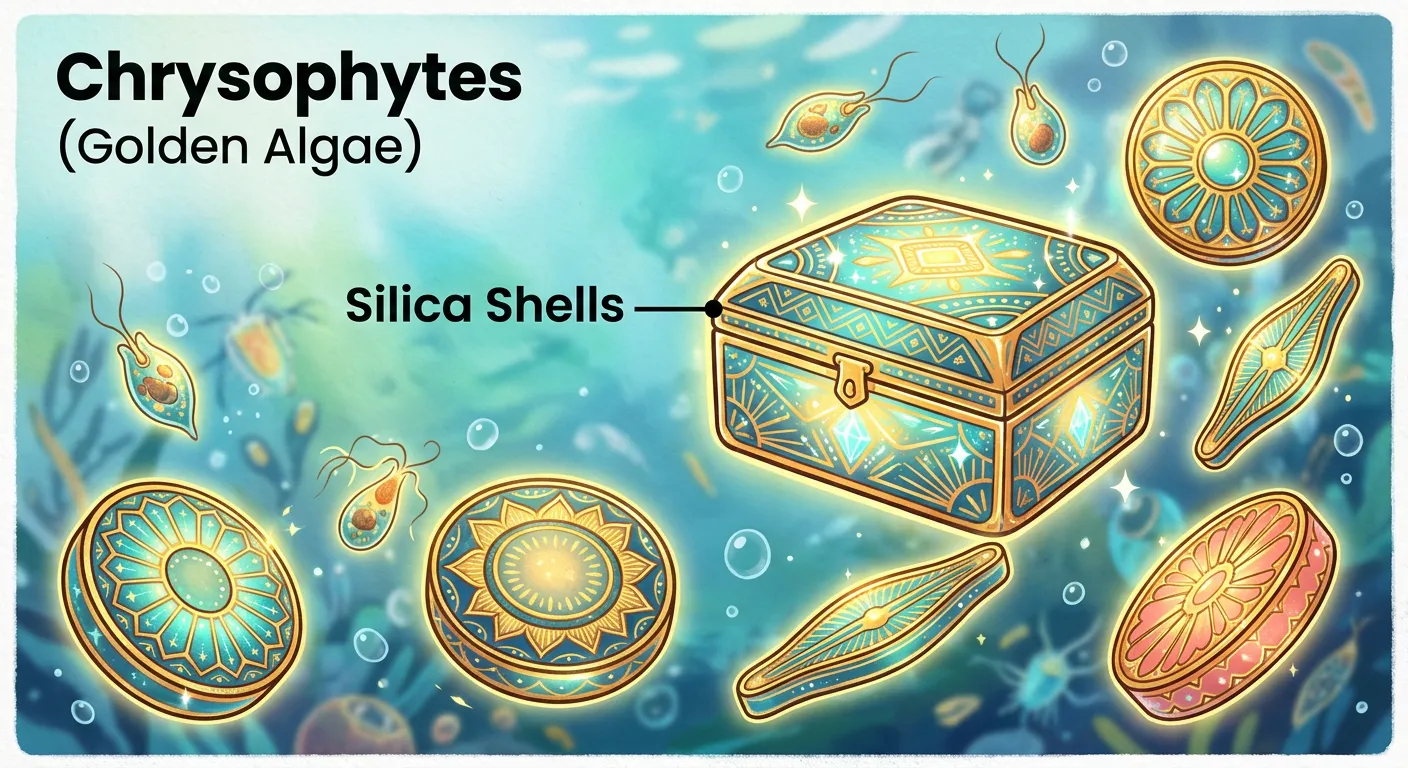
“Meet the Chrysophytes, the jewelry makers of the ocean. These include diatoms which have indestructible silica shells. When they die, their shells pile up to form 'diatomaceous earth'. Imagine a sparkling, gritty sand beach made entirely of the fossils of these tiny, beautiful ocean architects!”
Chrysophytes, which include the Diatoms and Golden Algae (Desmids), are arguably the most beautiful organisms in this kingdom. Found in both freshwater and marine environments, they are mostly microscopic and drift passively with water currents, earning them the title of 'plankton.' Diatoms are particularly famous for their unique cell wall structure. Imagine two thin, overlapping shells that fit together perfectly like a soapbox. These walls are embedded with silica, making them virtually indestructible even after the organism dies.
Because these silica-rich walls do not decay, they accumulate at the bottom of oceans and lakes over millions of years. This massive accumulation is known as 'Diatomaceous Earth.' This gritty, soil-like substance is a geological treasure with significant industrial value. Because of its abrasive and porous nature, it is used in polishing and the filtration of oils, syrups, and even pharmaceutical products. It is also an excellent insulator for heat and sound. Diatoms serve as a fascinating example of how microscopic life can leave behind a massive physical footprint on the planet.
Ecologically, Diatoms are the 'Chief Producers' of the oceans. They perform a staggering amount of the world's photosynthesis, pumping oxygen into the atmosphere and providing the primary energy source for marine life. Their geometric shapes and intricate patterns are not just for show; they provide structural integrity that allows them to withstand the high pressures of the deep sea while maintaining the necessary buoyancy to stay in the photic zone.
Quick Revision Points
- Composition: Includes Diatoms and Desmids (Golden Algae).
- Cell Wall: Overlapping silica shells called frustules; structure resembles a soapbox.
- Diatomaceous Earth: Accumulated silica walls used in industry for polishing and filtration.
- Planktonic: Drift passively in water currents.
- Ecological Role: Referred to as the 'Chief Producers' of the oceans.
NEET Exam Angle
- Chief Producers: NEET frequently asks which group is considered the chief producer of the oceans. The answer is Diatoms.
- Soapbox Structure: The term 'soapbox' is a keyword for Diatom cell walls in NCERT-based questions.
- Indestructibility: Why are diatom walls preserved? Answer: Due to silica deposition.
| Application | Benefit of Diatomaceous Earth |
|---|---|
| Filtration | Porous structure traps impurities in oils and syrups |
| Polishing | Gritty, abrasive nature is ideal for metal and tooth polishes |
| Soundproofing | Porous density acts as a sound insulator |
| Pest Control | Sharp silica particles dehydrate and kill crawling insects |
04Dinoflagellates: Flagellar Dynamics, Red Tides, and Bioluminescence
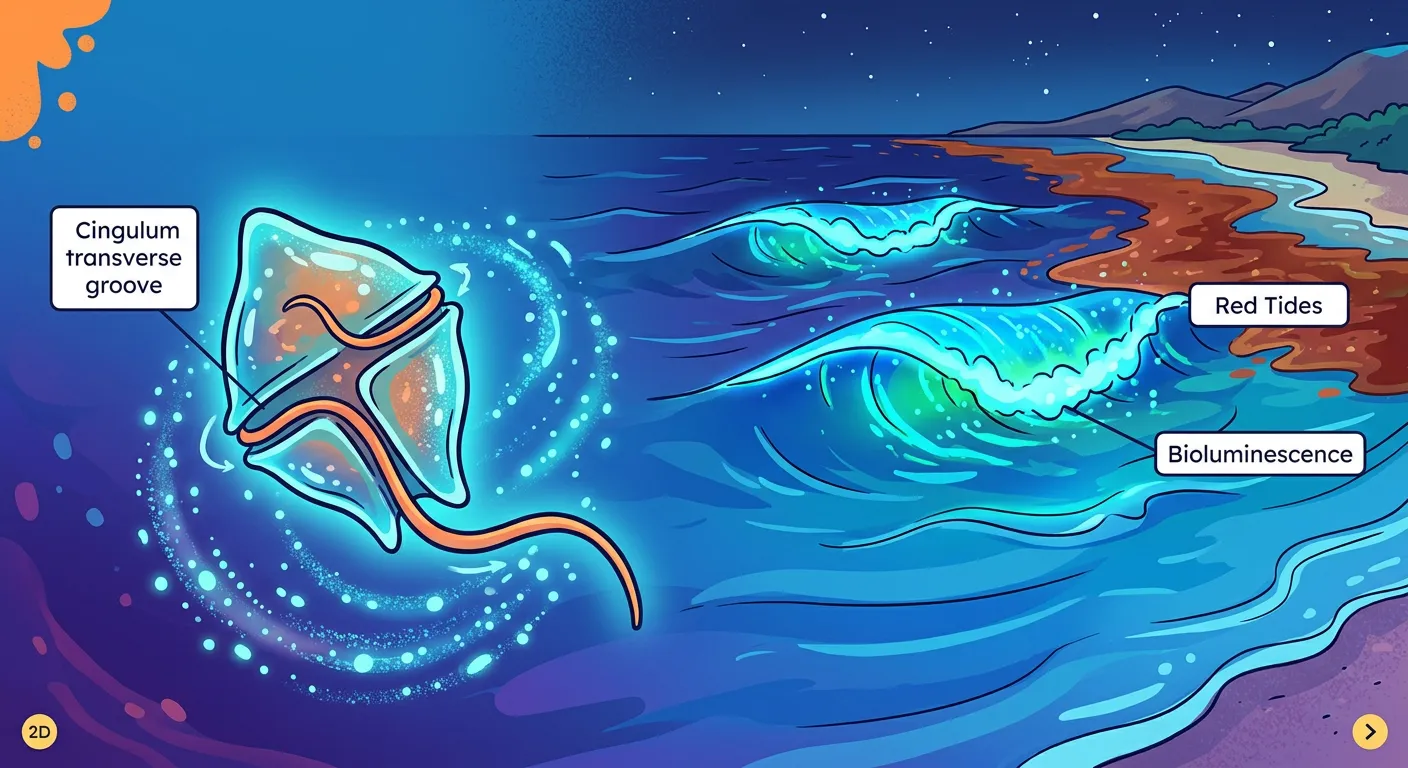
“Dinoflagellates are the drama queens of the sea! With two flagella, they spin like tops. Some create 'red tides' that turn the ocean blood-red, while others glow in the dark like underwater neon lights. They are both beautiful to look at and chemically fascinating!”
Dinoflagellates are the 'spinning' specialists of the Protista kingdom—the name itself comes from the Greek word 'dinos,' meaning whirling. Mostly marine and photosynthetic, these organisms appear in various colors—yellow, green, brown, blue, or even red—depending on the specific pigments, such as chlorophyll and various xanthophylls, present in their cells. Their anatomy is distinct: the cell wall is composed of stiff cellulose plates on the outer surface, giving them a rugged, armored appearance that protects them from predation.
Most dinoflagellates possess two flagella that are arranged in a very specific way. One flagellum lies longitudinally (running vertically), while the other lies transversely (horizontally) in a furrow between the rigid wall plates. This unique arrangement causes the organism to spin like a top as it moves through the water column. This 'whirling' motion is a hallmark of the group and is essential for their ability to move toward optimal light levels for photosynthesis.
Beyond their movement, dinoflagellates are known for two dramatic phenomena. The first is 'Red Tides.' Certain species, most notably Gonyaulax, undergo such rapid multiplication that they turn the entire sea red. During these massive blooms, they release potent toxins, such as saxitoxins, that can paralyze and kill marine animals, including fish. These toxins can also bioaccumulate in shellfish, posing a significant health risk to humans who consume them. The second phenomenon is bioluminescence. Some species emit a ghostly blue-green light when disturbed by waves or predators, making the ocean glow at night—a spectacle that has fascinated sailors for centuries.
Quick Revision Points
- Cell Wall: Rigid plates made of cellulose.
- Flagella: Two flagella—one longitudinal, one transverse in a furrow.
- Red Tides: Caused by the rapid multiplication of Gonyaulax.
- Toxicity: Blooms can release toxins lethal to fish and other marine life.
- Pigments: Variety of colors based on the dominant cell pigments.
NEET Exam Angle
- Gonyaulax: Frequently appearing in 'Match the Column' questions regarding Red Tides.
- Flagella Position: A common 'Incorrect Statement' question target. Remember: one is longitudinal, the other is transverse.
- Cellulose Plates: Focus on the 'stiff cellulose plates' as a defining characteristic compared to the silica of diatoms.
05Euglenoids: The Mixotrophic Bridge and Pellicle Structure
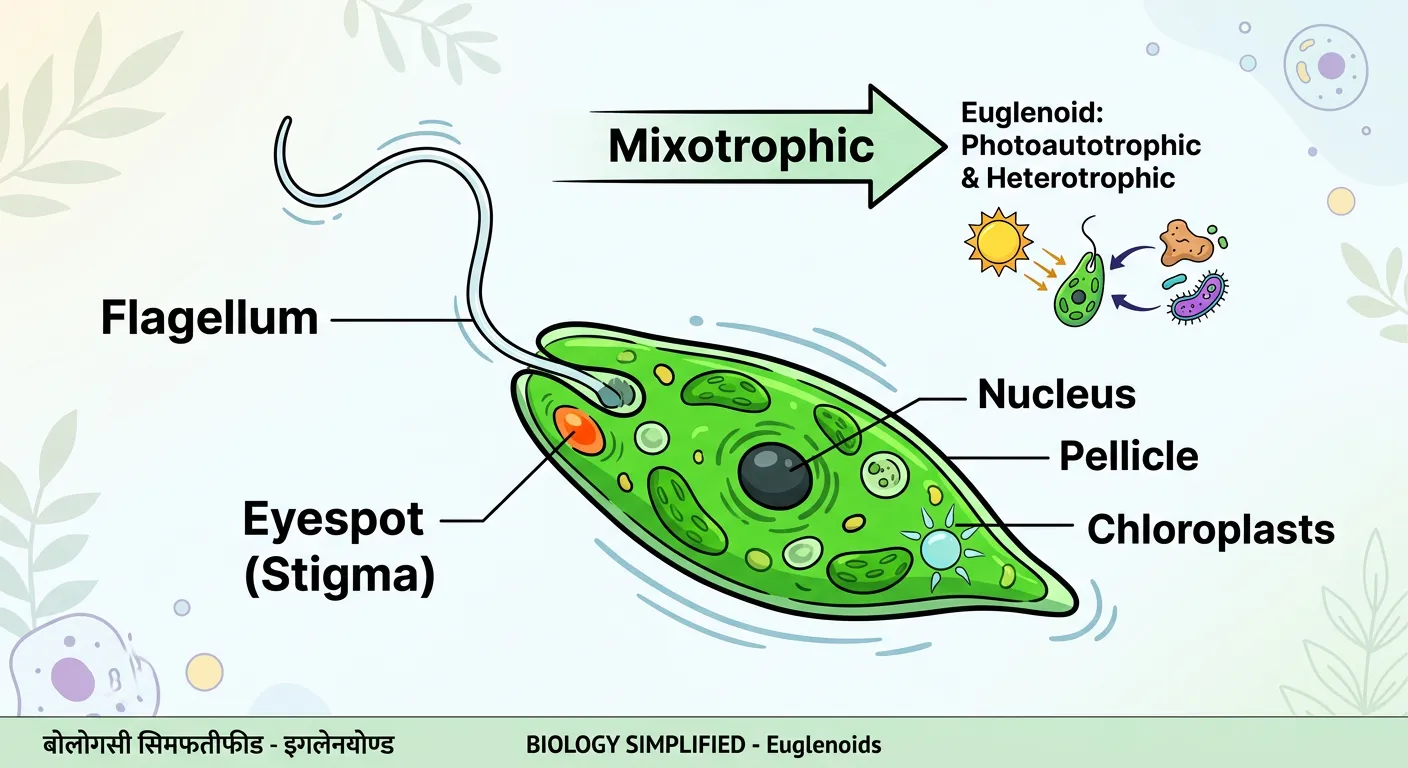
“Euglena is the ultimate diplomat of the kingdom. It’s mixotrophic—meaning it photosynthesizes in sunlight but becomes a predator in the dark. It even has an 'eyespot' to sense light! It’s basically the biological equivalent of a student who is both a morning person and a night owl.”
Euglenoids are primarily freshwater organisms found in stagnant water, such as ponds and ditches. They are the great 'rule-breakers' of biology because they blur the line between plants and animals. Unlike most other plant-like protists, Euglenoids lack a rigid cell wall. Instead, they are wrapped in a protein-rich layer called the pellicle. This pellicle is flexible, allowing the organism to change its shape as it moves, a specific type of movement sometimes referred to as 'metaboly' or 'euglenoid movement.'
Their nutrition is the highlight of their biology. Euglenoids are mixotrophic. In the presence of sunlight, they are photosynthetic, using chlorophyll pigments that are identical to those found in higher plants (Chlorophyll a and b). This suggests a strong evolutionary link between euglenoids and the ancestors of land plants. However, when sunlight is unavailable, they don't simply die; they switch to a heterotrophic mode, behaving like predators and eating smaller organisms. This dual survival strategy makes them incredibly resilient to changing light conditions.
At the anterior end, they usually have two flagella—one short and one long. They also possess a light-sensitive 'eyespot' or stigma, which contains red pigment. This eyespot helps the organism detect light direction so it can swim toward the sun for photosynthesis. This sensory capability is another animal-like feature in an organism that otherwise acts like a plant. They also possess a contractile vacuole, which is vital for osmoregulation in their freshwater habitats.
Quick Revision Points
- Habitat: Mostly stagnant freshwater.
- Pellicle: Protein-rich layer that provides flexibility in the absence of a cell wall.
- Mixotrophy: Photosynthetic in light, heterotrophic/predatory in the dark.
- Pigments: Identical to higher plants (Chlorophyll a and b).
- Locomotion: Two unequal flagella (one long, one short).
NEET Exam Angle
- Pellicle vs. Cell Wall: NEET often asks which group lacks a cell wall but has a protein-rich layer. Answer: Euglenoids.
- Pigment Identity: The fact that their pigments are identical to higher plants is a high-frequency question.
- Evolutionary Link: They are considered the connecting link between plants and animals.
| Condition | Mode of Nutrition | Cellular Behavior |
|---|---|---|
| Presence of Light | Autotrophic | Photosynthesis via Chlorophyll a & b |
| Absence of Light | Heterotrophic | Predation of smaller organisms |
| Physical Support | Pellicle-based | Flexible body shape/movement |
06Slime Molds: The Aggregating Saprophytes and Plasmodium Dynamics
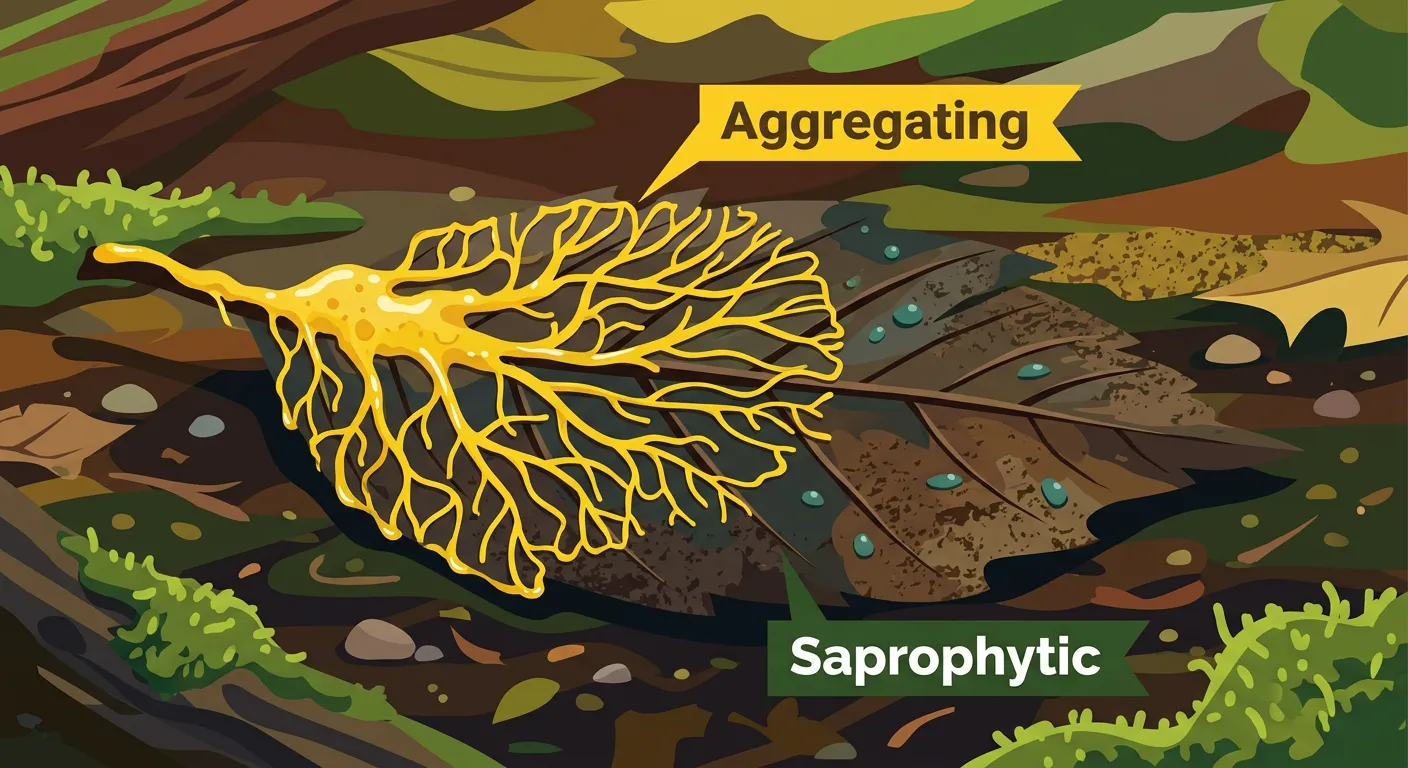
“Slime molds are the weirdest roommates ever! They live as saprophytes, eating decaying matter. When conditions get tough, they aggregate into a massive 'plasmodium' to move together. It’s like a tiny, coordinated flash mob of cells roaming the forest floor looking for a snack.”
Slime molds are saprophytic protists that look like a cross between a fungus and an amoeba. They spend their lives crawling over decaying twigs and leaves, engulfing organic material and bacteria. They are the primary recyclers of the forest floor, breaking down complex organic matter. What makes them truly unique is their life cycle, which changes drastically based on environmental conditions, moving from a single-celled state to a large, coordinated mass.
Under favorable conditions (moist environments with plenty of food), individual slime mold cells aggregate to form a large, multi-nucleated mass called a plasmodium. This plasmodium is not just a bunch of cells sticking together; it is a giant, single cell with thousands of nuclei working in perfect coordination. The plasmodium can grow and spread over several feet, moving slowly across the substrate through a process of protoplasmic streaming. However, when conditions become unfavorable—such as during a drought or when food supplies are exhausted—the plasmodium undergoes a remarkable transformation.
During these tough times, the plasmodium stops moving and differentiates into fruiting bodies. These structures produce spores at their tips. Unlike the main body of the slime mold, these spores possess 'true walls' made of cellulose, which is a key fungus-like characteristic. These walls make the spores incredibly resistant to extreme heat, cold, and desiccation. These spores can survive for many years in a dormant state until favorable conditions return, at which point they are dispersed by air currents to start the life cycle anew. This transition from a creeping mass to a resistant spore is a masterclass in survival.
Quick Revision Points
- Nutrition: Saprophytic (decomposers).
- Plasmodium: An aggregate formed under favorable conditions; can grow very large.
- Fruiting Bodies: Formed under unfavorable conditions to produce spores.
- Spores: Have true cell walls; highly resistant and dispersed by air.
- Movement: Crawl over substrates like decaying vegetation.
NEET Exam Angle
- True Walls: A major distinction. The vegetative body lacks walls, but the spores have true walls. This is a common true/false question.
- Plasmodium Definition: Don't confuse the 'Plasmodium' stage of a slime mold with the genus Plasmodium (which causes malaria).
- Air Currents: Spores are dispersed by air, not water—this is a subtle detail frequently tested.
07Protozoans: Evolutionary Relatives of Animals and Disease Vectors
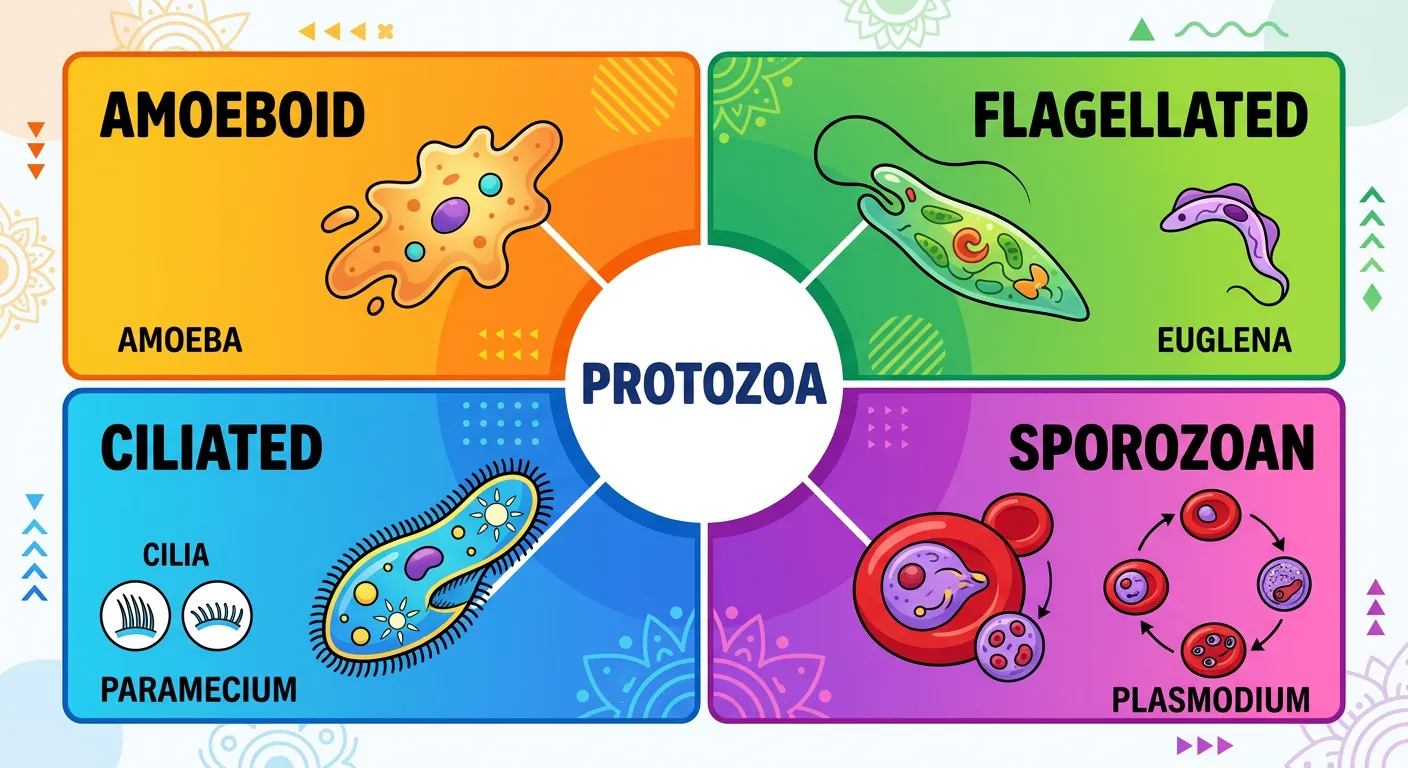
“Finally, we have the Protozoans, divided by how they move: Amoeboids use pseudopodia, flagellates use tails, ciliates use tiny hairs, and sporozoans are parasites like the infamous Plasmodium that causes malaria. Remember these distinct groups; they are a high-frequency topic for your NEET exams!”
Protozoans are the most 'animal-like' of all protists. They are heterotrophs that live as either predators or parasites. Because they lack cell walls and move actively to find food, they are considered primitive relatives of animals. Biologists divide protozoans into four major groups based on their method of locomotion, and understanding these groups is vital for any medical aspirant because many are significant human pathogens that affect millions globally.
- Amoeboid Protozoans: These move and capture prey using 'false feet' called pseudopodia, similar to the well-known Amoeba. Marine forms of this group often have silica shells on their surface, making them look somewhat like tiny snails. Some species, like Entamoeba histolytica, are parasitic and cause diseases like amoebic dysentery in humans.
- Flagellated Protozoans: These organisms move using one or more whip-like flagella. While some are free-living, many are parasitic. For instance, Trypanosoma is transmitted by the tsetse fly and causes the dreaded African Sleeping Sickness, a disease that affects the central nervous system.
- Ciliated Protozoans: These are aquatic, highly organized organisms that use thousands of tiny cilia to move and steer food. They have a permanent cavity called the 'gullet' (cytostome) that opens to the outside of the cell surface. The coordinated movement of rows of cilia causes the water laden with food to be steered into the gullet. Paramecium is the classic example here.
- Sporozoans: This group is unique because it includes organisms that have an infectious, spore-like stage in their life cycle. They lack specific locomotory structures. The most infamous is Plasmodium, the malarial parasite, which utilizes mosquitoes as vectors and has a massive impact on human health and mortality worldwide.
Quick Revision Points
- Amoeboid: Use pseudopodia (e.g., Amoeba, Entamoeba).
- Flagellated: Use flagella (e.g., Trypanosoma).
- Ciliated: Use cilia and have a gullet (e.g., Paramecium).
- Sporozoans: Non-motile, infectious spore stage (e.g., Plasmodium).
- Nutrition: Strictly heterotrophic (predators or parasites).
NEET Exam Angle
- Sleeping Sickness: Always associate Trypanosoma with flagellated protozoans and the Tsetse fly vector.
- Malaria: Plasmodium is a Sporozoan. Note its life cycle involves multiple hosts.
- Silica Shells: Be careful; while Diatoms are famous for silica, marine Amoeboids also possess silica shells.
| Protozoan Group | Locomotion | Example Organism | Disease/Feature |
|---|---|---|---|
| Amoeboid | Pseudopodia | Entamoeba | Amoebic Dysentery |
| Flagellated | Flagella | Trypanosoma | Sleeping Sickness |
| Ciliated | Cilia | Paramoecium | Presence of Gullet |
| Sporozoans | None (Spore) | Plasmodium | Malaria |
Recommended Reading
Explore related Biology topics to build deeper chapter connections for NEET.
- What is Living · Topic 1.1
- Kingdom Fungi · Topic 1.10
- Lichens · Topic 1.11
- Viruses and Viroids · Topic 1.12
- Algae · Topic 1.13
- Bryophytes · Topic 1.14
- Jump to Key Terms (Quick Revision)
- Review Common NEET Mistakes
- Solve NEET Practice MCQs
- Read Topic FAQs
- Practice NEET MCQs
- Solve NEET PYQs
📚 Key Terms
⚠️ Common NEET Mistakes
- 1Confusing the 'Plasmodium' stage of slime molds with the 'Plasmodium' genus that causes malaria.
- 2Assuming all protists are photosynthetic; remember that many are hunters or decomposers.
- 3Thinking Euglenoids have a cell wall; they actually have a flexible protein pellicle.
- 4Believing red tides are caused by red algae; they are actually caused by dinoflagellates like Gonyaulax.
- 5Forgetting that slime mold spores have 'true' cellulose walls, even though the vegetative body does not.
- 6Mixing up the flagella of Dinoflagellates (one longitudinal, one transverse) with Euglenoids (one long, one short).
📝 NEET PYQ & Practice Questions
Test your understanding of Kingdom Protista with NCERT-aligned sample questions.
Which of the following statements is correct regarding "Eukaryotic" in the context of NEET Biology?
In NEET question papers, questions related to "Kingdom Protista" predominantly test:
Consider Diatomaceous Earth associated with Kingdom Protista. What is the primary characteristic expected in NEET MCQs?
Master Kingdom Protista with NeetQ AI Tutor
Practice 50+ topic-wise MCQs, previous 15 years NEET questions, and get step-by-step doubt resolution instantly.
❓ Frequently Asked Questions
Why are the boundaries of Kingdom Protista not well-defined?
The boundaries are not well-defined because Protista is a diverse collection of all unicellular eukaryotes. It includes organisms that have plant-like (photosynthetic), animal-like (holozoic), and fungus-like (saprophytic) characteristics, making it a transitional kingdom rather than a homogenous one.
What makes the cell wall of Diatoms unique and industrially important?
Diatoms have cell walls embedded with silica that form two thin overlapping shells (like a soapbox). These walls are indestructible and accumulate over millions of years to form 'Diatomaceous Earth,' which is used for filtration, polishing, and insulation.
How do Dinoflagellates cause the death of marine animals like fishes?
Certain red dinoflagellates like Gonyaulax undergo rapid multiplication (blooms), creating 'red tides.' These organisms release toxins into the water that can paralyze the respiratory systems of fish and other marine animals, leading to large-scale mortality.
Explain the mixotrophic mode of nutrition in Euglena with respect to light availability.
Euglena is mixotrophic: in the presence of sunlight, it performs photosynthesis using chlorophyll. In the absence of sunlight, it switches to heterotrophic nutrition, acting as a predator by capturing and digesting smaller organisms.
Under what environmental conditions do slime molds form a Plasmodium?
Slime molds form a Plasmodium under favorable environmental conditions (plenty of food and moisture). Under unfavorable conditions, the Plasmodium differentiates to form fruiting bodies that bear resistant spores.
Which group of protozoans includes the causative agent of Malaria, and how is it classified?
The causative agent of Malaria is Plasmodium, which belongs to the Sporozoan group of protozoans. Sporozoans are characterized by an infectious, spore-like stage in their life cycle and a lack of specific locomotory structures.
Written By
NEET Content Strategist & Biology Expert
Sangita Kumari is a NEET educator and content strategist with over 6 years of experience teaching Biology, Chemistry, and Physics to Class 11 and 12 aspirants. She helps bridge the gap between traditional NCERT preparation and modern AI-powered learning. Her content is trusted by thousands of NEET aspirants across India.