🎬 Video Lesson Available
Watch the full 7-slide video lesson for Need for Classification with AI teacher narration and visual explanations.
Need for Classification — Learn Need for Classification for NEET Biology.
01The Grand Scale of Earth's Biodiversity
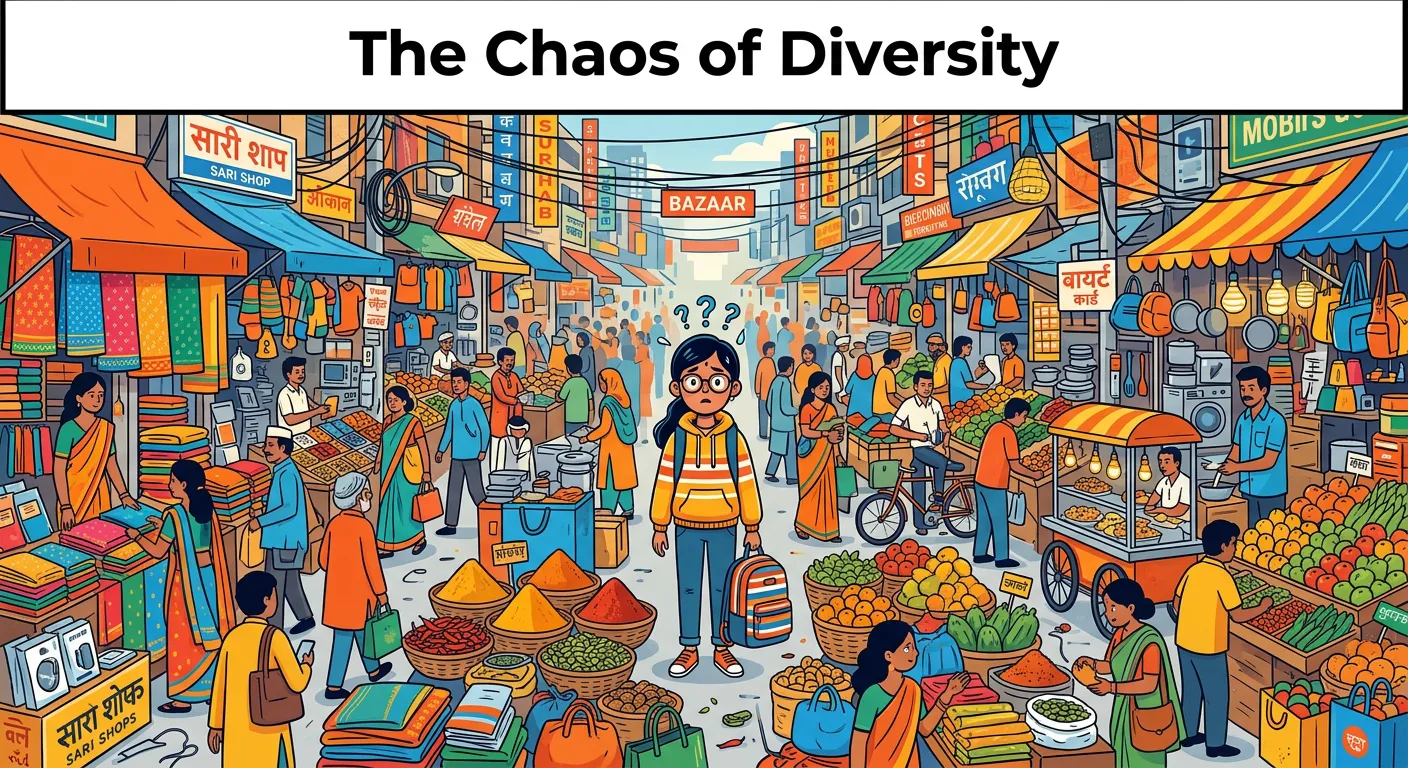
“Imagine entering a massive market where millions of items are thrown randomly in a pile! You would never find what you need. That is exactly what Earth’s biodiversity looks like to a scientist. With millions of species, we need a system to make sense of this beautiful chaos.”
Imagine for a moment that you walk into a massive hypermarket where millions of items—from electronics to fresh vegetables—are thrown into one gigantic, mountain-sized pile in the middle of the floor. You would spend a lifetime looking for a single specific needle or a particular brand of juice. This is exactly what the biological world looks like to a scientist who lacks a system. We share our planet with an incredible variety of life forms. Current estimates suggest that there are about 1.7 to 1.8 million species that have been described and named, but millions more are yet to be discovered. This staggering number represents the 'biodiversity' of our world.
Without an organized approach, the sheer volume of information would be overwhelming. The primary need for classification arises from this biological chaos. We need a way to turn this massive heap of data into a structured system where every organism has a place. By grouping organisms, we move away from trying to remember millions of individual facts and instead focus on the characteristics of a group. This makes the study of living organisms not only possible but also efficient and logical. For a NEET aspirant, understanding this 'need' is the first step toward mastering the logic of the entire plant and animal kingdoms.
Quick Revision Points
- Biodiversity refers to the number and types of organisms present on Earth, currently estimated at 1.7-1.8 million species.
- The enormous variety of life makes it impossible to study every organism individually.
- Classification is the process of grouping organisms based on observable similarities and differences.
- The main goal of classification is to make the study of diverse organisms organized and easy.
- Systematic arrangement allows scientists to store and retrieve biological information effectively.
NEET Exam Angle
- NCERT Data: Always remember the specific range 1.7-1.8 million; examiners often pick these exact numbers for MCQ options.
- Concept Application: Questions often ask why we classify; the answer usually involves 'making study easier' or 'organizing biodiversity'.
- Terminology: Distinguish between biodiversity (the variety) and classification (the process of organizing that variety).
| Aspect | Unorganized Biodiversity | Organized Classification |
|---|---|---|
| Study Method | Individual organism study (Impossible) | Group-based study (Efficient) |
| Information Retrieval | Extremely slow and confusing | Rapid and logical |
| New Species | No place to fit them | Placed in existing categories |
| Predictability | Zero predictive power | High (traits can be predicted by group) |
02Defining Classification: The Library of Life
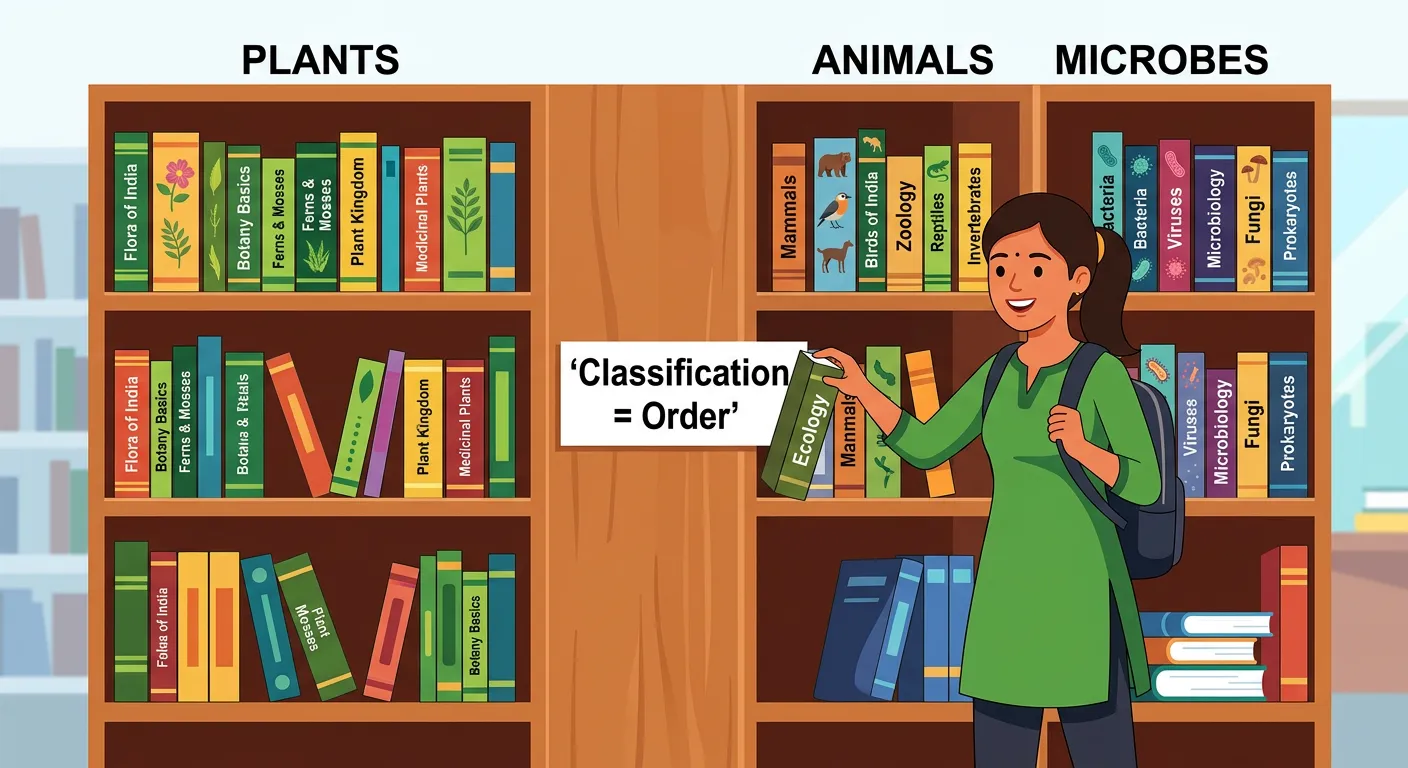
“Classification is our way of organizing the living world. Just like a library groups books by genre, biology groups organisms based on shared characteristics. It turns a massive, confusing pile of data into an organized, logical system that is easy to study and remember.”
To understand classification, think about how a modern library functions. A library doesn't just toss books onto shelves; it categorizes them. You have sections for Fiction, Science, History, and Biography. Within those, books are further arranged by the author's name or the date of publication. Biological classification works on the exact same principle. It is the scientific procedure of arranging organisms into groups or categories based on some easily observable and fundamental characteristics. This isn't just about naming; it's about creating a framework where the relationships between organisms become visible.
In biology, we don't just group things randomly. We look for 'homologies' or shared traits that indicate a deeper connection. For instance, if you know the basic characteristics of mammals—like having mammary glands and hair—you don't need to study every single mammal to know that a newly discovered hairy animal that nurses its young is likely a mammal. This saves an incredible amount of time. By classifying, we create a 'shorthand' for nature. Instead of describing every detail of a dog, a cat, and a lion separately, we can discuss the features of the order 'Carnivora' and cover the basics for all of them at once.
Quick Revision Points
- Classification is the arrangement of organisms into categories based on similarities and differences.
- It acts as a filing system for the vast amount of biological data available to us.
- Grouping is done based on shared characteristics, such as external structure or internal anatomy.
- This system allows researchers to study a few representative organisms to understand an entire group.
- Classification is the foundation of Taxonomy, which deals with identification, nomenclature, and grouping.
NEET Exam Angle
- Definition Logic: Be prepared for 'Assertion-Reason' questions regarding why we use 'observable characteristics' for basic classification.
- Comparison: Understand how biological classification differs from simple non-scientific grouping (like grouping animals by color).
- Group Utility: Focus on how studying one member of a group (e.g., a type of chordate) helps in understanding the general characteristics of the whole Phylum.
03Identification and the Power of Placement
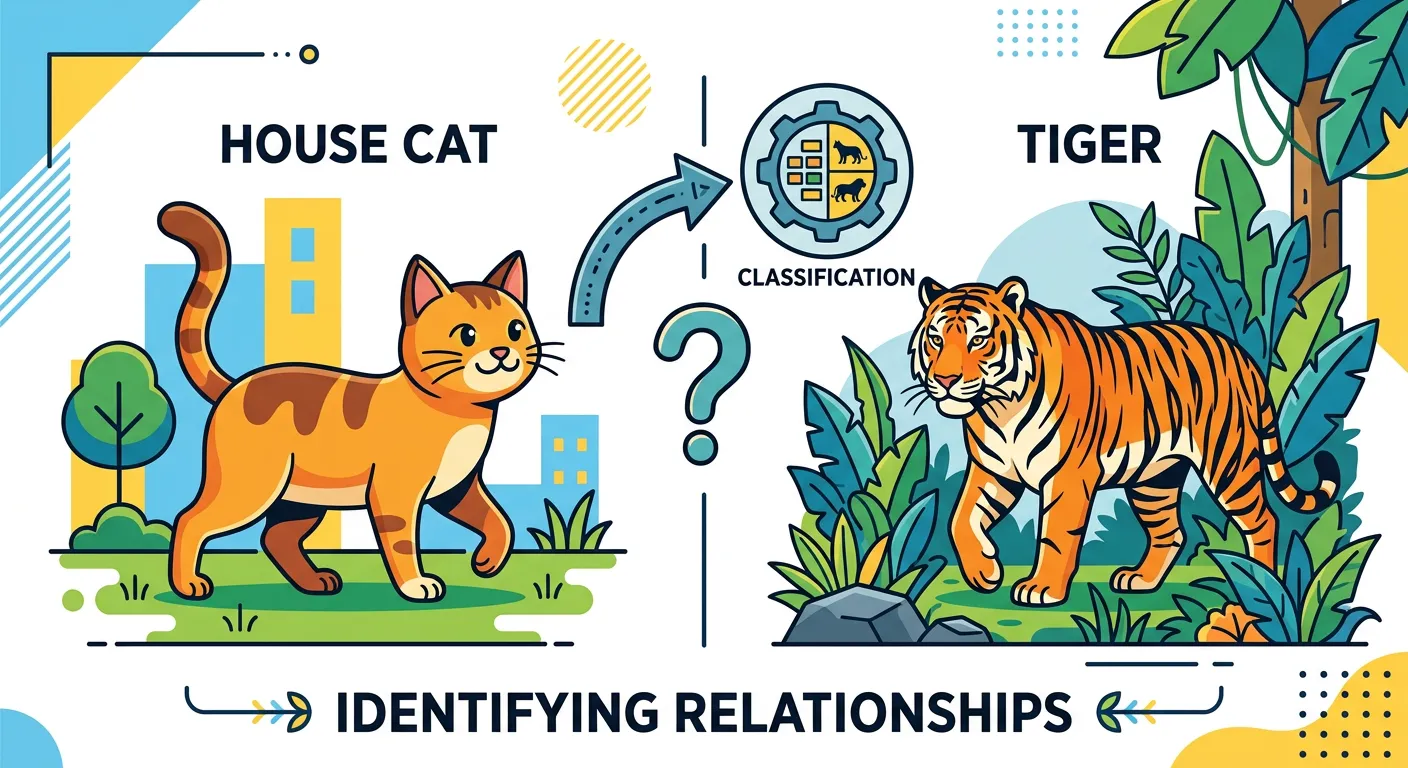
“Why do we classify? First, for identification! It helps us correctly name and place a new organism. It tells us how a common house cat is related to a wild tiger. By classifying, we instantly understand the basic features of a species before we even study it.”
One of the most practical reasons we need classification is for identification. When a biologist finds a strange-looking plant in the rainforest or a microscopic creature in a deep-sea vent, the first question is: "What is this?" Without a classification system, there would be no way to answer that. Classification provides a pre-existing map. By comparing the traits of the new organism to the traits of known groups, we can identify it. If it has flowers, it goes into the Angiosperms; if it has seeds but no flowers, it might be a Gymnosperm.
This process also helps us understand the degree of relationship between organisms. For example, look at a common house cat and a wild tiger. On the surface, they look very different in size and temperament. However, classification reveals that they share almost all their skeletal and muscular traits, placing them both in the family Felidae. This tells us that they are close relatives. Classification allows us to see these hidden connections that aren't always obvious at first glance. It provides a standardized 'ID card' for every living thing, ensuring that once an organism is identified, its traits are immediately known to scientists worldwide.
Quick Revision Points
- Identification is the correct description of an organism so that we know which category it belongs to.
- Classification helps in placing an unidentified organism into a previously defined group.
- It reveals the degree of similarity and relationship between different species.
- Shared characteristics (like those in cats and tigers) allow for higher-level grouping in families and orders.
- Identification is a prerequisite for nomenclature (naming the organism).
NEET Exam Angle
- Cat Family (Felidae): This is a frequent NCERT example. Remember that cats (Felis) and leopards/lions/tigers (Panthera) are in the same family.
- Hierarchy of Similarity: Note that as you move to higher categories (Species to Kingdom), the number of shared characteristics decreases.
- Practical Questions: You might be asked to identify the 'first step' in taxonomy—which is often the characterization or identification of the specimen.
| Organism | Common Name | Genus | Family | Shared Features |
|---|---|---|---|---|
| House Cat | Cat | Felis | Felidae | Retractable claws, carnivores |
| Tiger | Tiger | Panthera | Felidae | Retractable claws, carnivores |
| Dog | Dog | Canis | Canidae | Non-retractable claws, carnivores |
04Phylogeny: Tracing the Evolutionary Family Tree
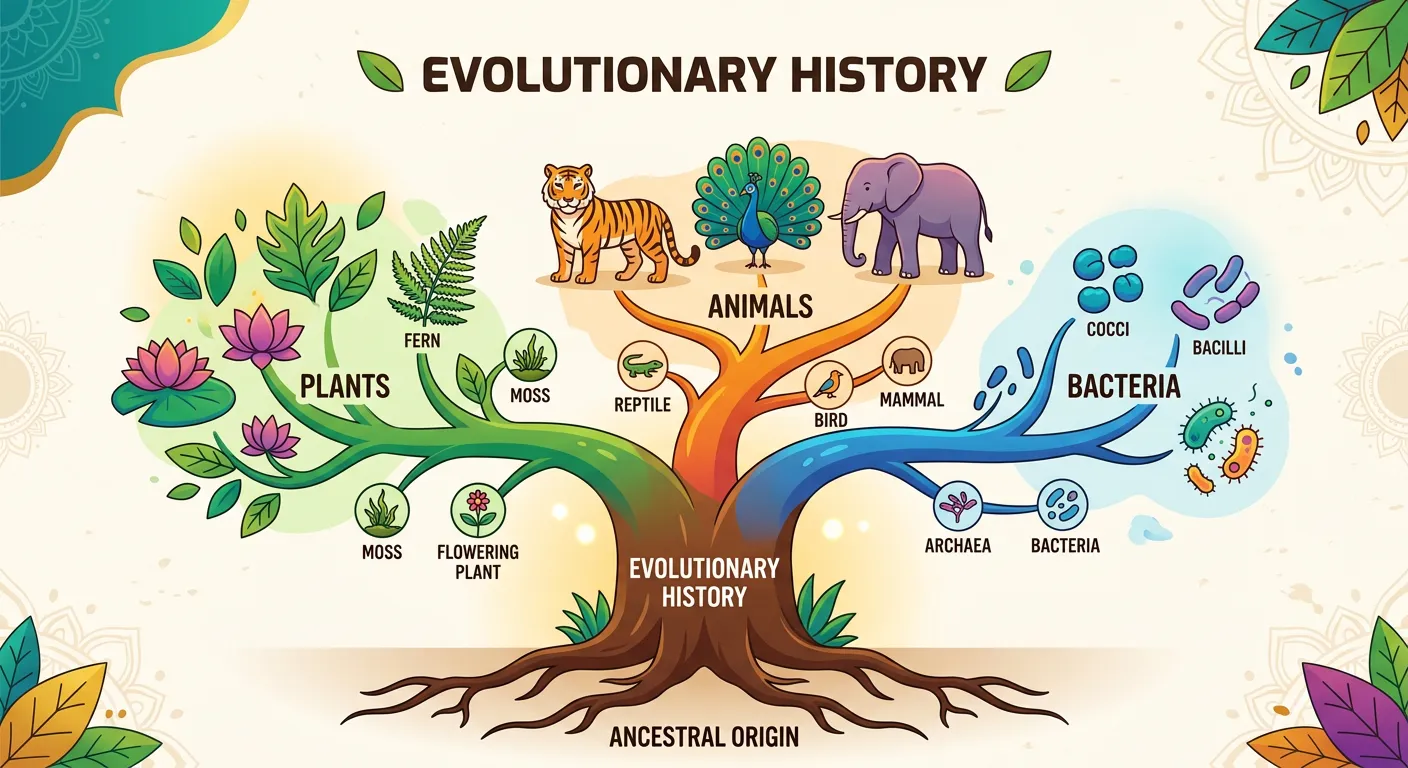
“Classification reveals the evolutionary history of life. It shows us the 'family tree' of organisms. When we group them, we see how complex life evolved from simple ancestors over millions of years. It’s like tracing your own family tree to see where you came from.”
Classification isn't just about sorting things into boxes based on how they look today; it’s about history. Modern classification systems aim to be 'phylogenetic,' meaning they reflect the evolutionary history of organisms. When we group organisms, we are essentially building a giant family tree of life. This tree shows us how complex organisms like humans or oak trees evolved from much simpler, single-celled ancestors over billions of years. By looking at the classification of an organism, you can trace its ancestry.
For instance, the reason birds and reptiles are often discussed together in higher biology is that classification shows they share a common ancestor. This 'evolutionary mapping' is vital because it explains why certain traits exist. Why do whales have lungs instead of gills? Classification (placing them in Mammalia) reminds us of their land-dwelling ancestors. This context is essential for understanding the 'why' behind biological structures. Without classification, evolution would be a series of disconnected events rather than a continuous, logical story of descent with modification. For a student, this turns biology from a list of things to memorize into a fascinating story of survival and change.
Quick Revision Points
- Phylogeny is the study of the evolutionary history and relationships of organisms.
- Classification reflects the 'Tree of Life,' showing how species are related through common ancestors.
- It helps us understand the transition from simple life forms to complex multicellular organisms.
- Modern taxonomy (Biosystematics) uses genetic and evolutionary data, not just physical appearance.
- Evolutionary relationships are the gold standard for modern classification systems.
NEET Exam Angle
- Term Alert: 'Phylogenetic'—NEET often asks which system of classification is currently most accepted (Answer: Phylogenetic systems).
- Clues in Classification: Understand that if two organisms are in the same Genus, they share a very recent common ancestor compared to two in the same Class.
- Ancillary Evidence: Note that fossils, molecular data (DNA), and embryology all support phylogenetic classification.
| System Type | Basis of Classification | Example Concept |
|---|---|---|
| Artificial | One or two superficial traits | Habit, color, or number of petals |
| Natural | Multiple internal and external traits | Anatomy, embryology, phytochemistry |
| Phylogenetic | Evolutionary relationships | Common ancestry and DNA lineage |
05Solving the Language Barrier with Nomenclature
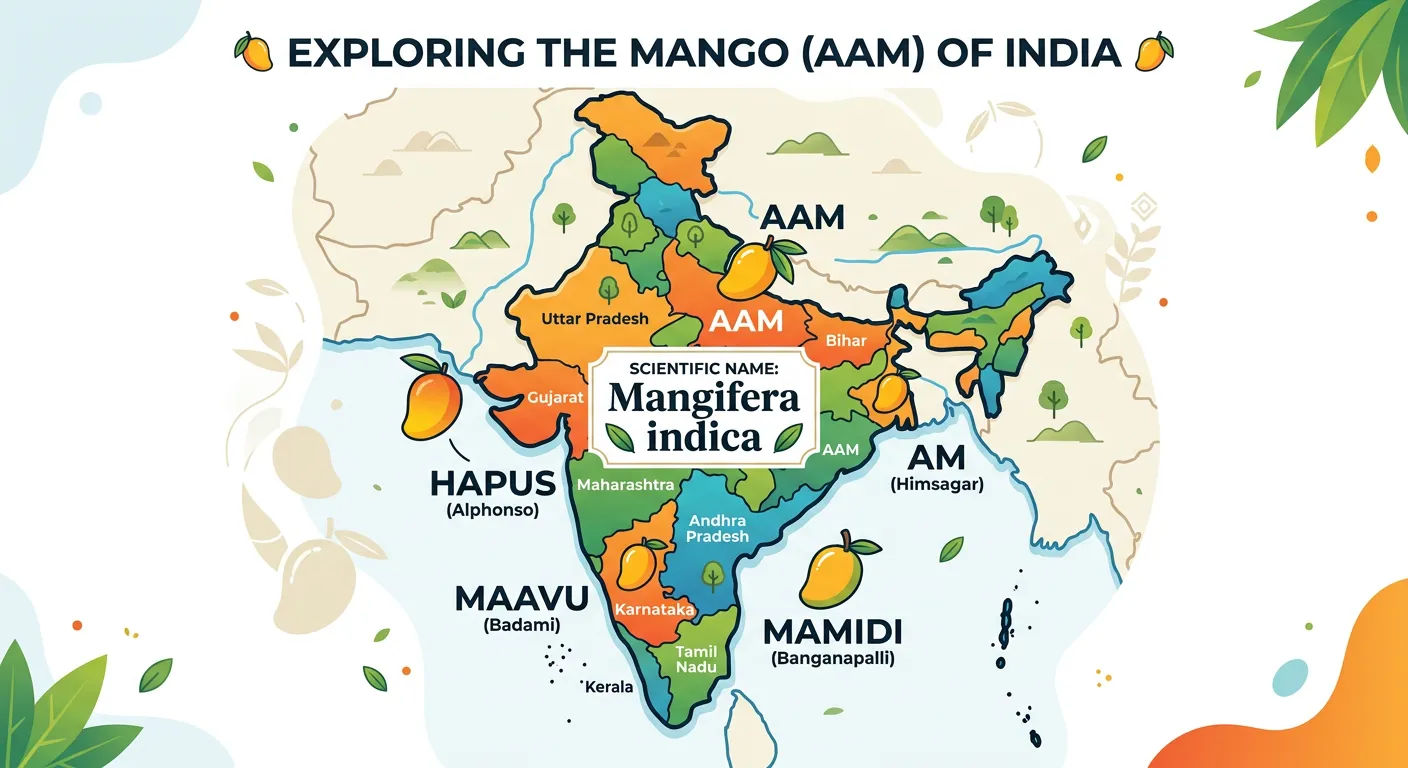
“Have you noticed we call a Mango 'Aam' in Hindi, but it has different names in other languages? This leads to confusion! Classification gives every organism a unique scientific name recognized worldwide. It ensures that a researcher in India and one in Germany talk about the same species.”
One of the most frustrating things in early biology was the use of common or vernacular names. Take the mango, for example. In Hindi, it's 'Aam,' in Telugu it's 'Mamidi,' and in Spanish, it's 'Mango.' While this is fine for local grocery shopping, it's a disaster for international science. If a researcher in India discovers a cure for a disease using a specific local plant, and a researcher in Brazil cannot identify that plant because of the name, lives could be lost. Classification solves this by providing 'Nomenclature'—a system of standardized naming.
By classifying an organism, we assign it a unique, two-part scientific name (Binomial Nomenclature) that is recognized in every country on Earth. The mango becomes Mangifera indica. No matter what language a scientist speaks, Mangifera indica always refers to the exact same species. This creates a universal language for biology. It ensures clarity, prevents confusion between unrelated species that might share a common name (like 'Starfish,' which isn't a fish), and allows for the global exchange of biological information. This is why classification is the absolute bedrock of scientific communication.
Quick Revision Points
- Vernacular names (local names) vary by region and language, leading to scientific confusion.
- Nomenclature is the scientific naming of organisms such that one name is used globally.
- Classification provides the framework needed to assign these unique names.
- Binomial nomenclature (Genus + species) is the standard system used worldwide.
- A scientific name ensures that scientists in different countries are discussing the same organism.
NEET Exam Angle
- Scientific Names: Focus on the rules of Binomial Nomenclature (Latin origin, italics, capitalization of Genus).
- Examples to Memorize: NCERT favorites include Mangifera indica (Mango), Homo sapiens (Human), and Triticum aestivum (Wheat).
- Reasoning: Be ready to explain why common names like 'Jellyfish' or 'Silverfish' are misleading (they aren't true fish), reinforcing the need for scientific names.
| Common Name | Scientific Name | Why Common Name is Confusing |
|---|---|---|
| Mango | Mangifera indica | Hundreds of different local names worldwide |
| Lion | Panthera leo | Often confused with other big cats in local dialects |
| Potato | Solanum tuberosum | Shared names with 'Sweet Potato' (unrelated plant) |
| Human | Homo sapiens | Universal biological identity across all cultures |
06The Power of Systematic Study and Prediction
“Systematic study is the goal. Without classification, every single organism would be a new mystery. By grouping them into categories like Kingdom, Phylum, or Species, we can predict traits of an unknown organism just by knowing which group it belongs to. It saves us massive time!”
The ultimate goal of classification is systematic study. Imagine if every time you saw a new type of bird, you had to perform an entire autopsy and DNA test just to know if it laid eggs. That would be incredibly inefficient. Because of classification, we have a hierarchical system—Kingdom, Phylum, Class, Order, Family, Genus, and Species. This hierarchy acts like a ladder of information. When we know an organism belongs to a certain group, we can 'predict' its traits with high accuracy without ever seeing that specific individual before.
For example, if you are told that a newly discovered animal is in the Phylum Chordata and Class Mammalia, you can immediately predict that it has a backbone, hair, and produces milk. You don't need to check these features; the classification tells you they are present. This predictive power is what makes biology a 'predictive science' rather than just a descriptive one. It saves researchers years of repetitive work. Instead of starting from zero, they start with a wealth of knowledge provided by the organism's taxonomic rank. For NEET students, mastering this hierarchy is like learning the secret code to unlock the characteristics of any organism mentioned in the exam.
Quick Revision Points
- Systematics is the study of the diversity of organisms and all their comparative and evolutionary relationships.
- Taxonomic hierarchy consists of seven obligate categories (Kingdom to Species).
- Classification allows us to predict the traits of an organism based on its group members.
- Knowing the 'Class' of an organism gives us a broad understanding of its anatomy and physiology.
- This systematic approach saves time and allows for the organized storage of biological discoveries.
NEET Exam Angle
- Hierarchy Order: Memorize the sequence (KPCOFGS). A common mnemonic is "Keep Pots Clean Or Family Gets Sick."
- Specific Traits: NEET often asks which category has the most common characters (Species) vs. the least common characters (Kingdom).
- Application: If a question describes a new 'Insecta' member, you should automatically know it has three pairs of jointed legs.
07Summary: Building the Foundation for Biology
“To summarize, classification is the tool that bridges the gap between chaos and knowledge. It helps us identify, name, and understand the deep relationships between all living things. Master this foundation, and you’ve already taken the biggest step toward acing your NEET Biology exam!”
To conclude our look at the need for classification, it is important to realize that this isn't just the first chapter of your textbook; it is the foundation of every chapter that follows. Whether you are studying Plant Physiology, Animal Kingdom, or Ecology, you are using the tools provided by classification. It is the bridge between the overwhelming chaos of nature and the organized body of knowledge we call Biology. By identifying, naming, and grouping organisms, we create a clear window through which we can observe the wonders of life.
For a student preparing for NEET, the 'need for classification' teaches you to look for patterns. Science is all about finding patterns in nature. When you see a leaf, you don't just see a leaf; you see a pattern that tells you if it's a Monocot or a Dicot. When you see an insect, you see the pattern of the Phylum Arthropoda. Classification trains your brain to think like a scientist. Once you master the logic of why we organize life this way, the millions of facts in Biology start to fall into place. It’s no longer about memorizing; it’s about understanding the beautiful, logical system of the living world.
Quick Revision Points
- Classification is the essential tool for bridging the gap between chaos and knowledge.
- It provides a global framework for scientific communication and data sharing.
- The system helps in identification, naming, and understanding evolutionary history.
- Classification serves as the base for all other biological disciplines (Ecology, Genetics, etc.).
- Mastering this foundation is crucial for scoring well in the 'Diversity in Living World' unit of NEET.
NEET Exam Angle
- Holistic View: Remember that this unit (Diversity) usually carries a weightage of about 10-12% in the NEET Biology section.
- Connecting Topics: Classification in Chapter 1 links directly to the detailed groups in Chapters 3 (Plant Kingdom) and 4 (Animal Kingdom).
- Exam Strategy: Focus on the 'why' and 'how' of classification to tackle conceptual questions rather than just rote learning names.
Recommended Reading
Explore related Biology topics to build deeper chapter connections for NEET.
- What is Living · Topic 1.1
- Kingdom Fungi · Topic 1.10
- Lichens · Topic 1.11
- Viruses and Viroids · Topic 1.12
- Algae · Topic 1.13
- Bryophytes · Topic 1.14
- Jump to Key Terms (Quick Revision)
- Review Common NEET Mistakes
- Solve NEET Practice MCQs
- Read Topic FAQs
- Practice NEET MCQs
- Solve NEET PYQs
📚 Key Terms
⚠️ Common NEET Mistakes
- 1Confusing 'Taxonomy' with 'Systematics'—remember that systematics includes evolutionary history.
- 2Thinking that classification is only based on how an organism looks (morphology); it actually includes anatomy, embryology, and genetics.
- 3Using common names in competitive exams instead of scientific names (e.g., thinking a Silverfish is an actual fish).
- 4Mixing up the order of the taxonomic hierarchy (e.g., placing Order before Class).
- 5Ignoring the specific number range for biodiversity (1.7-1.8 million) mentioned in NCERT, which is a favorite for NEET questions.
📝 NEET PYQ & Practice Questions
Test your understanding of Need for Classification with NCERT-aligned sample questions.
Which of the following statements is correct regarding "Biodiversity" in the context of NEET Biology?
In NEET question papers, questions related to "Need for Classification" predominantly test:
Consider Nomenclature associated with Need for Classification. What is the primary characteristic expected in NEET MCQs?
Master Need for Classification with NeetQ AI Tutor
Practice 50+ topic-wise MCQs, previous 15 years NEET questions, and get step-by-step doubt resolution instantly.
❓ Frequently Asked Questions
Why can't we just use common names for all organisms?
Common names vary by region, language, and culture, leading to confusion. For example, 'starfish' is not a fish. Scientific names provide a universal, standardized way to identify a species globally.
What is the difference between taxonomy and systematics?
Taxonomy focuses on the rules and principles of identification, nomenclature, and classification. Systematics is broader, including taxonomy plus the study of evolutionary relationships (phylogeny) between organisms.
How does classification help in the discovery of new species?
It provides a framework where the traits of a new organism are compared against known groups. If the traits don't fit perfectly into any existing group, it signals the discovery of a potentially new species or genus.
Is classification a permanent system?
No, classification is dynamic. As we gain new knowledge through DNA sequencing and fossil evidence, organisms are often moved between groups or new groups are created to better reflect evolutionary truths.
What is the primary criteria for modern biological classification?
Modern classification is primarily based on phylogenetic (evolutionary) relationships, genetic similarities, and fundamental structural features, rather than just superficial traits like color or habitat.
Why is the number of species known (1.7-1.8 million) so much smaller than estimated totals?
Many areas, like the deep oceans and tropical rainforests, are difficult to explore. Additionally, many microscopic organisms (bacteria/fungi) are hard to isolate and describe with current technology.
Written By
NEET Content Strategist & Biology Expert
Sangita Kumari is a NEET educator and content strategist with over 6 years of experience teaching Biology, Chemistry, and Physics to Class 11 and 12 aspirants. She helps bridge the gap between traditional NCERT preparation and modern AI-powered learning. Her content is trusted by thousands of NEET aspirants across India.