🎬 Video Lesson Available
Watch the full 7-slide video lesson for Classification of Animals with AI teacher narration and visual explanations.
Classification of Animals — Master the basis of animal classification for NEET. Learn about levels of organization, symmetry, coelom, and notochord with expert insights and analogies.
01The Blueprint of Animalia: Understanding the Need for Systematic Classification
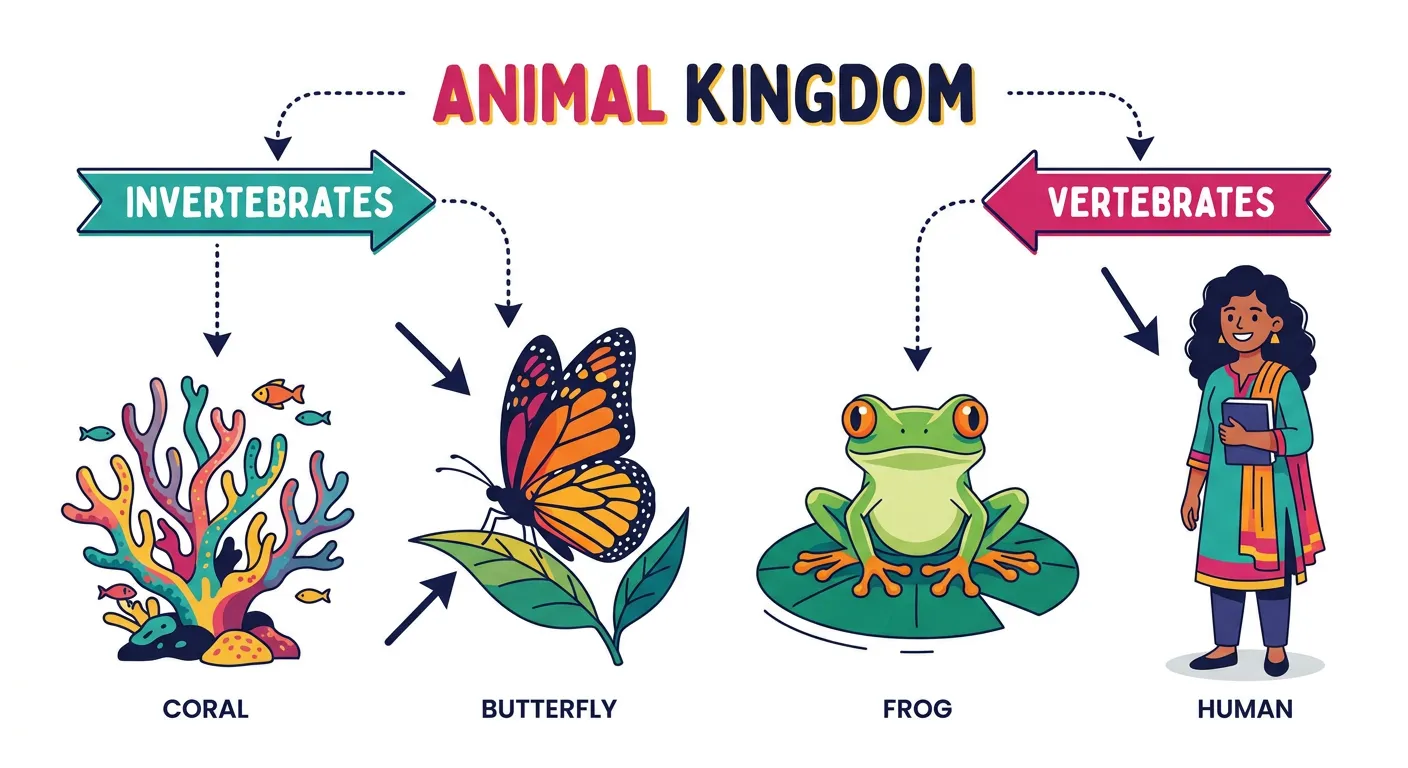
“Welcome, future doctors! Imagine the animal kingdom as a grand, bustling Indian city. From tiny sponges to massive whales, there are over a million species! Today, we categorize this biological chaos into organized phyla based on common body plans. Let’s start our NEET-level journey into animal classification!”
When we step into the vast world of Biology, specifically the Animal Kingdom, the sheer scale of biodiversity is enough to overwhelm any student. With over a million species already described and many more being discovered every year, trying to study each organism individually would be an impossible task. This is why classification isn't just a taxonomic exercise; it is a fundamental necessity. By grouping animals based on shared structural and functional characteristics, we create a roadmap that helps us understand the evolutionary relationships and the 'logic' behind why certain animals look and behave the way they do.
At the heart of this systematic approach is the concept of a 'Body Plan.' Every animal, whether it is a microscopic sponge or a massive blue whale, is built upon a fundamental architectural design. These designs are categorized using specific criteria such as the level of organization, symmetry, and the presence or absence of a body cavity. For a NEET aspirant, mastering these 'basis of classification' parameters is crucial because they form the foundation for all subsequent chapters in Zoology. Once you understand the blueprint, you can predict the features of a phylum without having to rote-memorize every single detail.
As we transition from the general diversity discussed in 'The Living World' to the specific complexities of Animalia, we use a hierarchical system. We look for fundamental features that are common to various individuals. These features serve as the 'diagnostic markers' for classification. For instance, the presence of a vertebral column isn't just a random trait; it’s a defining feature that separates billions of organisms into the category of vertebrates. This section will guide you through these fundamental markers, ensuring you develop the 'biological logic' needed to tackle complex MCQ patterns. The classification system acts as a language that biologists across the world use to communicate precisely about the identity and history of an organism.
Quick Revision Points
- Over 1.2 million animal species have been identified to date, necessitating a robust system of classification.
- Classification provides a systematic position to newly discovered species based on established criteria.
- Common fundamental features include levels of organization, body symmetry, and coelom nature.
- Systematics in animals helps bridge the gap between simple cellular life and complex multicellular organisms.
- Understanding these basics allows for a logical transition into detailed phylum-specific studies.
NEET Exam Angle
- NEET frequently tests the rationale behind classification rather than just naming groups.
- Questions often link 'The Living World' taxonomic hierarchy with 'Animal Kingdom' phyla.
- Remember: Classification is dynamic; as new molecular evidence emerges, the 'Basis of Classification' helps us re-evaluate evolutionary positions.
02Levels of Organization: From Cellular Aggregates to Complex Organ Systems
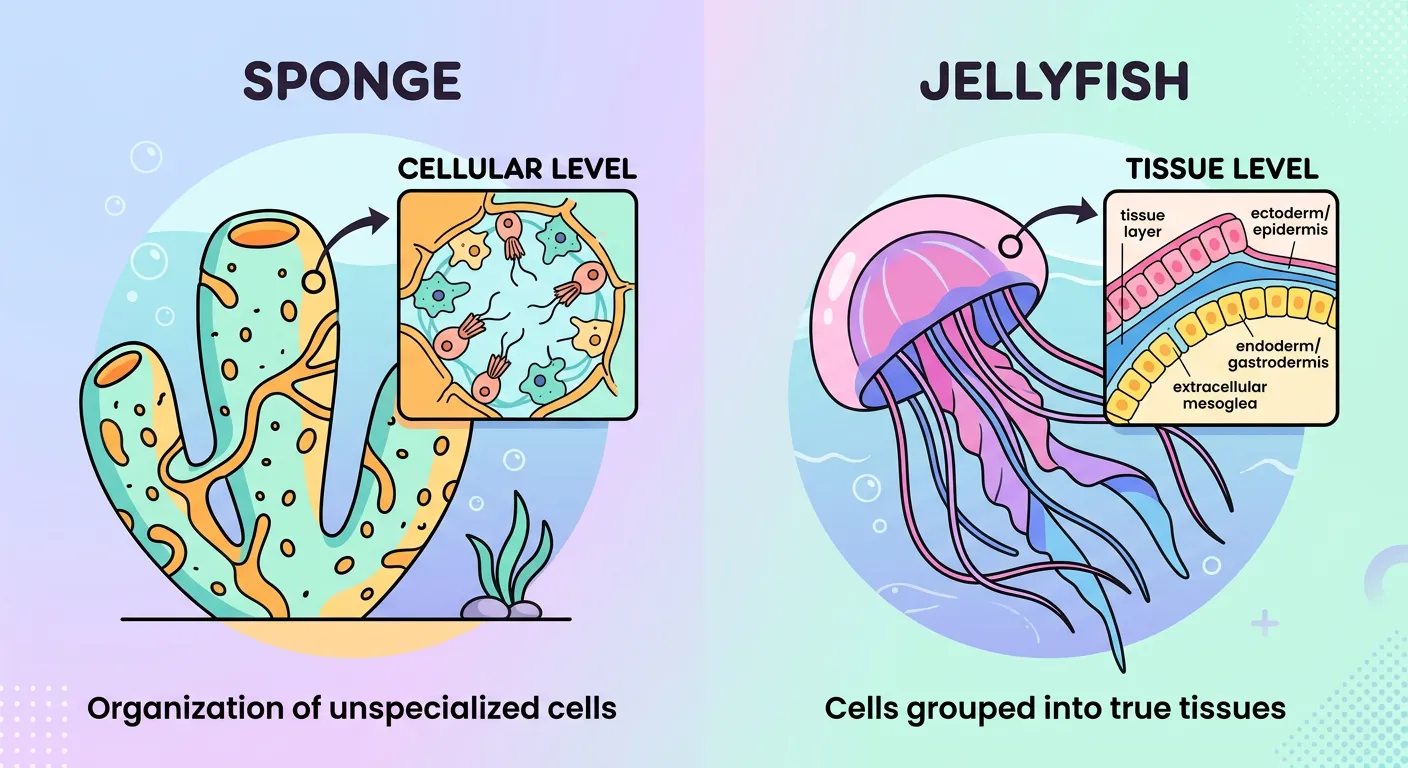
“First, the level of organization! Think of it like housing: Sponges are like a simple 'chawl' with basic cellular rooms. Moving up, Coelenterates are like a 'building' where cells work together as specialized tissues. Evolution is just upgrading from simple shacks to complex skyscrapers!”
One of the most intuitive ways to classify animals is by looking at how their cells are organized. Evolution is essentially a story of increasing complexity and the 'division of labor.' In the simplest animals, like those belonging to Phylum Porifera, we see the Cellular level of organization. Here, cells are not just hanging out; they exhibit a specific division of labor. Some cells handle digestion, while others handle water flow. However, these cells do not form coordinated tissues. Think of this as a group of individual workers in a field who are all doing their own thing to reach a common goal without a formal manager. Despite the lack of tissues, these organisms are remarkably efficient at survival in marine environments.
As we move up the evolutionary ladder to Coelenterates (Cnidarians) and Ctenophores, we encounter the Tissue level of organization. Here, cells performing the same function are arranged into tissues. This coordination allows for more complex movements and responses to the environment, such as the firing of stinging cells (cnidocytes). The next jump occurs in Platyhelminthes (flatworms), where tissues group together to form Organs. Each organ is specialized for a particular physiological function. Finally, from Aschelminthes all the way up to Chordates, we find the Organ System level of organization. In these animals, organs associate to form functional systems like the digestive, circulatory, or respiratory systems. Each system handles a major life process, making the organism highly efficient.
| Level of Organization | Key Characteristics | Phylum Examples |
|---|---|---|
| Cellular | Loose cell aggregates; division of labor exists but no tissues. | Porifera (Sponges) |
| Tissue | Specialized cells coordinate to form functional units. | Coelenterata, Ctenophora |
| Organ | Tissues grouped to perform a specific function. | Platyhelminthes |
| Organ System | Organs work together in integrated physiological systems. | Annelida to Chordata |
Quick Revision Points
- Porifera: Cellular level; basic division of labor within the cell colony.
- Cnidaria/Ctenophora: Tissue level; cells work together as a unit.
- Platyhelminthes: First phylum to show organ-level complexity.
- Annelids to Mammals: Highly complex organ system level of organization.
- The complexity of organ systems varies significantly even among different phyla (e.g., incomplete vs. complete digestive systems).
NEET Exam Angle
- Identify the first phylum to show 'Tissue level' (Cnidaria) vs 'Organ level' (Platyhelminthes).
- Be careful with 'Incomplete Digestive Systems' (single opening) in Platyhelminthes.
- Match-the-following questions often pair phyla with their respective level of organization.
03Body Symmetry: Decoding Radial and Bilateral Geometries
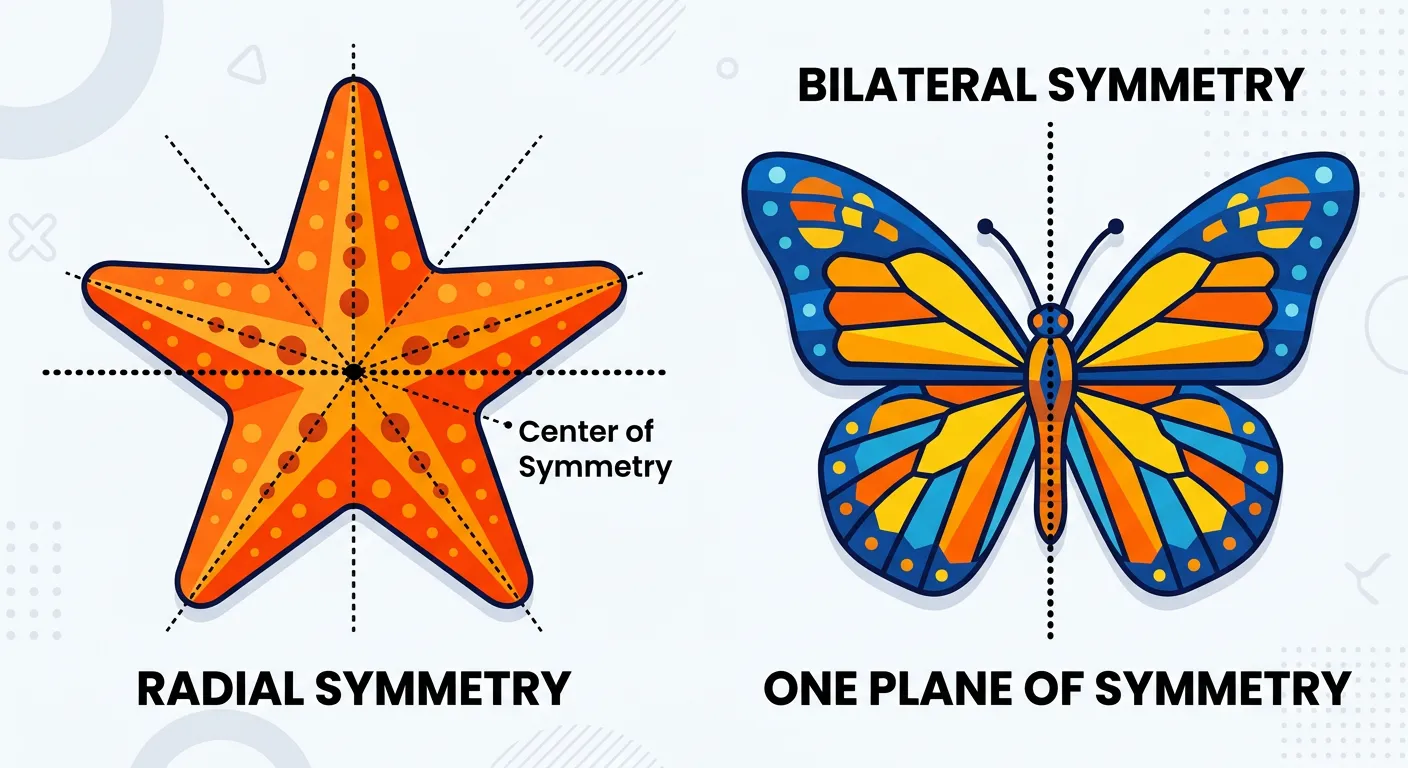
“Next, symmetry! If you cut a jellyfish anywhere through the center, it looks the same; that’s radial symmetry, like a rotating ceiling fan. But humans and butterflies have bilateral symmetry—only one line splits us into two identical left and right sides. Simple, right?”
Symmetry in biology refers to the geometric arrangement of body parts. It determines how an animal interacts with its environment. Some animals, like many sponges, are Asymmetrical, meaning no plane passing through their center can divide them into two equal halves. They are essentially 'shape-shifters' of the biological world. However, most animals follow a specific geometric plan.
Radial Symmetry is seen in animals like jellyfish (Coelenterates), Ctenophores, and adult Echinoderms. In these organisms, any plane passing through the central axis divides the body into two identical halves. This is an advantage for sessile (fixed) or slow-moving animals because they can sense food or danger from all directions equally—much like a circular table or a ceiling fan. It allows the animal to be equally responsive to stimuli from 360 degrees, which is vital for survival when you cannot turn your head to see what is behind you.
Bilateral Symmetry is the hallmark of more active, complex animals. Here, the body can be divided into identical left and right halves in only one plane. This symmetry is closely linked with Cephalization—the development of a head and sensory organs at the front end. Whether it's an Annelid, an Arthropod, or a Human, bilateral symmetry allows for streamlined movement and directed sensing. It’s the difference between a stationary fan (Radial) and a forward-moving car (Bilateral). This evolutionary shift was essential for the transition of life from water to land, where rapid directed response is key.
| Type of Symmetry | Description | Phylum / Example |
|---|---|---|
| Asymmetry | Cannot be divided into equal halves. | Many Sponges (Porifera) |
| Radial | Division into equal halves through any central plane. | Coelenterates, Ctenophores, Adult Echinoderms |
| Bilateral | Division into equal halves through only one plane. | Platyhelminthes to Chordates (except adult Echinoderms) |
Quick Revision Points
- Radial Symmetry: Advantageous for capturing prey from 360 degrees.
- Bilateral Symmetry: Encourages the formation of a distinct 'head' (Cephalization).
- Echinoderms: A unique NEET-favorite case; larvae are bilateral, but adults are radial.
- Symmetry is a primary criterion for dividing the Animalia kingdom into branches.
NEET Exam Angle
- CRITICAL TRAP: Adult Echinoderms exhibit radial symmetry, while their larvae are bilateral. This is a very frequent NEET question.
- Understand the plane of division: 'Any plane' (Radial) vs 'One plane' (Bilateral).
- Note that Platyhelminthes are the first group to show bilateral symmetry.
04Germ Layers and Coelom: The Internal Architecture of Life

“Now, the germ layers! Diploblastic animals have two layers, like a simple sandwich. Triploblastic animals add a middle 'mesoderm' layer—a total game changer! This allowed for complex organs. Whether an animal has a body cavity or coelom determines its structural complexity in the NEET exam.”
During embryonic development, the cells of an animal arrange themselves into distinct layers called Germ Layers. These layers are the 'fate-makers' of every tissue and organ in the body. Animals like sponges and coelenterates are Diploblastic, meaning they only have two layers: an outer ectoderm and an inner endoderm, with an undifferentiated jelly-like layer called mesoglea in between. However, the introduction of a third layer, the Mesoderm, was a monumental evolutionary leap. Animals from Platyhelminthes to Chordates are Triploblastic. This middle layer allowed for the development of complex muscles, the circulatory system, and internal organs, significantly increasing the animal's physical potential.
Closely tied to these germ layers is the concept of the Coelom (body cavity). The coelom is a fluid-filled space between the body wall and the gut wall, specifically lined by mesoderm. Its presence or absence is a major classification benchmark. Acoelomates (like Flatworms) lack this cavity entirely, meaning their internal organs are packed in a solid tissue mass. Pseudocoelomates (like Roundworms) have a cavity, but it's not lined by mesoderm; instead, the mesoderm is present as scattered pouches between the ectoderm and endoderm. This 'false coelom' still provides some room for organ growth but lacks the refined muscular control of true coelomates. Finally, Coelomates (Annelids to Chordates) possess a true, mesoderm-lined cavity. This cavity provides the 'shock-absorbing' space for organs to grow and move independently of the body wall, acting as a hydrostatic skeleton in many invertebrates like earthworms.
| Coelom Type | Characteristic | Phylum Example |
|---|---|---|
| Acoelomate | Body cavity is absent. | Platyhelminthes |
| Pseudocoelomate | Cavity present but mesoderm is in scattered pouches. | Aschelminthes (Roundworms) |
| Coelomate | True cavity present, fully lined by mesoderm. | Annelida, Arthropoda, Mollusca, etc. |
Quick Revision Points
- Diploblastic: Ectoderm + Endoderm (e.g., Hydra).
- Triploblastic: Ectoderm + Mesoderm + Endoderm (e.g., Human).
- Mesoglea: The non-cellular layer in diploblastic animals.
- Coelom Significance: Allows for organ compartmentalization-vs-eukaryotic-cell-structure-neet-biology)-vs-eukaryotic-cell-structure-neet-biology)-vs-eukaryotic-cell-structure-neet-biology)-vs-eukaryotic-cell-structure-neet-biology)-vs-eukaryotic-cell-structure-neet-biology)-vs-eukaryotic-cell-structure-neet-biology)-vs-eukaryotic-cell-structure-neet-biology)-vs-eukaryotic-cell-structure-neet-biology)-vs-eukaryotic-cell-structure-neet-biology)-vs-eukaryotic-cell-structure-neet-biology)-vs-eukaryotic-cell-structure-neet-biology)-vs-eukaryotic-cell-structure-neet-biology)-vs-eukaryotic-cell-structure-neet-biology)-vs-eukaryotic-cell-structure-neet-biology)-vs-eukaryotic-cell-structure-neet-biology)-vs-eukaryotic-cell-structure-neet-biology)-vs-eukaryotic-cell-structure-neet-biology)-vs-eukaryotic-cell-structure-neet-biology)-vs-eukaryotic-cell-structure-neet-biology)-vs-eukaryotic-cell-structure-neet-biology)-vs-eukaryotic-cell-structure-neet-biology)-vs-eukaryotic-cell-structure-neet-biology)-vs-eukaryotic-cell-structure-neet-biology) and hydrostatic support.
- Aschelminthes: The ONLY phylum that is pseudocoelomate.
NEET Exam Angle
- The 'Scattered Pouches' description is the definitive keyword for Pseudocoelomates in MCQs.
- Remember the order: Acoelomate (Platy) -> Pseudocoelomate (Aschel) -> Coelomate (Annelids onwards).
- NEET often asks which layer forms the coelom (answer: Mesoderm).
05Circulatory Systems: Efficiency of Open vs. Closed Transport Networks
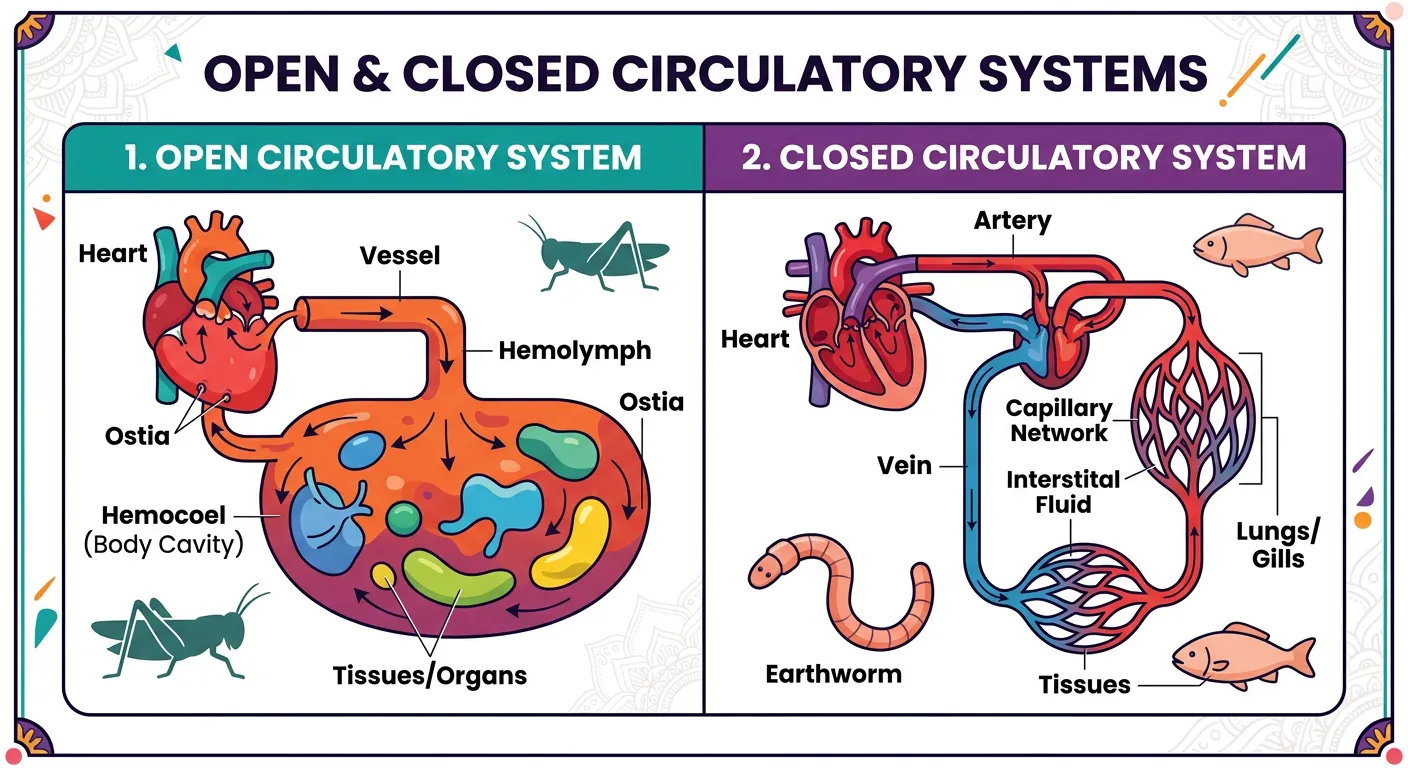
“Think of circulatory systems as traffic: Open systems are like a village market where blood just flows everywhere. Closed systems are like a well-planned highway network with pipes—the veins and arteries—ensuring efficient delivery. More efficient transport means more complex life. Keep this distinction in your notes!”
As animals grew larger and more complex, simple diffusion was no longer enough to transport nutrients and oxygen to every cell. This led to the evolution of circulatory systems. There are two primary types: Open and Closed. In an Open Circulatory System, the blood (often called hemolymph) is pumped by the heart into open spaces called sinuses or lacunae. The tissues and organs are literally 'bathed' in blood, which fills the body cavity known as the hemocoel. This system is common in Arthropods and most Molluscs. While it's energy-efficient for smaller animals with lower metabolic rates, it doesn't allow for high-pressure delivery to specific organs, which limits the potential for very large body sizes on land.
In contrast, the Closed Circulatory System is like a high-speed highway network. The blood circulates through a closed network of vessels (arteries, veins, and capillaries) and never leaves them to bathe the tissues directly. Instead, exchange happens across the thin walls of the capillaries. This system allows for precise regulation of blood flow and high pressure, supporting the high metabolic demands of active animals. Interestingly, the first phylum to exhibit a closed circulatory system is Annelida (like the earthworm). This is a common point of confusion for students who assume only higher vertebrates have closed systems. Understanding these transport patterns helps us see how animals adapted to their environmental and metabolic needs. For instance, Cephalopods (like Octopuses) evolved closed systems to support their highly active predatory lifestyle, despite being Molluscs. This illustrates that efficiency in transport is a major driver of evolutionary success.
Quick Revision Points
- Open System: Blood flows through sinuses; lower pressure (Arthropods, Molluscs).
- Closed System: Blood flows through vessels; higher pressure (Annelids, Chordates).
- Hemocoel: The blood-filled cavity found in animals with open circulatory systems.
- Efficiency: Closed systems allow for more rapid and targeted oxygen delivery.
- Evolutionary Trend: Increasing complexity of the heart (from 2-chambered to 4-chambered) follows the development of closed systems.
NEET Exam Angle
- Identify exceptions: Most Molluscs have open systems, but Cephalopods (like Octopus) have closed systems.
- Annelida is frequently used in 'True/False' questions regarding closed circulatory systems.
- Know that the closed system is more efficient for larger body sizes due to pressure maintenance.
06Segmentation and the Notochord: Diagnostic Features of Advanced Phyla
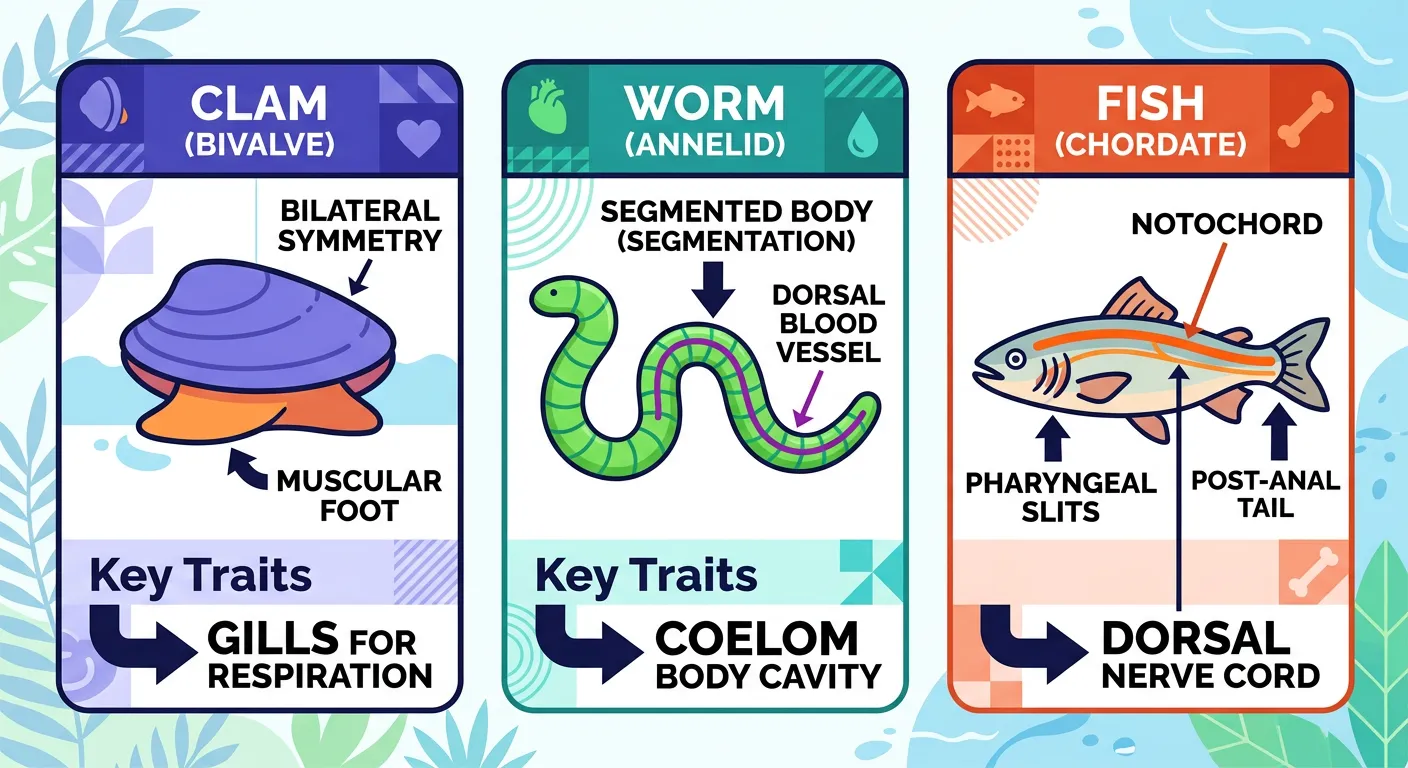
“We can't forget segmentation and notochords! Segmentation is like an apartment block with repeating floors, seen in earthworms. The notochord? That’s the structural foundation, the steel beam of the body that eventually becomes our backbone. It is the ultimate diagnostic feature for our group, the Chordates!”
Two of the final major criteria for animal classification are segmentation and the presence of a notochord. Segmentation, or Metamerism, refers to a body design where the body is externally and internally divided into segments with a serial repetition of at least some organs. The classic example is the earthworm, where the rings you see on the outside correspond to internal septa. This metameric segmentation is not just for show; it allows for highly coordinated movement as different segments can contract or expand independently. In Arthropods, these segments often fuse to form functional regions like the head, thorax, and abdomen (Tagmatization), allowing for even more specialized tasks.
Finally, we have the Notochord, a mesodermally derived rod-like structure formed on the dorsal side during embryonic development in some animals. The presence of this 'biological steel beam' is the ultimate divider in the animal kingdom. Animals that possess a notochord at any stage of their life are called Chordates, while those that lack it are Non-Chordates (Porifera to Echinoderms). In higher vertebrates, this notochord is replaced by a bony or cartilaginous vertebral column (the backbone). This single feature defines our own biological heritage and remains a high-priority topic for NEET. It is crucial to remember that the notochord is not the same as the nerve cord; the notochord is skeletal in function, whereas the nerve cord is part of the nervous system. The dorsal position of the notochord in chordates provides the necessary rigidity for complex muscle attachment, which facilitated the evolution of powerful swimming and later, walking movements. This structural advancement was the key to the massive success of the Chordata phylum.
| Feature | Present in | Significance |
|---|---|---|
| Metamerism | Annelida, Arthropoda, Chordata | Serial repetition of segments for movement/specialization. |
| Notochord | Chordata | Provides structural support; precursor to the backbone. |
| Pseudo-segmentation | Platyhelminthes (Tapeworm) | Not true metamerism; segments added from the neck. |
Quick Revision Points
- Metamerism: True segmentation seen in Annelids; serial repetition of organs.
- Notochord: Derived from the Mesoderm; located dorsally.
- Non-Chordates: Phyla from Porifera to Hemichordata (in older texts) or Echinodermata.
- Chordates: Must have a notochord at some point in their life cycle.
NEET Exam Angle
- Differentiate between 'Metamerism' (Earthworm) and 'Pseudometamerism' (Tapeworm).
- Notochord origin: Always Mesodermal (this is a high-yield embryology link).
- Match-the-following questions often use the term 'Dorsal tubular nerve cord' vs 'Notochord'.
07Synthesizing the Basis of Classification: A Strategic Map for NEET Success
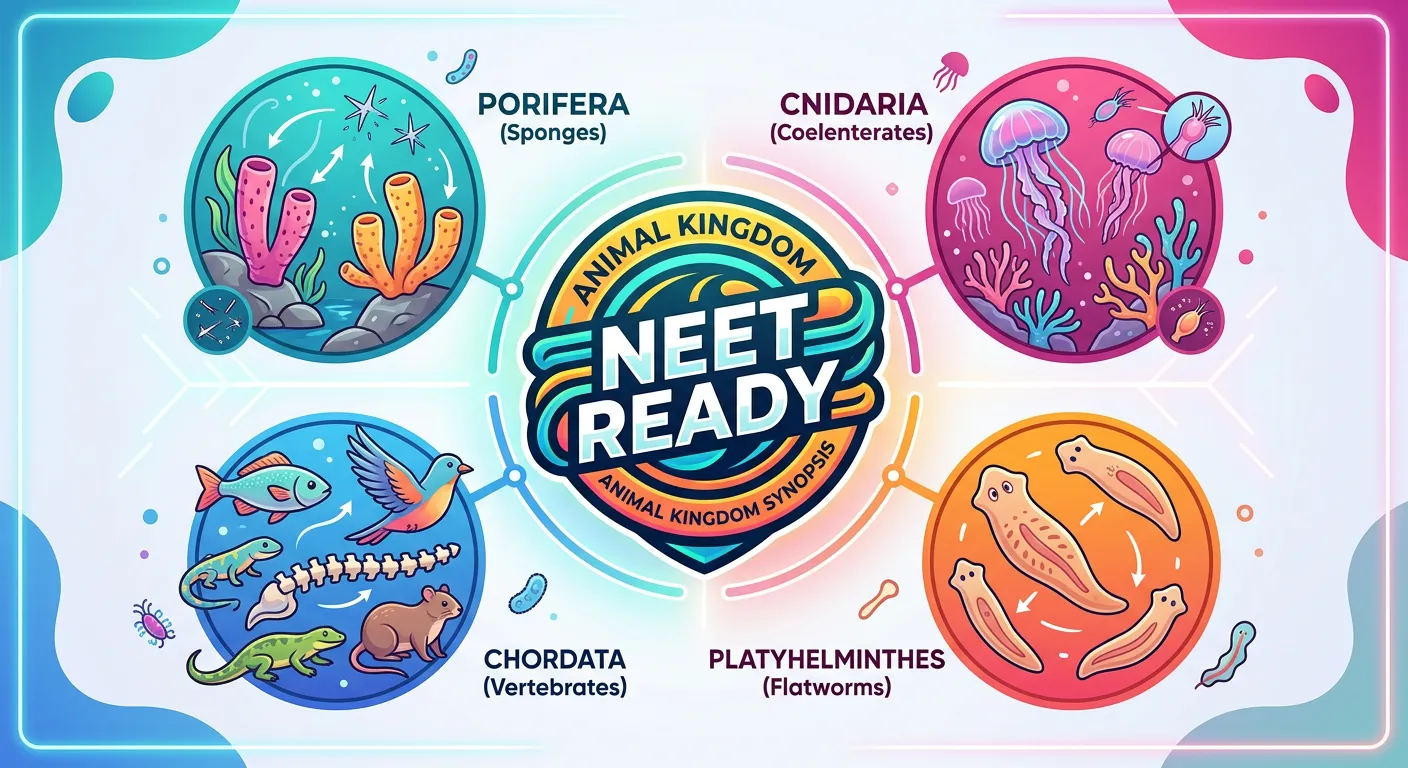
“We've covered the basics: organization, symmetry, layers, and structure. You now have the map to navigate the entire Animal Kingdom. Memorizing these features is your key to acing those NEET questions. Stay curious, keep revising, and keep building that biological logic. See you in the next lesson!”
As we conclude our exploration into the basis of classification, it's important to see these features not as isolated facts, but as a cohesive map. When you encounter a question about a specific animal, you should run through a mental checklist: What is its level of organization? Is it symmetrical? How many germ layers does it have? Does it have a true coelom? This 'Biological Logic' is far more effective than rote memorization because it allows you to solve application-based MCQs even if you forget the specific name of a species. For example, if you know an animal is an Annelid, you automatically know it's a triploblastic, bilateral, coelomate with metamerism.
For the NEET exam, the classification flowchart provided in the NCERT textbook is your most valuable tool. It summarizes everything we've discussed: how animals are first divided by their level of organization, then subdivided by symmetry, and finally categorized by the nature of their coelom. This hierarchy represents the evolutionary journey of life on Earth. By mastering this 'Basis of Classification,' you have unlocked the key to the entire Animal Kingdom unit. Keep practicing the identification of phyla based on these diagnostic features, and you'll find that Zoology becomes one of the most scoring sections of your Biology paper. Remember to pay special attention to the 'exceptions' like Echinoderm symmetry, as these are the most common targets for paper setters. Use mnemonics to remember the order of phyla and their primary features. A strong grasp here will make the detailed study of individual phyla much smoother. As you prepare, visualize the structural changes from sponges to chordates—the development of tissues, then organs, then the coelom, and finally the notochord. This progressive view will help you answer 'Assertion-Reason' questions where you must explain the 'why' behind an animal's classification.
Quick Revision Points
- Checklist: Organization -> Symmetry -> Coelom -> Segmentation -> Notochord.
- NCERT Flowchart: The definitive guide for all NEET-level phylum identification.
- Logic over Rote: Use diagnostic features to eliminate options in MCQs.
- Continuity: These basics will be applied to every single phylum study in the coming lessons.
- Revision: Regularly draw the classification table to cement the phyla order in your mind.
NEET Exam Angle
- NEET often presents 'Statement-type' questions where you must verify if a phylum satisfies all given conditions (e.g., "An animal is triploblastic, bilateral, and pseudocoelomate").
- Focus on the overlap: For example, all Coelomates are also Triploblastic and Bilateral (with the Echinoderm exception).
- High-yield tip: Practice 'Odd One Out' questions based on these 6 criteria.
Recommended Reading
Explore related Biology topics to build deeper chapter connections for NEET.
- What is Living · Topic 1.1
- Kingdom Fungi · Topic 1.10
- Lichens · Topic 1.11
- Viruses and Viroids · Topic 1.12
- Algae · Topic 1.13
- Bryophytes · Topic 1.14
- Jump to Key Terms (Quick Revision)
- Review Common NEET Mistakes
- Solve NEET Practice MCQs
- Read Topic FAQs
- Practice NEET MCQs
- Solve NEET PYQs
📚 Key Terms
⚠️ Common NEET Mistakes
- 1Thinking all invertebrates have radial symmetry (Actually, most are bilateral).
- 2Confusing the Notochord (skeletal) with the Nerve Cord (nervous system).
- 3Assuming only mammals or vertebrates have closed circulatory systems (Annelids have them too).
- 4Forgetting that adult Echinoderms are radial while their larvae are bilateral.
- 5Categorizing Platyhelminthes as pseudocoelomates instead of acoelomates.
📝 NEET PYQ & Practice Questions
Test your understanding of Classification of Animals with NCERT-aligned sample questions.
Which of the following statements is correct regarding "Metamerism" in the context of NEET Biology?
In NEET question papers, questions related to "Classification of Animals" predominantly test:
Consider Coelom associated with Classification of Animals. What is the primary characteristic expected in NEET MCQs?
Master Classification of Animals with NeetQ AI Tutor
Practice 50+ topic-wise MCQs, previous 15 years NEET questions, and get step-by-step doubt resolution instantly.
❓ Frequently Asked Questions
What is the difference between radial and bilateral symmetry with examples?
Radial symmetry allows an animal to be divided into identical halves by any plane passing through the central axis (e.g., Jellyfish, Starfish). Bilateral symmetry allows division into identical left and right halves in only one specific plane (e.g., Humans, Crab, Earthworm).
Why are Aschelminthes called pseudocoelomates?
Aschelminthes (roundworms) possess a body cavity, but it is not completely lined by mesoderm. Instead, the mesoderm exists as scattered pouches between the ectoderm and endoderm, hence the term 'pseudo' (false) coelom.
Which phylum exhibits the first instance of a closed circulatory system?
Phylum Annelida (e.g., Earthworms) is the first group in the animal kingdom to exhibit a closed circulatory system where blood flows through a network of vessels.
What is the evolutionary significance of the triploblastic condition?
The development of a third germ layer, the mesoderm, allowed for the evolution of complex organs, specialized muscular systems, and a true body cavity (coelom), leading to greater structural complexity.
How does the cellular level of organization differ from the tissue level?
In cellular level (Porifera), cells are loose aggregates with individual functions. In tissue level (Coelenterata), cells performing the same function are coordinated and organized into a higher functional unit called a tissue.
Can an animal be triploblastic but acoelomate? Give an example.
Yes. Phylum Platyhelminthes (Flatworms) are triploblastic (have three germ layers) but lack a body cavity (coelom), making them acoelomates.
Written By
NEET Content Strategist & Biology Expert
Sangita Kumari is a NEET educator and content strategist with over 6 years of experience teaching Biology, Chemistry, and Physics to Class 11 and 12 aspirants. She helps bridge the gap between traditional NCERT preparation and modern AI-powered learning. Her content is trusted by thousands of NEET aspirants across India.