🎬 Video Lesson Available
Watch the full 7-slide video lesson for Inflorescence with AI teacher narration and visual explanations.
Inflorescence — Master Inflorescence for NEET! Learn differences between Racemose and Cymose patterns with acropetal/basipetal succession, examples, and high-yield mnemonics.
01Floral Architecture: Defining Inflorescence and the Floral Axis
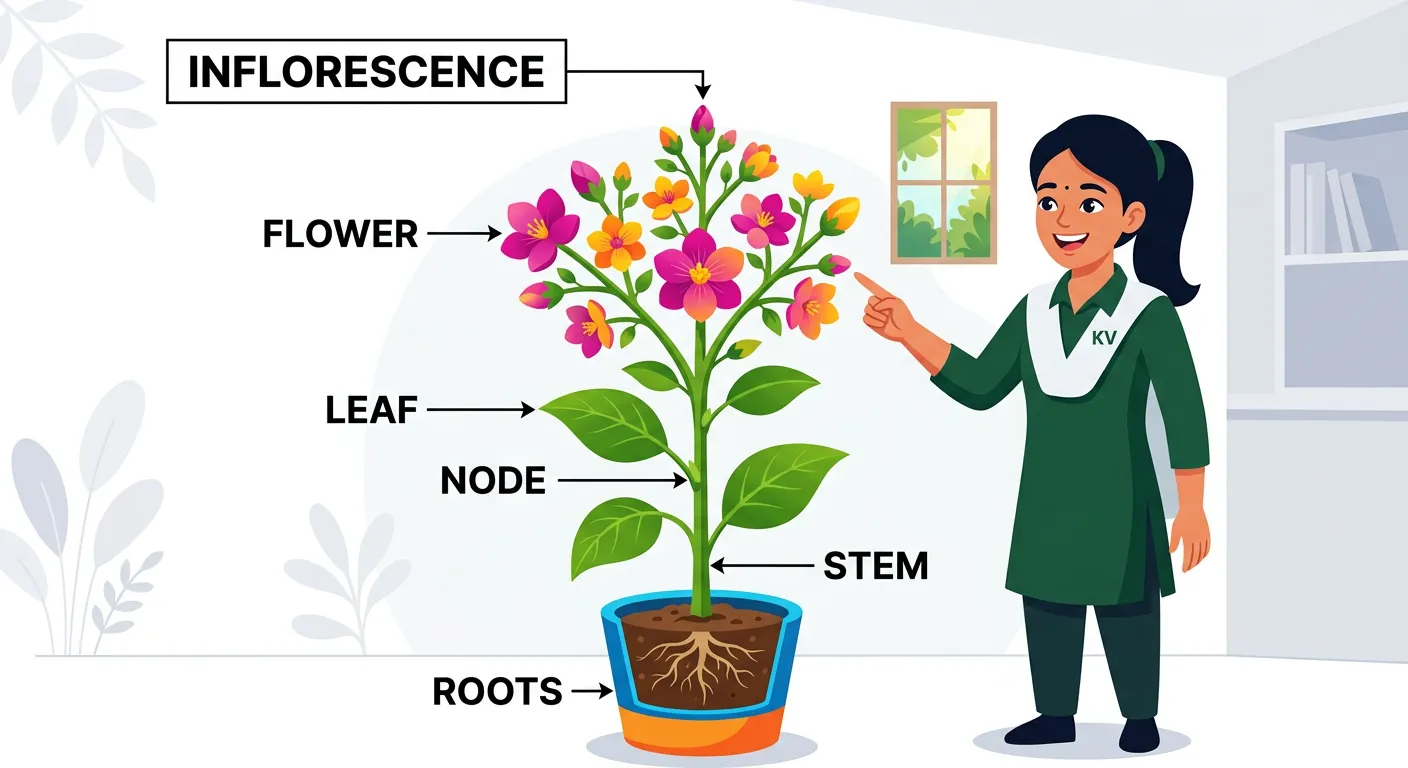
“Welcome, future doctors! Ever wondered why flowers grow in patterns? That’s 'Inflorescence'—the arrangement of flowers on a floral axis. Think of it like a seating chart at a big Indian wedding; everything is organized, and placement determines who gets the most attention!”
Welcome to one of the most visually rewarding topics in plant morphology. In biology, we don’t just look at a flower as a single unit of beauty; we look at how the plant organizes these reproductive structures to maximize its survival. This brings us to the concept of Inflorescence. By definition, inflorescence is the arrangement and distribution of flowers on the floral axis, also scientifically known as the peduncle. Understanding this arrangement is crucial because it dictates how a plant interacts with its environment, particularly with pollinators like bees, butterflies, and even the wind.
Think of the peduncle as a stage and the flowers as the performers. The way they are positioned isn't accidental. A plant might group flowers closely to create a massive splash of color that attracts insects from a distance, or it might space them out to ensure each flower has enough room to develop its fruit. In your NEET preparation, you must distinguish between a 'solitary' flower—where a single flower sits alone at the apex or in the axil—and an inflorescence, which involves a cluster of flowers sharing a common axis. This distinction is the first step in mastering the structural organization of flowering plants.
From an evolutionary perspective, the 'seating chart' of flowers ensures that pollination is efficient. If all flowers bloomed at once in a cramped space, they might compete for the same pollinator or fail to develop properly due to lack of nutrients. By organizing them into specific patterns like Racemose or Cymose, the plant manages its resources and timing perfectly. As we dive deeper, remember that the behavior of the growing tip (the apex) of the floral axis is what determines the type of inflorescence you are looking at.
Quick Revision Points
- Inflorescence: The specific arrangement of flowers on the floral axis (peduncle).
- Peduncle: The main stalk or axis that supports an entire inflorescence.
- Solitary Flower: A flower that grows alone, not as part of a cluster (e.g., Hibiscus).
- Biological Significance: Enhances visibility for pollinators and optimizes seed dispersal.
- Apex Fate: The classification depends on whether the apex continues to grow or transforms into a flower.
NEET Exam Angle
- Focus on the definition of the 'peduncle' as it frequently appears in descriptive questions.
- Differentiate between 'solitary axillary' and 'solitary terminal' positions for basic morphology marks.
- Understand that inflorescence is a modified shoot where the shoot apical meristem changes into a floral meristem.
02Racemose Inflorescence: The Logic of Acropetal Succession
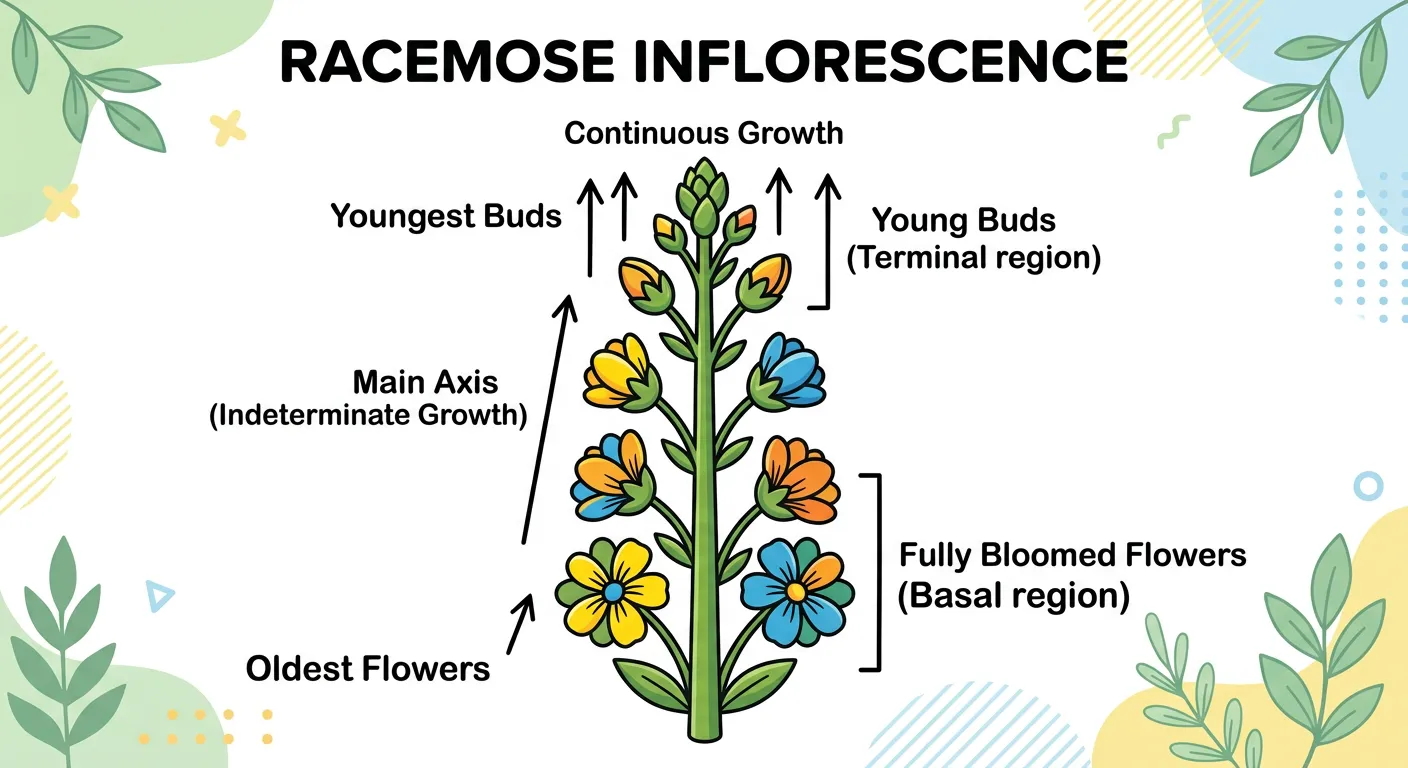
“First up, Racemose! Imagine a never-ending staircase. The main axis grows indefinitely, and flowers bloom from the bottom up in an acropetal succession. The younger buds are always at the tip, like the youngest siblings sitting at the front of the family photo.”
When you observe a plant where the main axis seems to stretch endlessly toward the sky, you are likely looking at a Racemose inflorescence. The defining characteristic here is the 'indefinite growth' of the primary floral axis. In these plants, the growing point (the apical meristem) does not terminate in a flower. Instead, it continues to produce new floral buds as it elongates. This creates a vertical hierarchy that is very easy to identify once you know what to look for.
The flowers in a racemose system are arranged in what we call acropetal succession. This is a fancy botanical term for a simple concept: the oldest flowers are located at the base of the axis, while the youngest flowers and unopened buds are found at the apex. Imagine a never-ending staircase where the oldest steps are at the bottom and new steps are constantly being added at the top. This ensures that the plant can continue to produce flowers over a long period, increasing the window of time available for pollination.
In many competitive exams, you will see this described as a 'centripetal' opening if the axis is flattened (like in a sunflower head, which is a specialized racemose type), but for the standard vertical raceme, acropetal is the keyword. This growth pattern is highly efficient because it allows the plant to stagger its blooming phase. If a sudden frost or a pest attack occurs, only a few flowers are lost, while the buds at the top remain protected and ready to bloom later.
Quick Revision Points
- Growth Type: Indefinite/Indeterminate growth of the main axis.
- Succession: Acropetal (Oldest at bottom, Youngest at top).
- Apex Status: The main axis never ends in a flower; it continues to grow.
- Visual Cue: The plant looks like a tapering tower of flowers.
- Mnemonic: 'R' in Racemose stands for 'Running'—the axis keeps running upwards.
NEET Exam Angle
- Questions often ask to identify the position of the youngest bud in a Racemose axis (Answer: Apex).
- Recognize that acropetal succession is the hallmark of the Racemose type.
- Be prepared to identify Racemose patterns in family descriptions, especially Brassicaceae.
| Feature | Racemose Detail |
|---|---|
| Main Axis Growth | Unlimited / Continues to grow |
| Flower Arrangement | Acropetal (Base to Top) |
| Opening of Flowers | Centripetal (Outer to Inner) |
| Termination | No terminal flower |
03Cymose Inflorescence: Terminal Flowering and Basipetal Patterns
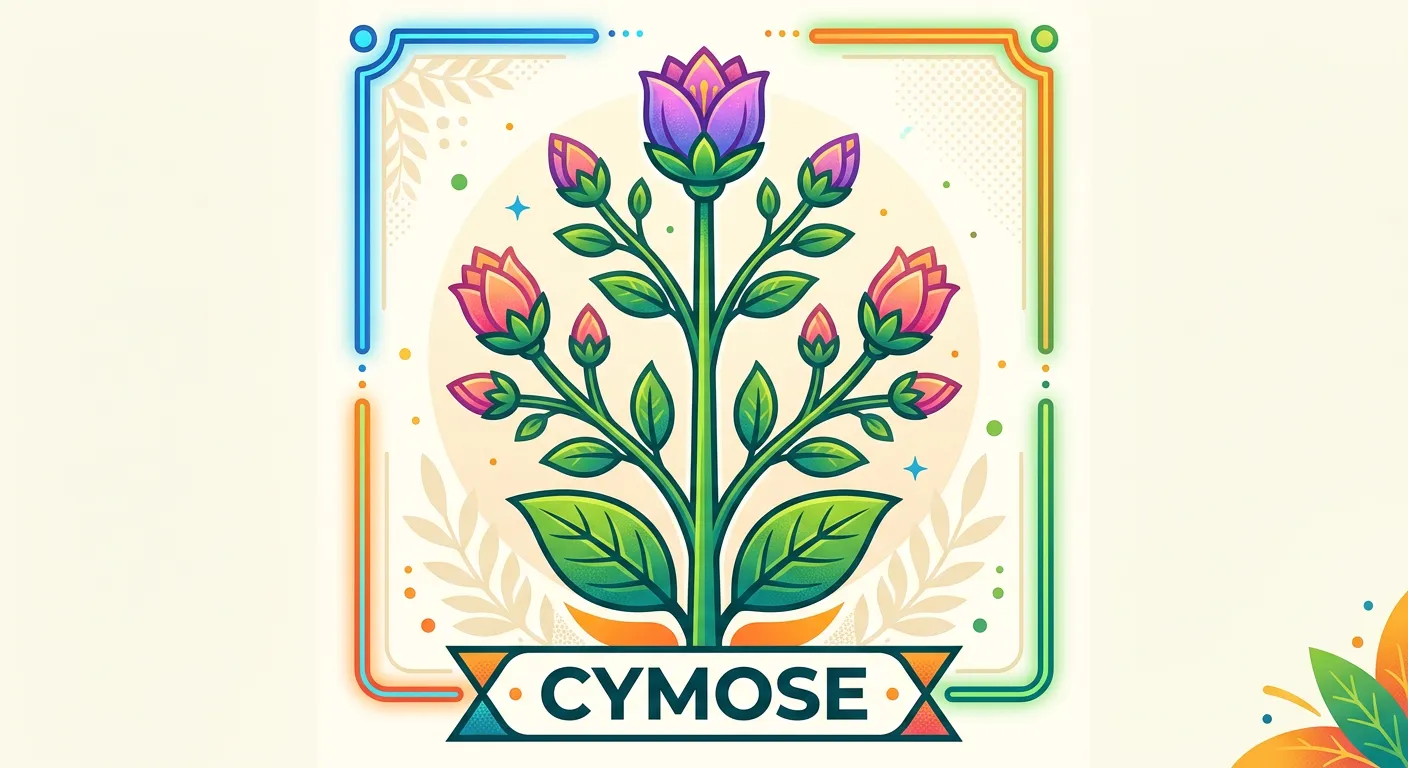
“Next is Cymose. Here, the bossy main axis ends in a flower, stopping further upward growth. It’s 'basipetal' succession—the oldest flower is right at the top! New flowers bloom on side branches, almost like a tree branching out as it grows older.”
In contrast to the continuous growth of Racemose, the Cymose inflorescence is characterized by 'definite growth.' Here, the main axis is somewhat 'bossy'—it grows for a short period and then immediately terminates in a flower. Once that terminal flower forms, the upward growth of that specific axis stops completely. This is a fundamental shift in the plant’s developmental logic, shifting the focus from vertical height to lateral branching.
Because the main axis ends in a flower, subsequent flowers must develop from lateral branches produced below the terminal flower. This results in basipetal succession. In this pattern, the oldest flower is at the very top (the terminal position), and the younger flowers develop lower down on the sides. If you look at a Cymose cluster, the flower in the center or at the peak is usually the one that withered first, while the fresh blooms are found at the periphery or lower branches.
This growth strategy is often associated with plants that prefer a more compact or spreading shape. By stopping vertical growth, the plant can allocate resources into several side branches simultaneously. This often results in a broader, more umbrella-like or bushier appearance compared to the tall, spike-like look of Racemose plants. For NEET, remembering the term 'basipetal' is non-negotiable, as it is the primary differentiator used in multiple-choice questions regarding Solanum or Jasmine.
Quick Revision Points
- Growth Type: Definite/Determinate growth of the main axis.
- Succession: Basipetal (Oldest at top, Youngest at base).
- Apex Status: The main axis terminates in a flower, stopping vertical growth.
- Branching: Lateral branches take over growth once the main axis stops.
- Visual Cue: Older flowers appear centrally or at the top of the cluster.
NEET Exam Angle
- Terminal flower presence is the 'deciding factor' for Cymose classification.
- Basipetal succession implies the oldest flower is the highest or most central.
- Understand that the growth of the peduncle is limited in this type.
04Indefinite vs. Definite: A Comparative Analysis of Growth Potential
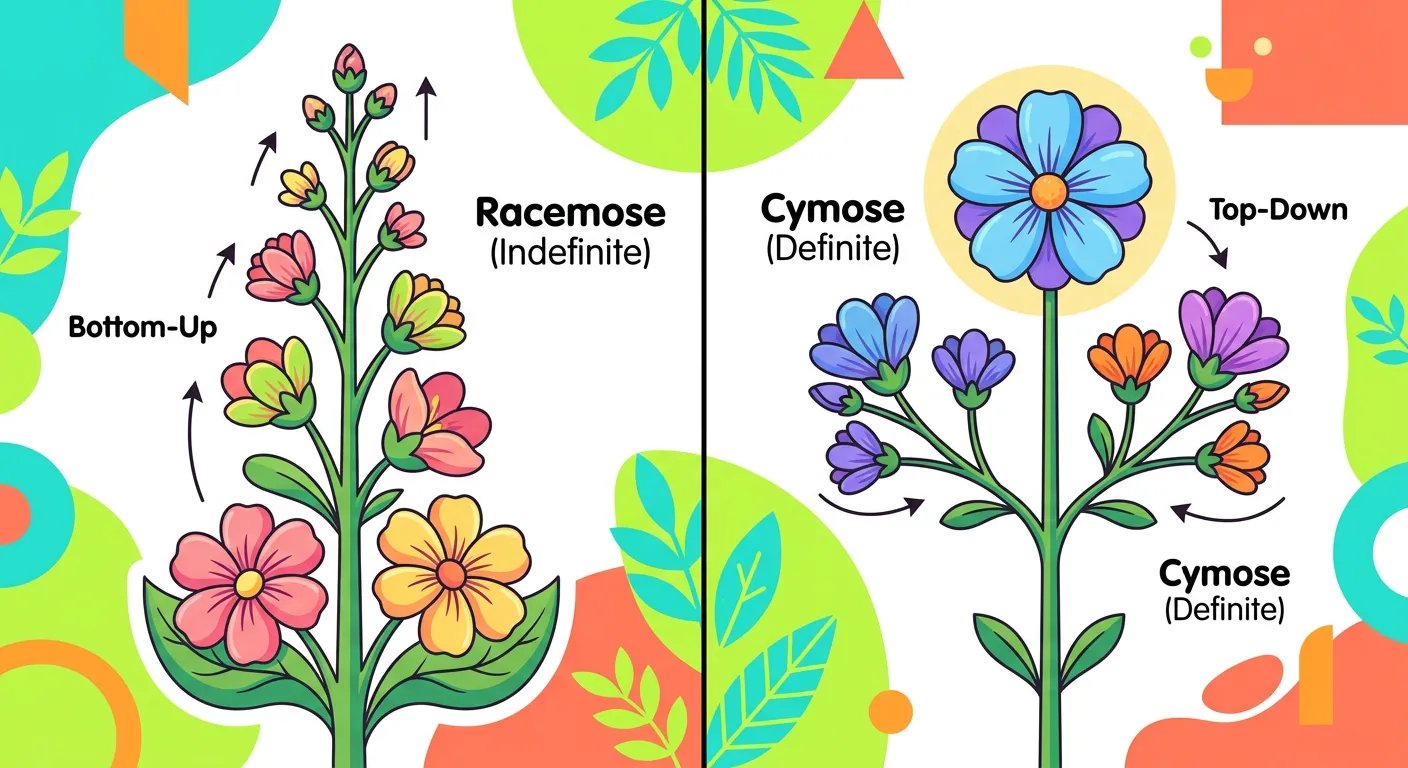
“The biggest difference? Growth potential! Racemose is 'indefinite', meaning it keeps growing like a ambitious NEET aspirant. Cymose is 'definite', stopping growth by producing a terminal flower. Remember this: Racemose keeps going; Cymose stops growing.”
To master this topic for NEET, you must be able to compare Racemose and Cymose side-by-side without hesitation. The core difference lies in the meristematic activity at the tip of the floral axis. In Racemose, the apical meristem remains vegetative in terms of growth (it keeps producing the axis) while laterally producing floral meristems. In Cymose, the apical meristem itself is completely consumed or converted into a floral meristem, which effectively places a 'cap' on the height of that axis.
This leads to different opening sequences. In Racemose (centripetal), the flowers open from the outside toward the center or from the bottom toward the top. In Cymose (centrifugal), they open from the center toward the outside or from the top toward the bottom. These terms—centripetal and centrifugal—are high-yield keywords that often separate the top-ranking students from the rest. Think of 'centripetal' as moving toward the center of attention (the apex), and 'centrifugal' as flying away from the center (since the center is already occupied by an old flower).
Another point of comparison is the overall shape. Racemose inflorescences often form elongated structures like spikes or racemes. Cymose inflorescences tend to be broader and more complex, often forming 'cymes' that can be monochasial (one branch) or dichasial (two branches). Understanding these structural nuances helps in identifying plant families during practical exams and taxonomic studies.
Quick Revision Points
- Racemose: Indefinite growth; Acropetal succession; Centripetal opening.
- Cymose: Definite growth; Basipetal succession; Centrifugal opening.
- Key Comparison: Does the axis end in a flower? (Yes for Cymose, No for Racemose).
- Arrangement: Racemose is usually linear/vertical; Cymose is often branched/clustered.
NEET Exam Angle
- A common PYQ asks: "In which type of inflorescence does the main axis continue to grow?" (Answer: Racemose).
- Study the comparison table below carefully for 'Match the Following' type questions.
| Character | Racemose | Cymose |
|---|---|---|
| Growth of Axis | Unlimited | Limited |
| Terminal Flower | Absent | Present |
| Flower Sequence | Acropetal | Basipetal |
| Opening Order | Centripetal | Centrifugal |
| Example | Mustard, Radish | Jasmine, Solanum |
05Racemose in Nature: Botanical Study of the Mustard Family
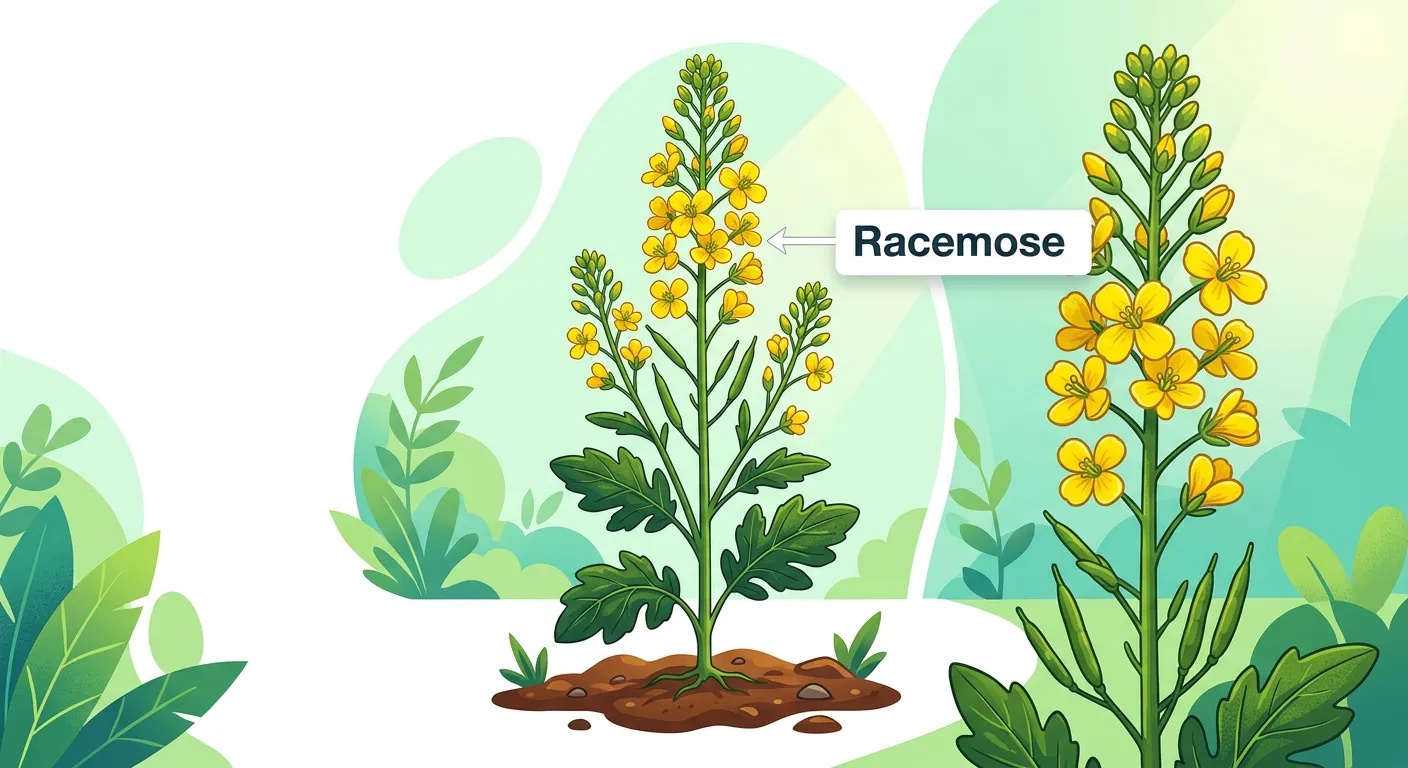
“Let’s look at nature. Mustard plants are classic Racemose examples. Just like a long queue for a movie ticket, the flowers are arranged along the central axis, one after another, always moving upwards. It's perfectly ordered and efficient for pollination.”
Let’s ground these theories in real-world examples. The most famous representative of the Racemose inflorescence in the NCERT syllabus is Mustard (Brassica). If you look at a mustard field, you'll see long stalks where the yellow flowers are arranged sequentially. The flowers at the bottom of the stalk are fully open and may even be forming small seed pods (siliqua), while the very top of the stalk is still crowded with tiny, green, unopened buds.
This is the 'movie ticket queue' of the plant world. Just as people join the back of a line and move forward, new buds are added at the top and 'move down' the hierarchy as the axis grows longer. This ensures a consistent supply of nectar and pollen for insects over several weeks. Other common examples include Radish and Lupins. In these plants, the central axis acts as a sturdy backbone that supports the weight of numerous flowers without ever stopping its upward progress.
In the family Brassicaceae, this arrangement is standard. When describing this family for your NEET theory papers, you must mention the 'raceme' inflorescence. It is a key taxonomic character. The efficiency of the racemose pattern is evident in how these plants can produce hundreds of seeds on a single axis by simply continuing to grow as long as environmental conditions allow.
Quick Revision Points
- Mustard (Brassica): The gold standard example for Racemose.
- Radish: Another common example showing acropetal growth.
- Pollination Strategy: Continuous blooming provides a steady resource for pollinators.
- Taxonomy Link: Racemose is a characteristic feature of the Brassicaceae family.
- Succession check: In Mustard, you will never find the oldest flower at the very tip.
NEET Exam Angle
- Mustard and Radish are high-frequency examples in MCQ options.
- Relate the inflorescence type to the family 'Brassicaceae' (Cruciferae).
- Understand that in a 'Raceme' (a specific type of racemose), flowers are pedicellate (have stalks).
| Plant Example | Type | Key Observation |
|---|---|---|
| Mustard | Racemose | Long axis, buds at the tip |
| Radish | Racemose | Continuous vertical growth |
| Lupin | Racemose | Densely packed acropetal flowers |
06Cymose Superstars: Examining Jasmine and Solanum Structures
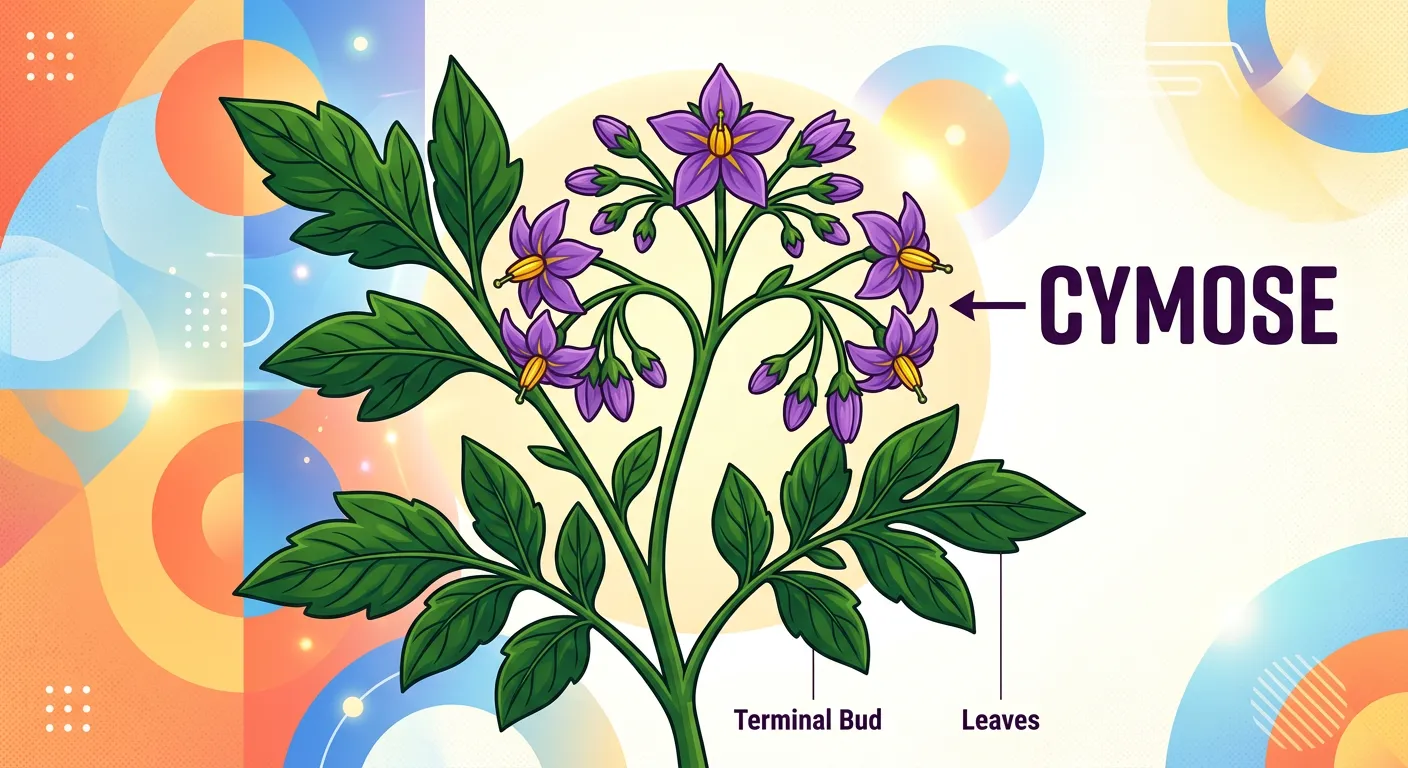
“Now, observe the Jasmine or Solanum. These are our Cymose superstars. Instead of one long line, they form compact, clustered groups. The terminal flower develops first, acting like a 'stop' sign, forcing the plant to grow outwards instead of just upwards.”
Now let’s look at the 'Cymose superstars.' When you study the Solanaceae family (the potato and tomato family), you will find that the inflorescence is typically cymose. In Solanum nigrum (Makoi), for example, the main axis ends in a flower, and the growth continues through lateral buds. This creates a very different silhouette compared to mustard; instead of a long spike, you get a cluster where the central or top-most flower is the most mature.
Jasmine is another beautiful example. Its white, fragrant flowers appear in clusters where the terminal flower opens first. This 'Stop Sign' effect of the terminal flower forces the plant to invest its energy into branching. In advanced NEET concepts, you might encounter terms like Monochasial Cyme (where one lateral branch develops) or Dichasial Cyme (where two lateral branches develop below the terminal flower). While the basic NCERT text focuses on the main 'Cymose' definition, knowing these branching patterns helps you visualize why some cymose plants look like zig-zags and others look like forks.
From a resource allocation perspective, the cymose arrangement allows the plant to have a more controlled reproductive phase. Because growth is definite, the plant 'knows' exactly how many flowers it can support on a particular branch. This is quite different from the 'ambitious' growth of racemose plants, which keep producing buds as long as they can.
Quick Revision Points
- Solanum: A critical NCERT example for Cymose (Family Solanaceae).
- Jasmine: A classic example of basipetal flowering.
- Growth Strategy: Definite growth leads to more compact, clustered floral groups.
- Taxonomy Link: Essential for describing the Solanaceae family correctly.
- Branching: Look for the oldest flower at the center/apex to identify Cymose.
NEET Exam Angle
- Solanum is the most frequent Cymose example used in NEET questions.
- Remember that 'Cymose' means 'Definite growth'—this is a common True/False statement.
- If a diagram shows a flower at the very tip of the main stalk, it must be Cymose.
| Plant Example | Type | Key Observation |
|---|---|---|
| Solanum | Cymose | Main axis ends in a flower |
| Jasmine | Cymose | Central flower opens first |
| Bougainvillea | Cymose | Often complex cymose branching |
07NEET Revision Strategy: Mnemonics and High-Yield Takeaways
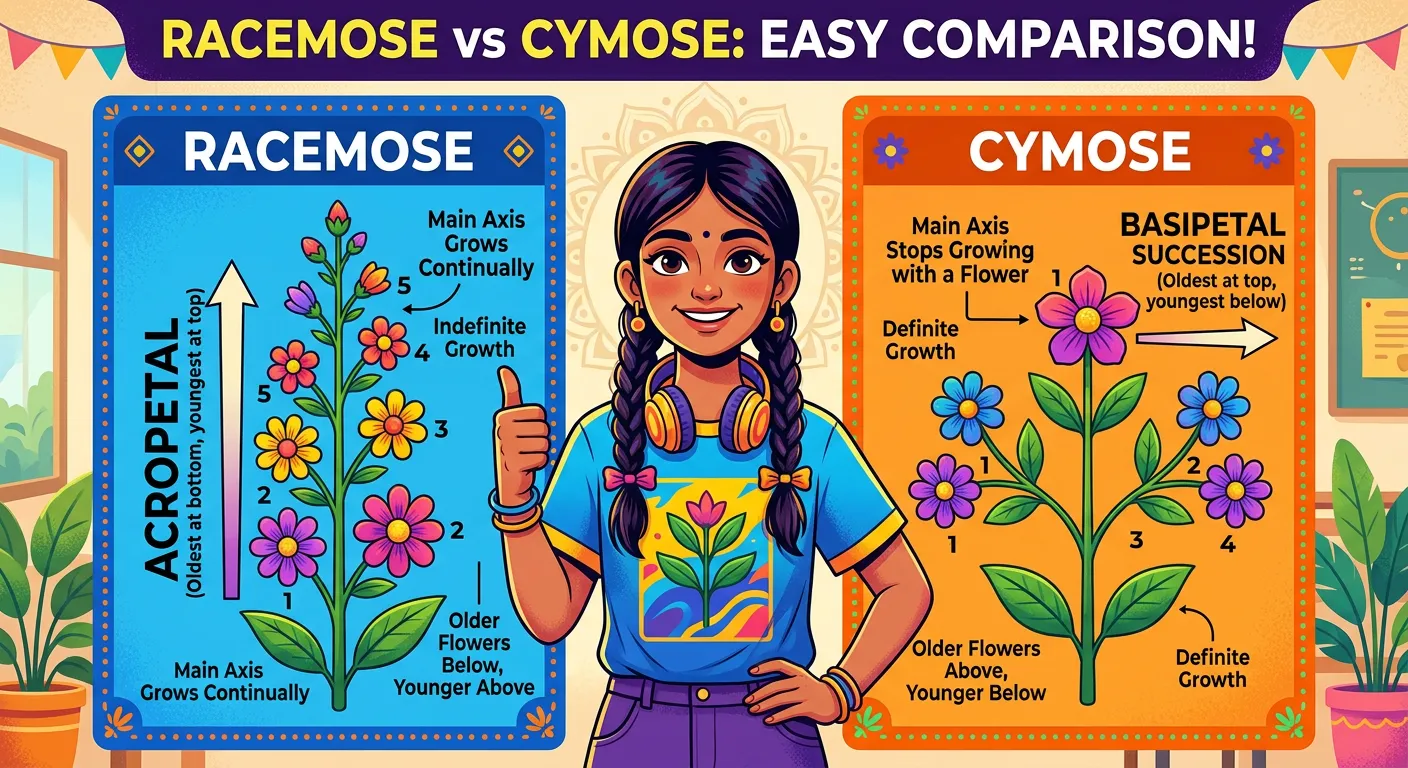
“To ace your NEET exam, remember: Racemose is acropetal, indefinite growth. Cymose is basipetal, definite growth. Use this mnemonic: 'Racemose runs, Cymose stops.' You’ve got the basics down—now keep studying, stay focused, and go crush those biology questions!”
As we wrap up this topic, let’s focus on how to retain this information for the long term. Biology is often about finding the right 'hook' for your memory. The simplest mnemonic for this topic is: 'Racemose Runs, Cymose Stops.' Racemose 'runs' indefinitely with its acropetal succession, while Cymose 'stops' its main axis growth with a terminal flower. This one sentence can save you from many confusing moments during the exam.
Another helpful tip is to visualize the succession patterns. Acropetal sounds like 'Apex'—the action is moving toward the apex. Basipetal sounds like 'Base'—the younger ones are moving toward the base. When you are looking at a plant diagram in the exam, always look at the very tip of the peduncle first. If there is a bud at the tip, it's Racemose. If there is a fully opened flower at the tip, it's Cymose. It’s that simple!
Finally, relate this topic back to the plant families. You cannot master Unit 2 (Structural Organisation) in isolation. When you study the description of families like Fabaceae or Brassicaceae, you will see 'Racemose' or 'Raceme' mentioned. When you study Solanaceae, you will see 'Cymose'. Linking the inflorescence type to the specific family is a high-yield strategy that will help you solve multi-concept questions efficiently. Keep practicing with diagrams and previous year questions, and you'll find that morphology becomes one of your strongest areas.
Quick Revision Points
- Mnemonic: 'Racemose Runs, Cymose Stops.'
- Diagram Check: Bud at apex = Racemose; Flower at apex = Cymose.
- Succession Check: Oldest at bottom = Acropetal (Racemose).
- Succession Check: Oldest at top = Basipetal (Cymose).
- Integration: Link Racemose to Brassicaceae and Cymose to Solanaceae.
NEET Exam Angle
- Expect at least one question combining inflorescence with family characteristics.
- Review the terms 'centripetal' and 'centrifugal' as they occasionally appear in difficult papers.
- Practice drawing simple line diagrams of both types to cement the logic of branching.
Recommended Reading
Explore related Biology topics to build deeper chapter connections for NEET.
- Morphology and Modifications · Topic 2.1
- Families · Topic 2.10
- Animal Tissues · Topic 2.11
- Frog Morphology · Topic 2.12
- Digestive System · Topic 2.13
- Circulatory System · Topic 2.14
- Jump to Key Terms (Quick Revision)
- Review Common NEET Mistakes
- Solve NEET Practice MCQs
- Read Topic FAQs
- Practice NEET MCQs
- Solve NEET PYQs
📚 Key Terms
⚠️ Common NEET Mistakes
- 1Confusing acropetal (Racemose) with basipetal (Cymose) successions.
- 2Thinking that 'solitary' flowers are a type of inflorescence (they are technically not clusters).
- 3Assuming all flowers on a Racemose axis open at the same time.
- 4Misidentifying the 'oldest flower' in a diagram (look for the largest or withered one).
- 5Forgetting that the terminal flower is the defining feature of Cymose growth.
📝 NEET PYQ & Practice Questions
Test your understanding of Inflorescence with NCERT-aligned sample questions.
Which of the following statements is correct regarding "Inflorescence" in the context of NEET Biology?
In NEET question papers, questions related to "Inflorescence" predominantly test:
Consider Racemose associated with Inflorescence. What is the primary characteristic expected in NEET MCQs?
Master Inflorescence with NeetQ AI Tutor
Practice 50+ topic-wise MCQs, previous 15 years NEET questions, and get step-by-step doubt resolution instantly.
❓ Frequently Asked Questions
What is the main difference between acropetal and basipetal succession?
Acropetal succession is found in Racemose inflorescences where the oldest flowers are at the base and youngest are at the apex. Basipetal succession occurs in Cymose types where the oldest flower is at the apex and younger flowers are lower down.
Why does the main axis stop growing in a cymose inflorescence?
In a cymose inflorescence, the shoot apical meristem of the main axis is completely used up to form a terminal flower, which physically prevents any further upward elongation of that axis.
Which family is characterized by racemose inflorescence in the NCERT syllabus?
The family Brassicaceae (including Mustard and Radish) is the primary example of Racemose inflorescence in the NCERT Class 11 Biology syllabus.
Can a plant have both types of inflorescence, and what are they called?
While most plants follow one pattern, some have 'Mixed Inflorescence' where characteristics of both are present, such as a Thyrsus (a racemose axis with cymose branches).
How does the arrangement of flowers in mustard differ from jasmine?
Mustard has a Racemose arrangement with indefinite growth and buds at the top. Jasmine has a Cymose arrangement with definite growth and a terminal flower at the top.
What is a 'terminal flower' and how does it determine growth potential?
A terminal flower is a flower that develops at the very end of a stem or axis. Its presence indicates 'definite growth' because it stops the meristem from producing more stem tissue, identifying the structure as Cymose.
Written By
NEET Content Strategist & Biology Expert
Sangita Kumari is a NEET educator and content strategist with over 6 years of experience teaching Biology, Chemistry, and Physics to Class 11 and 12 aspirants. She helps bridge the gap between traditional NCERT preparation and modern AI-powered learning. Her content is trusted by thousands of NEET aspirants across India.