🎬 Video Lesson Available
Watch the full 7-slide video lesson for Leaf with AI teacher narration and visual explanations.
Leaf — Master the leaf morphology for NEET Biology. Learn about venation, compound leaf types (pinnate/palmate), and modifications with Class 11 NCERT examples.
01The Structural Anatomy of a Typical Leaf: Lamina, Petiole, and Leaf Base
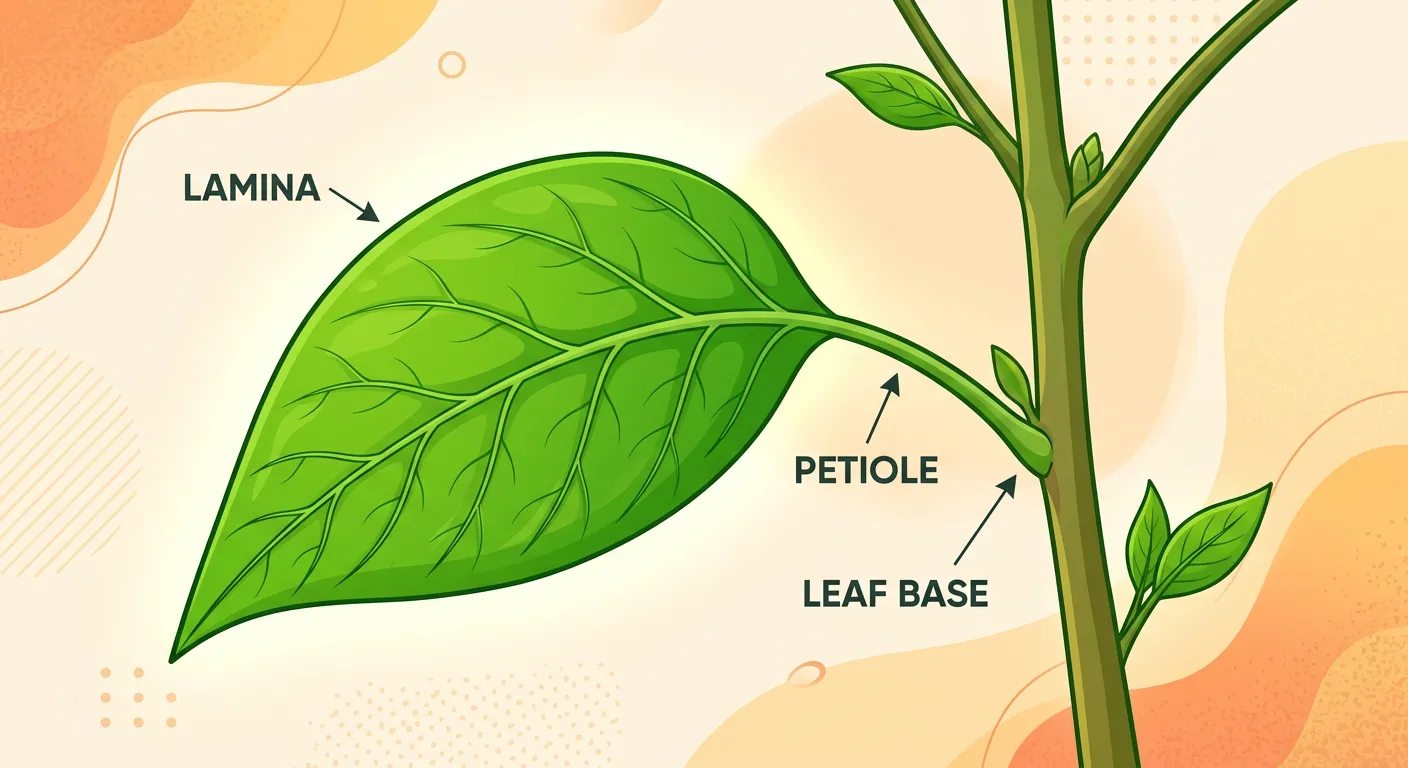
“Meet the leaf, the kitchen of the plant! Just like your kitchen is attached to your house, the leaf connects to the stem at the base, often via a stalk called the petiole. The main green, flat surface that does the heavy lifting is the lamina.”
A leaf is much more than just a green ornament on a plant; it is the primary site of energy conversion for nearly all life on Earth. Morphologically, the leaf is a lateral, generally flattened structure that develops at the node of a stem. It originates from the shoot apical meristem and is arranged in an acropetal order—meaning the youngest leaves are at the apex while the older ones are at the base. This specific arrangement ensures that every leaf gets its fair share of sunlight, preventing the top layers from completely shading the ones below. The leaf is technically an appendage of the stem, designed to maximize surface area for photosynthesis while minimizing water loss through specialized structures.
A typical leaf consists of three main parts: the leaf base (hypopodium), the petiole (mesopodium), and the lamina (epipodium). The leaf base is the point of attachment to the stem and is often flanked by stipules. Moving outward, the petiole acts as a flexible bridge. Its primary job is to hold the leaf blade to the light and allow it to flutter in the wind, which helps in cooling the leaf and bringing fresh air to the leaf surface for gas exchange. This mechanical fluttering also helps in decreasing the boundary layer of air, which can increase the rate of transpiration when needed. Finally, we have the lamina, or the leaf blade. This is the green, expanded part of the leaf with veins and veinlets. The central prominent vein is known as the midrib. These veins aren't just for show; they provide structural rigidity to the lamina, acting as a skeleton to keep it spread out, and serve as channels for the transport of water, minerals, and food materials via the vascular tissue.
Quick Revision Points
- Acropetal Order: Leaves develop in a sequence where the oldest are at the bottom and youngest at the top.
- Lamina (Leaf Blade): The expanded green portion responsible for photosynthesis and transpiration.
- Petiole: The stalk that helps the leaf catch the wind and keeps it cool through air circulation.
- Midrib: The central vein providing skeletal support and transport pathways.
- Three Parts: Every complete leaf is composed of the Hypopodium (base), Mesopodium (petiole), and Epipodium (lamina).
NEET Exam Angle
- Questions often focus on the term 'acropetal order'—remember this is the standard development pattern for leaves on a vegetative shoot.
- Identify the functions of the petiole: it is not just a stalk; it's a mechanical and cooling device that helps maintain the leaf's thermal balance.
| Leaf Part | Botanical Term | Primary Function |
|---|---|---|
| Leaf Base | Hypopodium | Attachment to the stem node |
| Petiole | Mesopodium | Orientation toward light and cooling |
| Leaf Blade | Epipodium | Photosynthesis and gas exchange |
02Stipules and Basal Variations: Protective Appendages in Plant Morphology
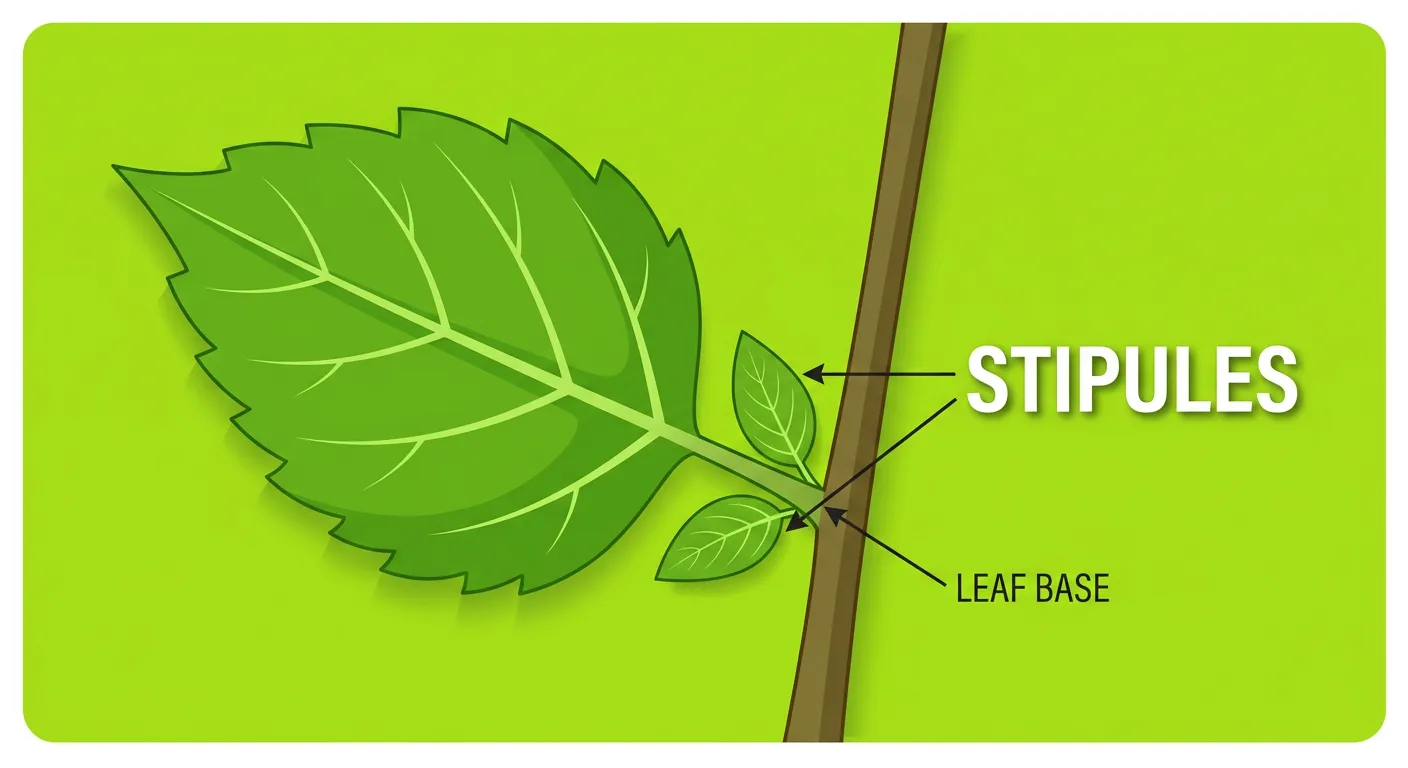
“Ever noticed tiny, leaf-like outgrowths at the base of the petiole? Those are stipules! Think of them as the leaf’s bodyguards, protecting the young, delicate bud before it fully unfolds. Not every plant has them, but they are crucial for many species!”
When you look closely at the point where the leaf base meets the stem, you might notice two tiny, leaf-like appendages. These are called stipules. While not present in all plants, stipules play a vital role in protecting the leaf during its vulnerable bud stage. When stipules are present, we call the leaf 'stipulate,' and when they are absent, the leaf is 'exstipulate.' This might seem like a minor detail, but in plant taxonomy, the presence or absence of stipules is a major identifying character used to distinguish plant families like Fabaceae and Rosaceae. Some stipules can even be modified into spines for defense or tendrils for climbing, showcasing the leaf's inherent plasticity.
Leaf bases also show fascinating variations between monocots and dicots that are critical for NEET preparation. In many monocotyledonous plants, such as maize and wheat, the leaf base expands into a sheath that partially or completely covers the stem node. This sheathing base provides additional support to the soft tissue of the stem and protects the intercalary meristem, which is responsible for the plant's vertical growth. On the other hand, in many leguminous plants, the leaf base may become swollen and fleshy. This specialized swollen base is called the pulvinus. The pulvinus is responsible for 'sleep movements' (nyctinasty) and the rapid folding seen in plants like Mimosa pudica (the 'touch-me-not' plant). These movements are driven by rapid changes in turgor pressure within the pulvinus cells in response to external stimuli like touch, heat, or darkness. Understanding these basal modifications helps explain how plants interact with their environment without a nervous system.
Quick Revision Points
- Stipules: Small lateral outgrowths at the base of the petiole for bud protection.
- Pulvinus: Swollen leaf base common in legumes (e.g., Pea, Bean) that regulates movement.
- Sheathing Base: A characteristic of monocots where the leaf base wraps around the stem node for protection.
- Exstipulate: A term used for leaves that lack stipules entirely, such as in many Solanaceae members.
NEET Exam Angle
- NTA frequently asks about the 'Pulvinus.' Associate it specifically with legumes and turgor-driven movement.
- Distinguish between sheathing leaf bases (monocots) and the typical dicot attachment; this is a common morphological comparison in MCQ options.
| Modification | Plant Group | Purpose |
|---|---|---|
| Pulvinus | Legumes | Turgor-driven movement and support |
| Sheathing Base | Monocots | Protection of the intercalary meristem and support |
| Stipules | Various Dicots | Protection of the leaf in the bud stage |
03Classification of Leaves: Distinguishing Simple and Compound Structures
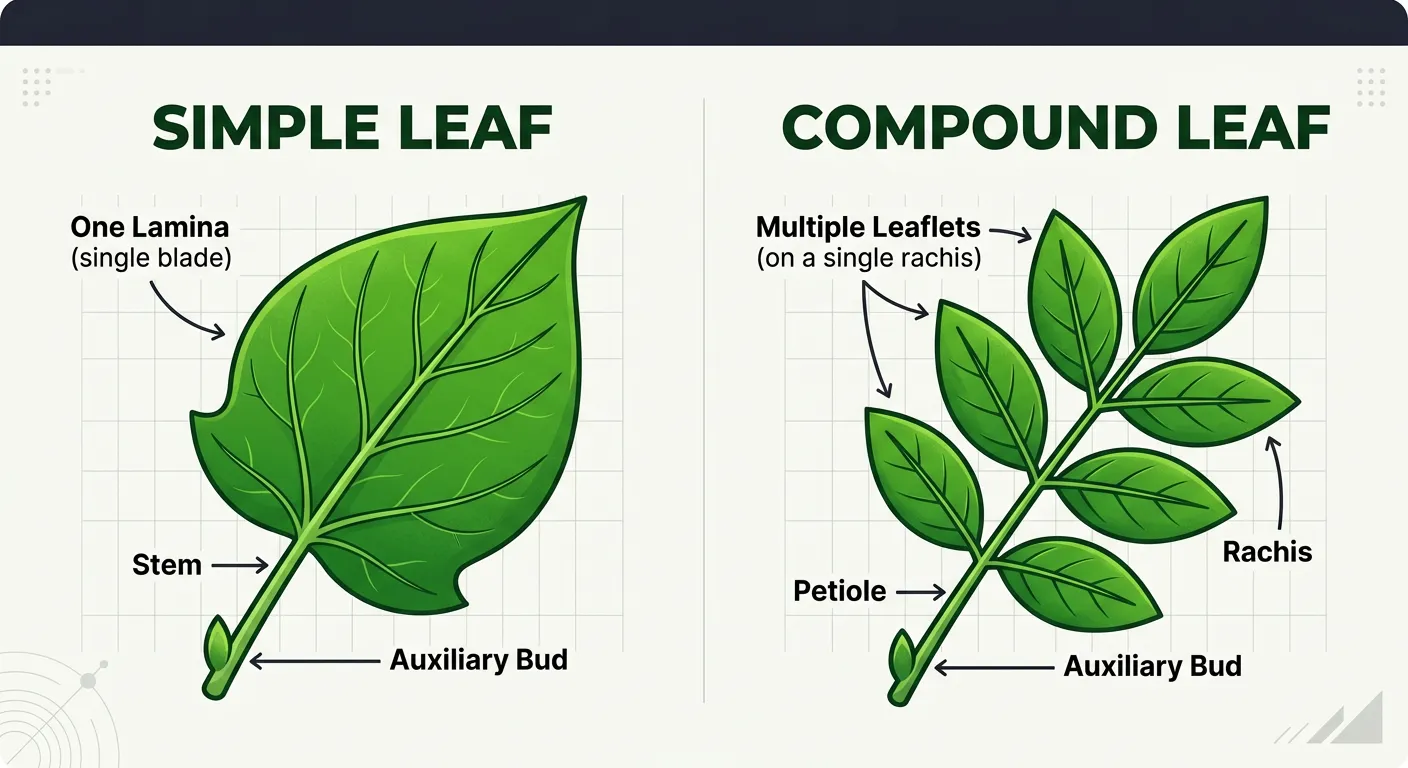
“Is it one piece or many? A simple leaf has a single, undivided lamina. But look at a Neem leaf—it’s divided into smaller leaflets. That’s a compound leaf! It’s like comparing a whole rotis to smaller bite-sized pieces for better structural efficiency.”
Botanists classify leaves into two broad categories based on the degree of division of the lamina: simple and compound. A leaf is considered simple when its lamina is either completely entire (undivided) or, if it is incised, the incisions do not reach the midrib. Think of a Mango, Guava, or Peepal leaf; even if the edges are a bit wavy or deeply lobed, the green blade remains one continuous unit connected to a single petiole. This is the simplest architectural design for a leaf, optimized for maximum light capture in a single plane while maintaining high hydraulic efficiency through a unified vascular network.
A compound leaf, however, takes a more complex approach. In this case, the incisions of the lamina go all the way down to the midrib, effectively breaking the blade into several distinct pieces called leaflets. Each leaflet functions as a photosynthetic unit, but it is not an independent leaf. This is where NEET students often get confused: how do you tell a leaflet from a full leaf? The answer lies in the axillary bud. A bud is always present in the axil of the petiole (the junction where the leaf meets the stem) in both simple and compound leaves. However, you will never find a bud in the axil of the leaflets of a compound leaf. This diagnostic feature is the golden rule for identifying complex plant structures in the field. From an evolutionary perspective, compound leaves are advantageous as they reduce wind resistance and can limit the spread of damage from herbivory or disease to just one leaflet rather than the entire leaf surface. This modular design allows the plant to shed damaged leaflets while keeping the rest of the leaf functional.
Quick Revision Points
- Simple Leaf: Lamina is whole or incised but never touches the midrib.
- Compound Leaf: Lamina is divided into multiple leaflets.
- Axillary Bud: Found at the base of the petiole, but never at the base of leaflets.
- Structural Efficiency: Compound leaves allow for better wind resistance and limit the spread of pathogens across the plant surface.
NEET Exam Angle
- The presence of the axillary bud is the most repeated 'True/False' concept regarding leaf identification.
- Understand that leaflets are part of a single leaf unit; they do not have their own axillary buds. If a bud exists at the base of a structure, that structure is the entire leaf.
- Remember that compound leaves are advanced evolutionary adaptations for survival in high-wind or high-pest environments.
04Types of Compound Leaves: Pinnate vs. Palmate Arrangements
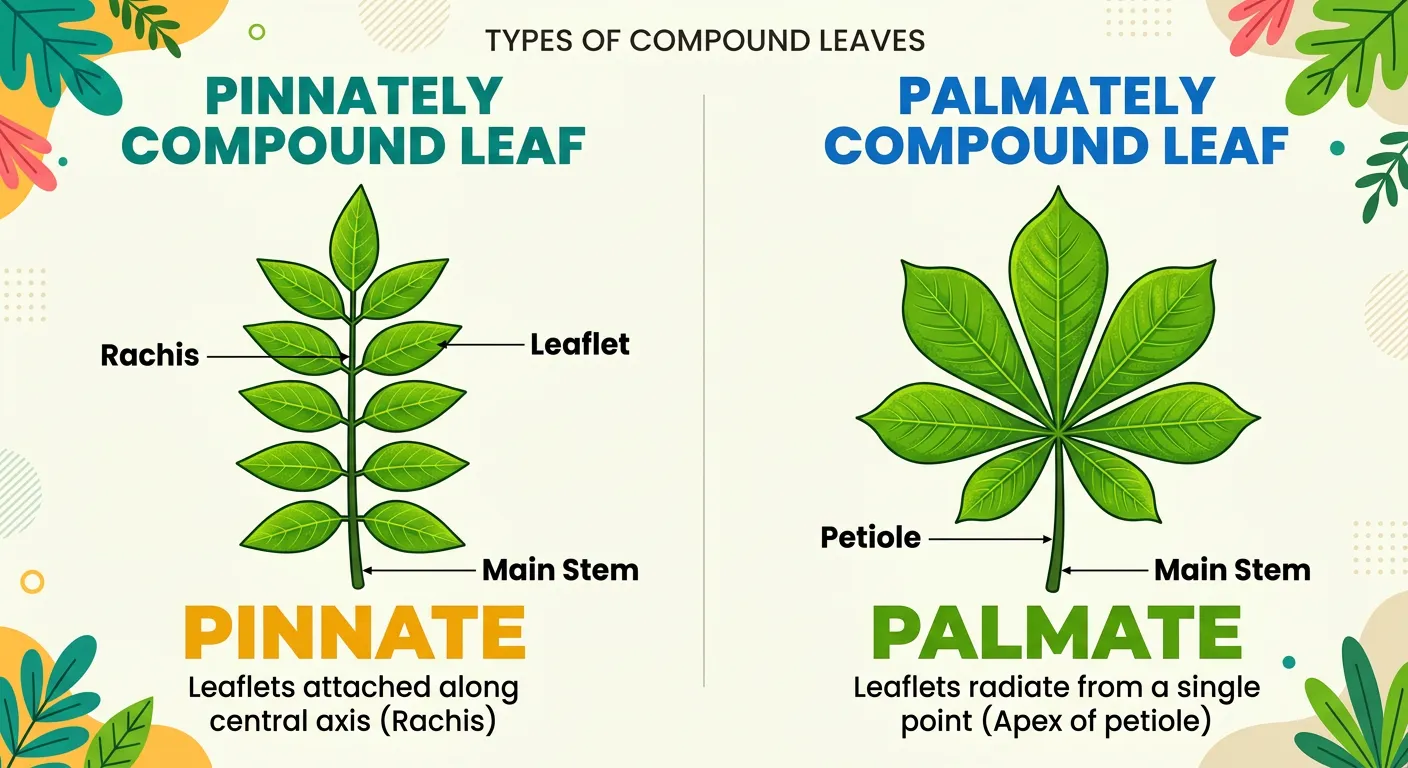
“Compound leaves come in two flavors. In pinnate leaves, like Neem, leaflets sit on a central axis, like a feather. In palmate leaves, like Silk Cotton, they all sprout from a single point, just like fingers on your palm. Easy to remember, right?”
Compound leaves are further categorized into two primary types based on the arrangement of leaflets: pinnately compound and palmately compound. In a pinnately compound leaf, a number of leaflets are present on a common axis called the rachis. The rachis actually represents the midrib of the leaf. A classic example is the Neem tree (Azadirachta indica). Imagine a feather where the central shaft (rachis) has barbs (leaflets) on both sides; that is exactly how a pinnate leaf is structured. Pinnately compound leaves can be unipinnate (leaflets directly on the rachis, like Neem), bipinnate (rachis branches once), or even tripinnate (rachis branches twice, like in Drumstick/Moringa). This hierarchical branching allows the plant to pack a massive amount of surface area into a single leaf structure.
Conversely, palmately compound leaves look like the palm of your hand. In this arrangement, all the leaflets are attached to a single common point at the tip of the petiole. There is no elongated rachis here; the midrib of each leaflet originates from the same junction. A famous example you must remember for NEET is the Silk Cotton tree (Bombax ceiba). Palmately compound leaves can be unifoliate (one leaflet, as in Citrus), bifoliate, or multifoliate (like Silk Cotton). Because all leaflets radiate from a central point, this structure allows the leaf to expand and contract slightly depending on water availability, and it is highly effective at capturing light from multiple angles as the sun moves across the sky. Mastering the difference between a rachis-based system and a single-point system is fundamental to identifying plant species in the morphological section of the NEET exam.
Quick Revision Points
- Pinnately Compound: Leaflets arranged on a common axis (rachis). Example: Neem, Rose.
- Palmately Compound: Leaflets attached at the petiole tip. Example: Silk Cotton, Cannabis.
- Rachis: The common axis in pinnate leaves, equivalent to a midrib.
- Leaflet: A single division of a compound leaf's lamina, lacking an axillary bud.
NEET Exam Angle
- Example Match: Neem = Pinnate; Silk Cotton = Palmate. This is a very common 'match the following' question.
- Conceptual check: Does a palmate leaf have a rachis? No, the leaflets attach directly to the petiole tip. This is a common trap in MCQ descriptions.
| Leaf Type | Arrangement | Key Example |
|---|---|---|
| Pinnately Compound | Leaflets on a common axis (Rachis) | Neem (Azadirachta indica) |
| Palmately Compound | Leaflets at a single common point | Silk Cotton (Bombax ceiba) |
05Leaf Venation Patterns: Reticulate vs. Parallel Infrastructure
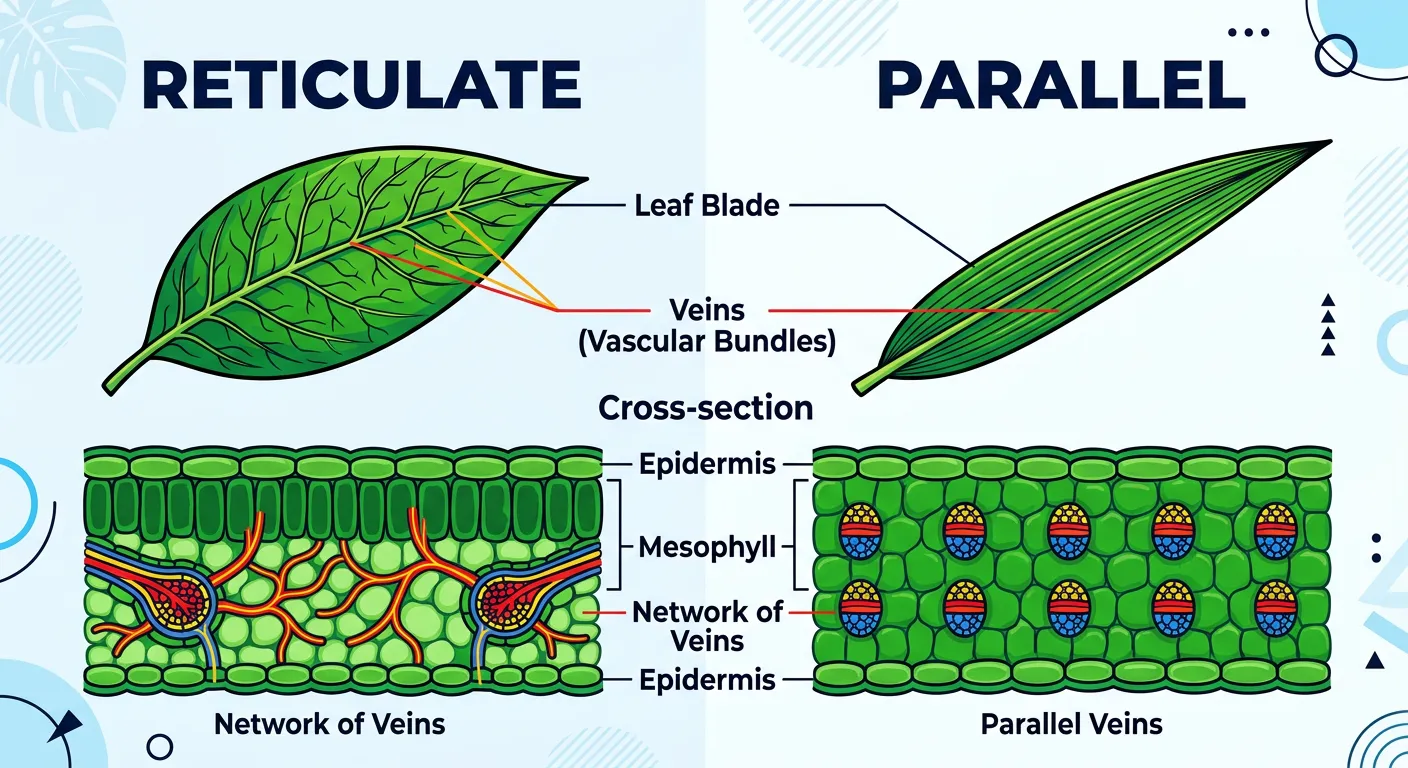
“Veins are the highways of the leaf. In dicots, they form a complex, beautiful net called reticulate venation. In monocots, like grass or banana, they run side-by-side in parallel. It’s the plant’s way of keeping its infrastructure organized and efficient for transport!”
Venation refers to the arrangement of veins and the network of veinlets in the leaf lamina. These veins are the vascular highways of the plant, containing xylem for water transport and phloem for the transport of photosynthetic sugars. Beyond transport, they provide a rigid framework that prevents the leaf from drooping. There are two primary types of venation patterns that serve as a hallmark for identifying the two main groups of flowering plants. When the veinlets form a complex, net-like web, the venation is called reticulate. This is the characteristic feature of most dicotyledonous plants, such as hibiscus, peepal, and mango. The branching nature of reticulate venation ensures that every cell in a broad leaf is within a few micrometers of a water supply.
In contrast, when the veins run parallel to each other within the lamina and do not form a network, the venation is termed parallel. This is the characteristic feature of most monocotyledonous plants, such as grass, wheat, maize, and bananas. While reticulate venation provides great mechanical strength to broad leaves, parallel venation is perfectly suited for the long, narrow, ribbon-like leaves typical of monocots. For NEET, while these rules are generally solid, keep in mind the exceptions which are favorite topics for examiners. For instance, Smilax is a monocot that shows reticulate venation, while Calophyllum is a dicot that shows parallel venation. Identifying these patterns is one of the first things a botanist does to distinguish between dicots and monocots. The arrangement of veins also dictates how a leaf will tear; parallel-veined leaves tear in straight lines, while reticulate ones tear irregularly.
Quick Revision Points
- Reticulate Venation: Network-like pattern, found in most Dicots (e.g., Pea, Mango).
- Parallel Venation: Veins run side-by-side, found in most Monocots (e.g., Grass, Maize).
- Vein Functions: Structural support and conduction of water/nutrients.
- Veinlets: Smaller branches of veins that form the intricate mesh in reticulate leaves.
NEET Exam Angle
- Direct Identification: If you see a network, think Dicot. If you see straight lines, think Monocot.
- Exception Alert: Remember Smilax (Monocot with reticulate) and Eryngium (Dicot with parallel). These 'exceptions to the rule' are high-yield for NTA exams.
| Venation Type | Pattern | Plant Group |
|---|---|---|
| Reticulate | Net-like/Reticulum | Dicots (e.g., Peepal, Hibiscus) |
| Parallel | Linear/Parallel | Monocots (e.g., Banana, Bamboo) |
06Adaptive Modifications: Spines, Tendrils, and Survival Mechanisms
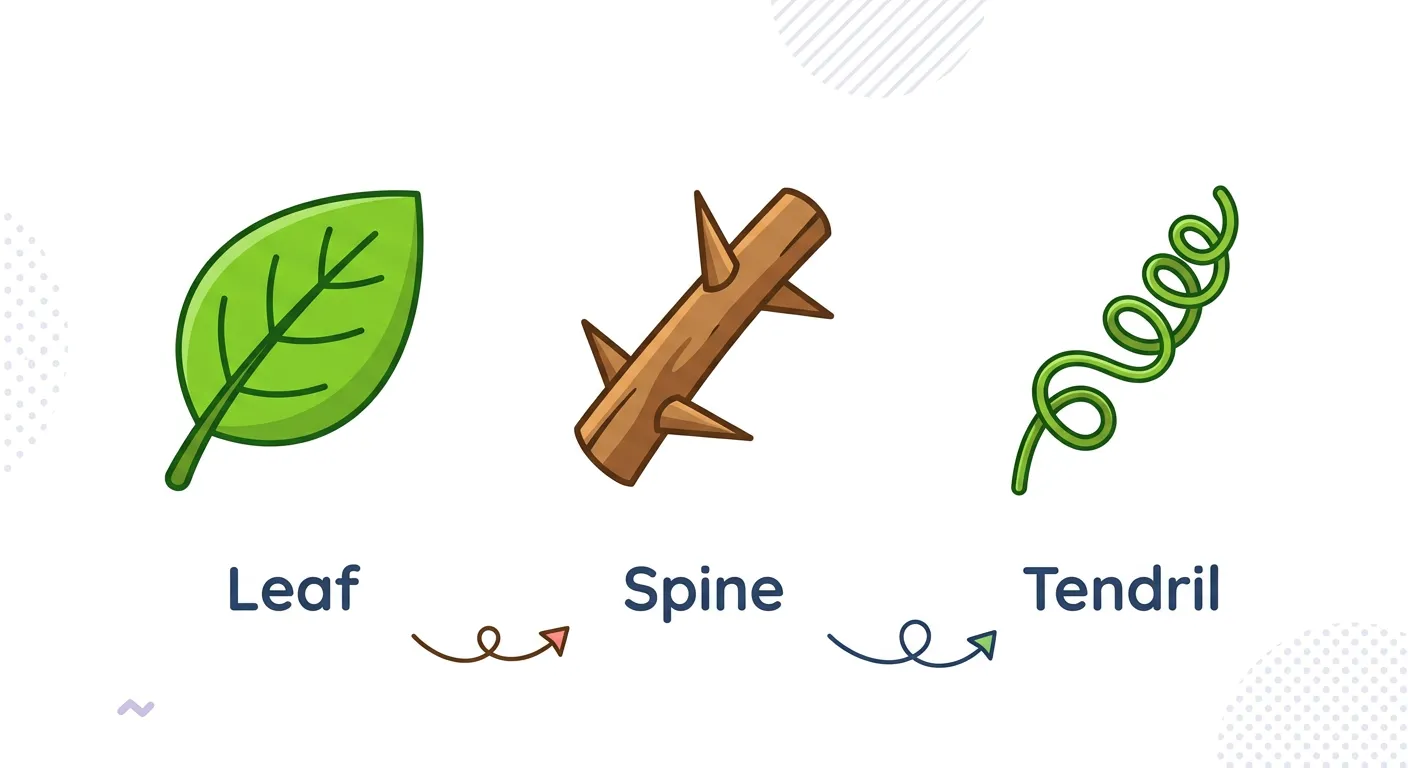
“Leaves don’t just photosynthesize; they adapt! In the cactus, they shrink into spines to save water. In pea plants, they curl into tendrils to help the plant climb. They are masters of disguise, changing their shape to suit their environment's tough conditions.”
Nature is the ultimate engineer, and leaves are its most versatile tools. Often, leaves are modified to perform functions other than photosynthesis, such as support, protection, or even predation. In climbing plants like the Sweet Pea (Lathyrus odoratus) or Wild Pea, leaves or leaflets are modified into leaf tendrils. These are slender, spirally coiled structures that are highly sensitive to touch (thigmotropism). When they come into contact with a support, they coil around it, helping the weak-stemmed plant climb upward toward the light. It is important to distinguish these from stem tendrils (like in gourds), which originate from axillary buds.
In arid or desert environments, water conservation is the priority. In plants like Cacti (Opuntia), the leaves are reduced to sharp, pointed spines. This serves a dual purpose: it drastically reduces the surface area for transpiration (water loss) and protects the plant from hungry herbivores. Because the leaves are modified into spines and cannot photosynthesize, the stem becomes green and fleshy to take over food production—a structure called a phylloclade. Furthermore, some of the most dramatic modifications occur in insectivorous plants. In the Pitcher plant (Nepenthes) or the Venus flytrap, parts of the leaves are modified into traps to capture and digest insects. In Nepenthes, the lamina forms the pitcher, and the leaf apex forms the lid. These plants capture insects not for energy, but to obtain nitrogen in nutrient-poor soils. These adaptations show how leaves can evolve into specialized tools for survival in extreme ecological niches.
Quick Revision Points
- Leaf Tendrils: Help in climbing (e.g., Peas). Do not confuse with stem tendrils found in grapes.
- Leaf Spines: Defense and water conservation (e.g., Cacti, Argemone).
- Insectivorous Leaves: Modified for nitrogen capture (e.g., Venus Flytrap, Utricularia).
- Phyllode: Petiole becomes green and photosynthetic while the blade is lost (e.g., Australian Acacia).
NEET Exam Angle
- Confusion Alert: Stem Spines (Thorns) vs. Leaf Spines. Remember: Citrus has thorns (stem), while Cactus has spines (leaf). This distinction is a classic NEET question.
- Example Check: Peas use leaf tendrils for support, while watermelons use stem tendrils. Always check the origin of the tendril in the question stem.
| Modification | Purpose | Example |
|---|---|---|
| Tendrils | Climbing/Support | Wild Pea (Lathyrus) |
| Spines | Defense/Water saving | Cactus (Opuntia) |
| Traps | Nitrogen acquisition | Pitcher Plant (Nepenthes) |
07Storage Leaves and Specialized Functions in Geophytes
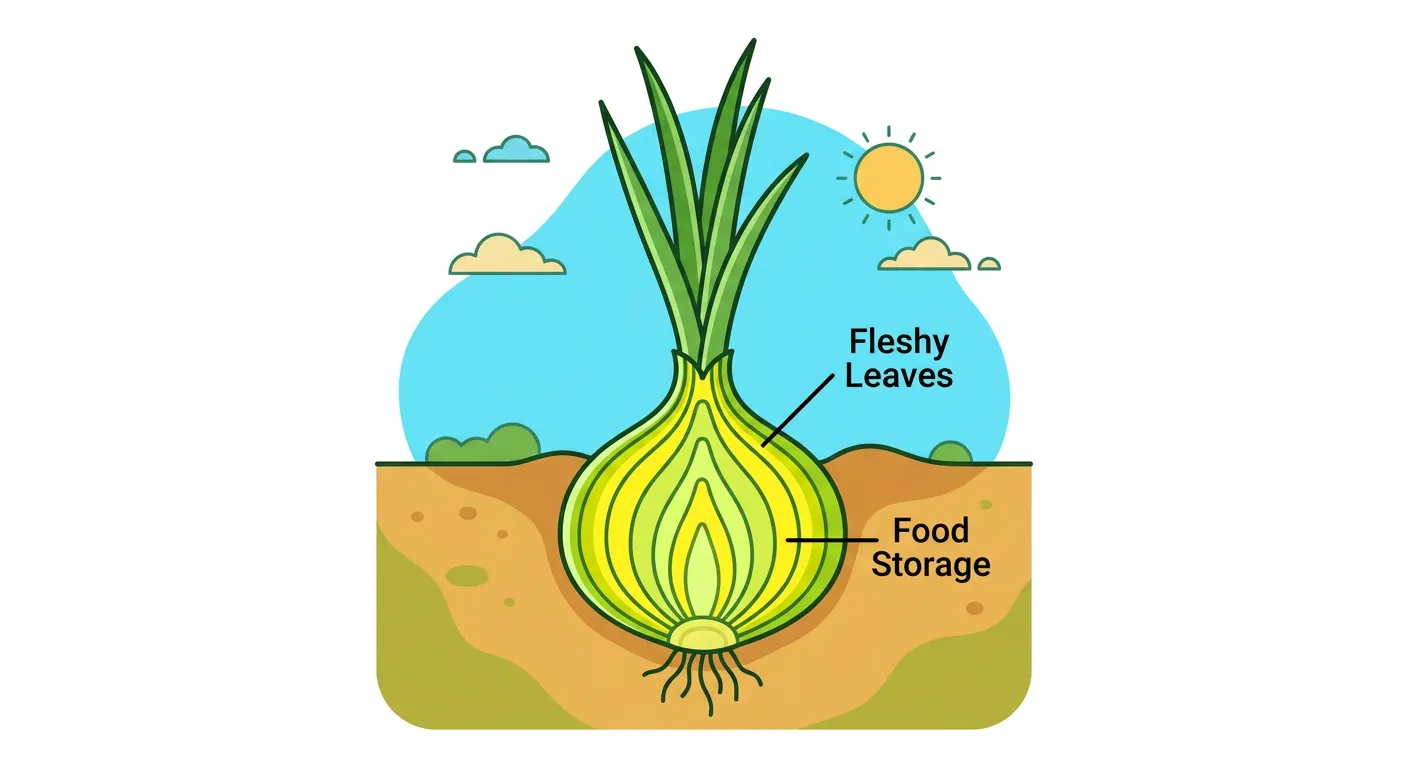
“Finally, leaves store food. Look at an onion—those thick, fleshy layers are actually leaves packed with nutrients. Nature's ultimate survival kit! Now you know the leaf is far more than just a green plate; it’s a genius biological machine. Keep learning!”
While we usually think of leaves as thin and airy, some plants use them as storage warehouses. In plants like Onion (Allium cepa) and Garlic, the leaves become fleshy and thick. These are actually the leaf bases that have been modified to store food and water in the form of carbohydrates. When you slice through an onion, you are mostly seeing these concentric layers of fleshy leaf bases. This allows the plant to survive underground during unfavorable winter or dry seasons and provides the energy needed for rapid growth and flowering when the season changes. This type of underground storage organ is called a bulb, where the stem is reduced to a small disc-like structure at the bottom.
Another fascinating modification is the phyllode, commonly seen in the Australian Acacia (Acacia auriculiformis). In this plant, the actual leaf blades are small, pinnate, and short-lived, falling off quickly. To compensate for the loss of photosynthetic surface area, the petiole expands, becomes green and flattened, and takes over the job of photosynthesis. This is a brilliant adaptation to arid climates; by using the petiole instead of a wide lamina, the plant minimizes the number of stomata and changes the leaf orientation to avoid the direct noon sun, thereby reducing water loss. It is crucial not to confuse 'Phyllode' (petiole modification) with 'Phylloclade' (stem modification). These specialized functions highlight the leaf's role as a survival organ that goes far beyond just being a 'solar panel.' Whether storing nutrients for the next generation or adapting to the harsh Australian outback, the leaf proves to be one of the most versatile organs in the plant kingdom.
Quick Revision Points
- Storage Leaves: Fleshy leaf bases found in Onion and Garlic bulbs.
- Phyllode: A photosynthetic, green, and flattened petiole (e.g., Australian Acacia).
- Geophytes: Plants like onion that use underground storage organs to survive dormancy.
- Resource Allocation: Leaves can shift from energy production to nutrient storage based on environmental needs.
NEET Exam Angle
- Very high probability question: Distinguish between 'Phylloclade' (stem modification in Opuntia) and 'Phyllode' (petiole modification in Acacia). NTA loves this comparison.
- Example focus: Onion and Garlic are the standard NCERT examples for fleshy storage leaves. Know them as part of a 'bulb.'
- Remember that in Onion, the edible part is morphologically a leaf, not a stem, though it is attached to a reduced stem called a disc.
| Feature | Phyllode | Phylloclade |
|---|---|---|
| Origin | Modified Petiole | Modified Stem |
| Example | Australian Acacia | Opuntia (Cactus) |
| Function | Photosynthesis | Photosynthesis & Water Storage |
Recommended Reading
Explore related Biology topics to build deeper chapter connections for NEET.
- Morphology and Modifications · Topic 2.1
- Families · Topic 2.10
- Animal Tissues · Topic 2.11
- Frog Morphology · Topic 2.12
- Digestive System · Topic 2.13
- Circulatory System · Topic 2.14
- Jump to Key Terms (Quick Revision)
- Review Common NEET Mistakes
- Solve NEET Practice MCQs
- Read Topic FAQs
- Practice NEET MCQs
- Solve NEET PYQs
📚 Key Terms
⚠️ Common NEET Mistakes
- 1Mistaking a leaflet for a whole leaf. Remember to look for the axillary bud at the base of the petiole; leaflets never have them.
- 2Confusing leaf spines (Cactus) with stem thorns (Citrus/Bougainvillea).
- 3Mixing up leaf tendrils (Peas) with stem tendrils (Cucumber/Grapes).
- 4Confusing Phyllode (modified petiole in Acacia) with Phylloclade (modified stem in Opuntia).
- 5Assuming all compound leaves have a rachis; palmately compound leaves do not have one.
📝 NEET PYQ & Practice Questions
Test your understanding of Leaf with NCERT-aligned sample questions.
Which of the following statements is correct regarding "Petiole" in the context of NEET Biology?
In NEET question papers, questions related to "Leaf" predominantly test:
Consider Stipules associated with Leaf. What is the primary characteristic expected in NEET MCQs?
Master Leaf with NeetQ AI Tutor
Practice 50+ topic-wise MCQs, previous 15 years NEET questions, and get step-by-step doubt resolution instantly.
❓ Frequently Asked Questions
What is the main difference between a simple leaf and a compound leaf?
In a simple leaf, the lamina is undivided or its incisions do not touch the midrib. In a compound leaf, the incisions reach the midrib, dividing the lamina into several distinct leaflets.
How can you identify a palmately compound leaf from a pinnately compound leaf?
In pinnately compound leaves (e.g., Neem), leaflets are arranged along a common axis called the rachis. In palmately compound leaves (e.g., Silk Cotton), all leaflets are attached to a single common point at the tip of the petiole.
Why do monocot leaves typically exhibit parallel venation?
Parallel venation is an evolutionary trait of monocots where veins run parallel to each other. This structure provides efficient transport and support for the typically long, narrow leaves of plants like grasses and lilies.
Give examples of plants where leaves are modified into spines for protection.
The most common example is the Cactus (Opuntia), where leaves are reduced to spines to prevent water loss through transpiration and to protect against herbivores.
What is a pulvinus, and in which family of plants is it commonly found?
A pulvinus is a swollen leaf base that allows for turgor-driven movements. It is commonly found in the Fabaceae (legume) family, such as in the pea plant or Mimosa pudica.
Is the spine of a cactus morphologically the same as the thorn of a citrus plant?
No. A cactus spine is a modified leaf, whereas a citrus thorn is a modified stem originating from an axillary bud.
Written By
NEET Content Strategist & Biology Expert
Sangita Kumari is a NEET educator and content strategist with over 6 years of experience teaching Biology, Chemistry, and Physics to Class 11 and 12 aspirants. She helps bridge the gap between traditional NCERT preparation and modern AI-powered learning. Her content is trusted by thousands of NEET aspirants across India.