🎬 Video Lesson Available
Watch the full 7-slide video lesson for Morphology and Modifications with AI teacher narration and visual explanations.
Morphology and Modifications — Master Morphology of Flowering Plants for NEET. Explore root, stem, and leaf modifications, phyllotaxy, and examples with this expert Class 11 Biology guide.
01The Architecture of Angiosperms: A Functional Startup Model
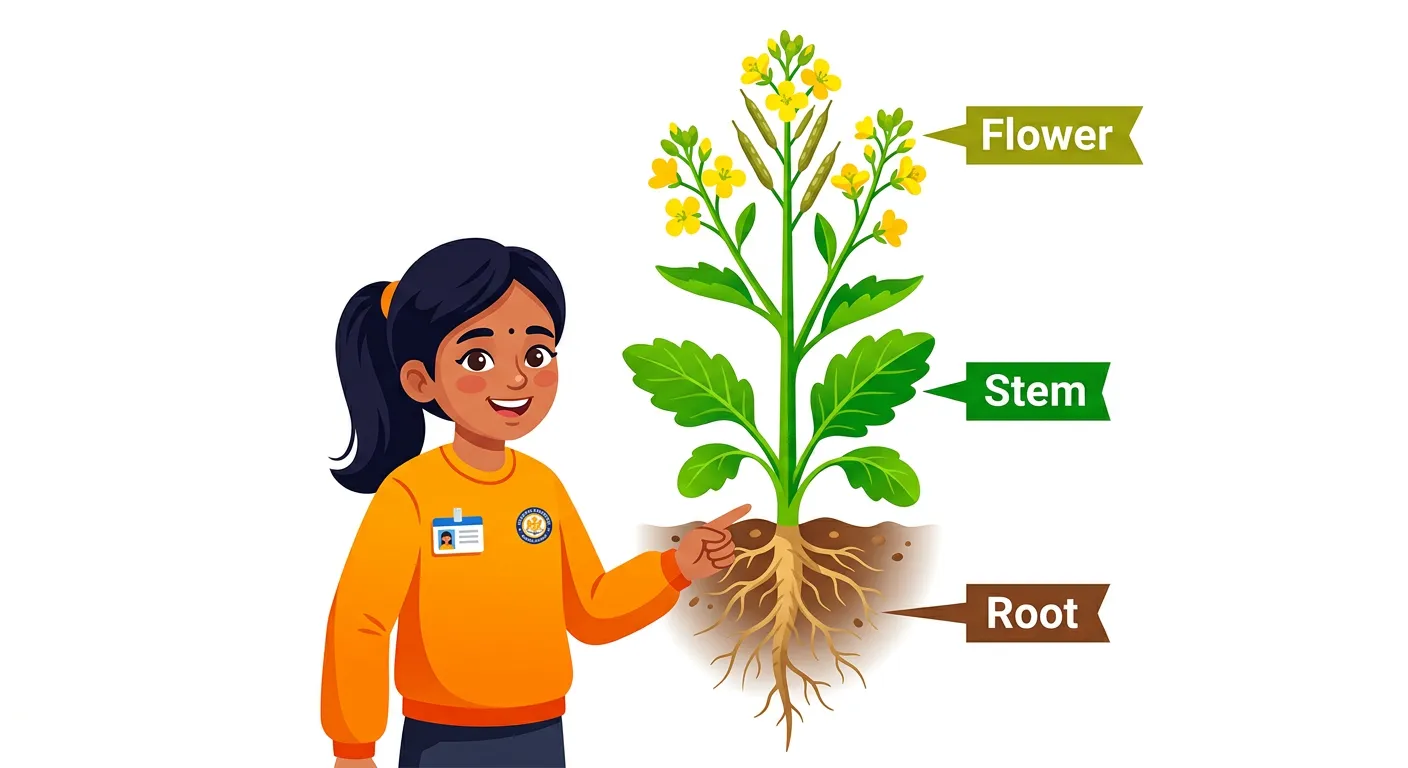
“Welcome, NEET warriors! Imagine a plant like a perfectly organized startup. The root system is the hidden infrastructure, the stem is the supply chain, and the flowers are the marketing department! Today, we are decoding the morphology of flowering plants, the backbone of your biology syllabus.”
Welcome to one of the most high-yield chapters in your NEET Biology preparation. To master the morphology of flowering plants, you must stop viewing them as static objects and start seeing them as dynamic, functional systems. Think of a plant as a perfectly organized startup. Every startup needs a solid foundation, a reliable supply chain, and a strategy for growth and legacy. In botanical terms, the Root System is your hidden infrastructure—gathering resources and providing stability. The Shoot System, comprising the stem and leaves, serves as the supply chain and manufacturing hub, while the flowers are the marketing department, ensuring the next generation through reproduction.
Morphology is the study of these external structures. Why is this so crucial for a future doctor? Just as you must understand the normal human anatomy before diagnosing a disease, a botanist or a NEET aspirant must understand the standard 'architecture' of an Angiosperm to identify variations, modifications, and evolutionary adaptations. This topic connects deeply with Unit 1 (Diversity), as morphological characters are the primary tools used in taxonomic classification. When you look at a plant, you aren't just seeing green parts; you are seeing millions of years of evolutionary engineering designed to maximize sunlight capture and nutrient absorption.
In the NEET exam, examiners love to test your ability to distinguish between the 'standard' version of an organ and its 'upgraded' or modified version. This section sets the stage by dividing the plant body into the vegetative parts (roots, stems, leaves) and the reproductive parts (flowers, fruits, seeds). Understanding this division is the first step toward mastering the more complex modifications that follow.
Quick Revision Points
- Morphology is the study of external forms and structures of plants.
- Angiosperms (Flowering plants) are characterized by the presence of roots, stems, leaves, flowers, and fruits.
- The Root System is generally the underground part, while the Shoot System is the aerial part.
- Morphological features are essential for plant identification and classification in Taxonomy.
- Vegetative organs focus on growth and survival; reproductive organs focus on the continuity of the species.
NEET Exam Angle
- NCERT terminology is king. Focus on terms like 'Angiosperms' and 'Morphology' as they relate to the classification systems discussed in Unit 1.
- Identify the 'Startup' analogy to remember the functions: Roots (Anchorage/Absorption), Stems (Conduction), Leaves (Photosynthesis).
| Plant System | Major Components | Primary Biological Function |
|---|---|---|
| Root System | Primary, secondary, tertiary roots | Anchorage, Absorption, Storage |
| Shoot System | Stem, Leaves, Buds | Conduction, Photosynthesis, Support |
| Reproductive System | Flowers, Fruits, Seeds | Pollination, Dispersal, Reproduction |
02Root System Fundamentals: Taproot vs. Fibrous Root Development
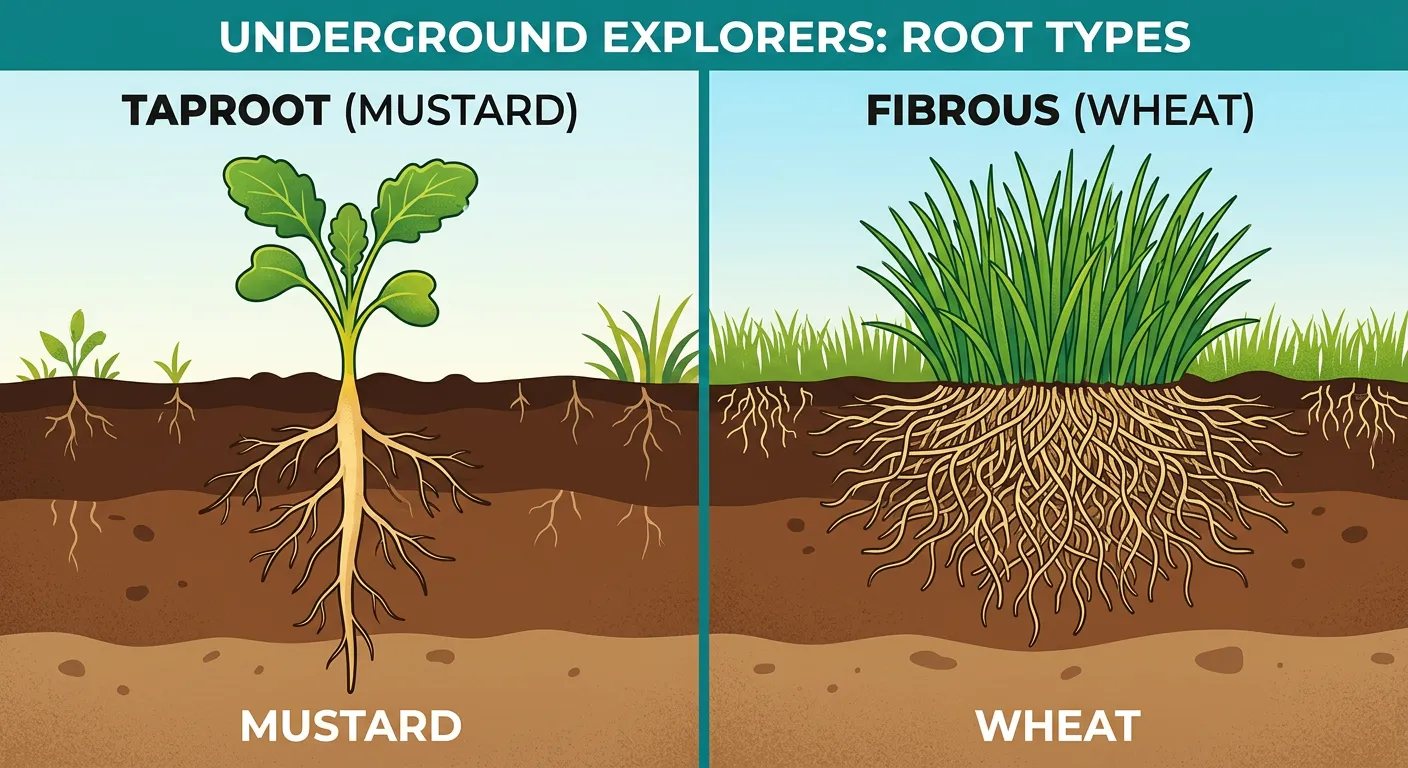
“Roots are like people; some go deep, others spread wide. Dicot plants like mustard develop a robust Taproot system from the radicle. Monocots like wheat prefer a Fibrous root system, starting from the base of the stem. It is all about how they anchor and soak up resources!”
Let's dive deep into the soil. Roots are the first structures to emerge when a seed germinates. The developmental origin of a root is the radicle of the embryo. Depending on how this radicle behaves, we categorize plants into two major groups: Dicots and Monocots. This distinction is a favorite topic for NEET examiners because it bridges the gap between morphology and anatomy.
In Dicotyledonous plants, such as Mustard, the radicle elongates directly to form the primary root. This primary root persists and grows deep into the soil, giving off lateral branches known as secondary and tertiary roots. This entire network is called the Taproot system. It provides incredible mechanical anchorage and allows the plant to tap into deep water reserves. Think of the taproot as a deep-diving anchor that keeps the plant secure even in harsh conditions.
Contrast this with Monocotyledonous plants like Wheat. In these plants, the primary root is short-lived. Instead of one deep root, a large number of roots originate from the base of the stem. These are the Fibrous roots. They spread out like a mat near the soil surface, which is excellent for preventing soil erosion and absorbing water from light rainfall. While they don't go as deep as taproots, their sheer volume provides a different kind of stability. Understanding these developmental pathways is essential for identifying plant types during your practicals and in theoretical MCQs.
Quick Revision Points
- Roots develop from the radicle during seed germination.
- Taproot System: Common in Dicots (e.g., Mustard, Gram). Consists of a persistent primary root and lateral branches.
- Fibrous Root System: Common in Monocots (e.g., Wheat, Paddy). Primary root is replaced by a cluster of roots from the stem base.
- Primary functions: Absorption of water/minerals, anchorage, and storage of reserve food material.
- Synthesis of plant growth regulators (PGRs) also occurs in root tips.
NEET Exam Angle
- Direct Example Alert: Mustard = Taproot; Wheat = Fibrous Root. This is a recurring MCQ pattern.
- Pay attention to the 'short-lived primary root' description; it is the specific diagnostic feature for Monocot roots in NCERT-based questions.
| Feature | Taproot System | Fibrous Root System |
|---|---|---|
| Origin | Persistent elongation of radicle | From the base of the stem |
| Occurrence | Dicotyledonous plants | Monocotyledonous plants |
| Examples | Mustard, Carrot, Mango | Wheat, Maize, Grasses |
| Longevity | Primary root is long-lived | Primary root is short-lived |
03Advanced Root Modifications: Mechanical Support and Survival Upgrades
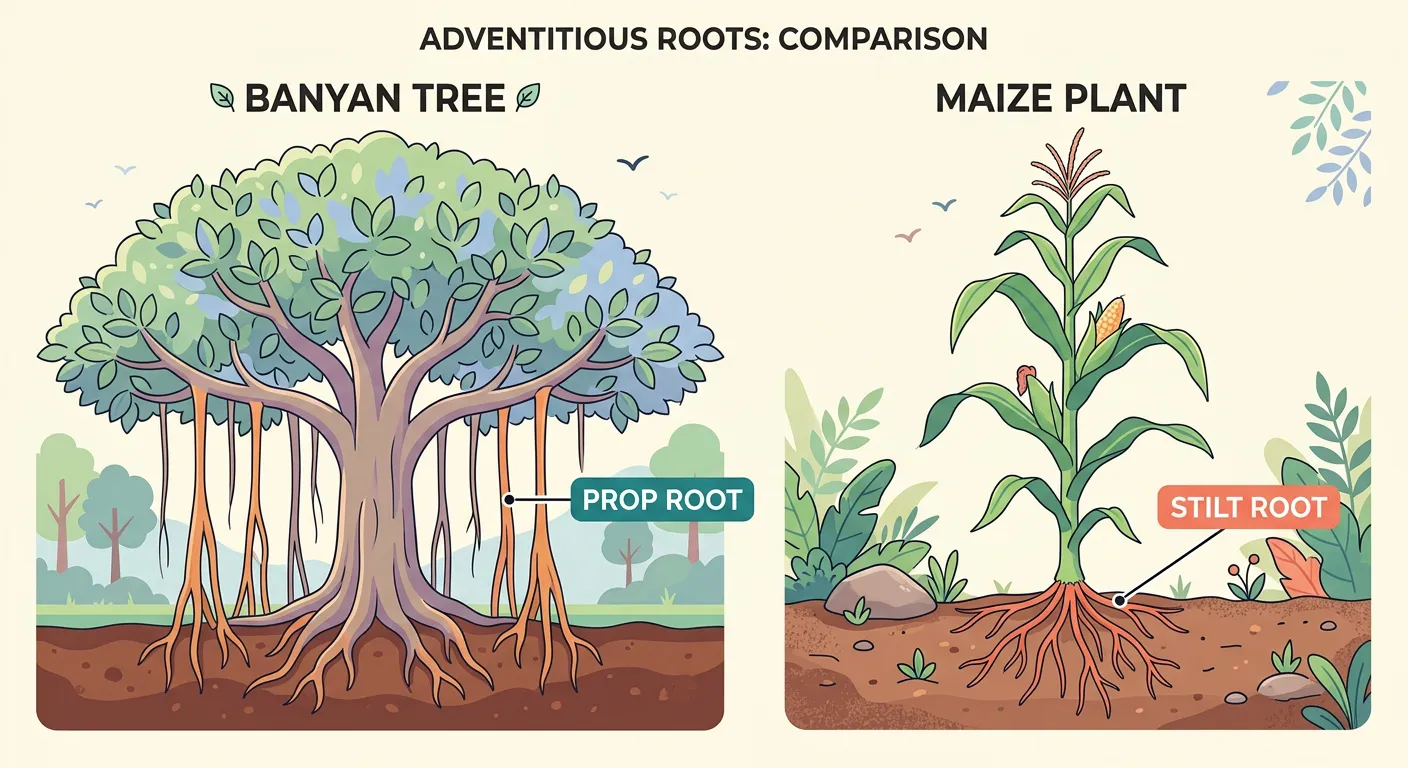
“Sometimes roots get extra roles! Like a Banyan tree needing pillars—those are Prop roots. Or Maize plants needing stability in loose soil—those are Stilt roots. Nature gives these plants 'upgrades' to survive their specific environments. Remember, form follows function in the botanical world!”
In biology, 'standard' is just the beginning. Sometimes, roots evolve to perform functions far beyond absorption and anchorage. These are known as adventitious roots—roots that arise from any part of the plant other than the radicle. This flexibility allows plants to adapt to specific environmental stressors, such as heavy winds, unstable soil, or low oxygen levels.
Consider the majestic Banyan tree (Ficus benghalensis). Its massive canopy requires more support than a standard trunk can provide. To solve this, it develops Prop roots—hanging structures that grow from the branches and eventually penetrate the soil, acting like concrete pillars. On the other hand, plants like Maize and Sugarcane grow in loose, often waterlogged soil. They need stability at the base, so they develop Stilt roots that emerge from the lower nodes of the stem and angle down into the ground. These act like the outriggers on a canoe, preventing the tall, slender stem from toppling over.
Another fascinating modification is seen in swampy areas. In plants like Rhizophora, the soil is so saturated with water that roots cannot breathe. To survive, they develop Pneumatophores—negatively geotropic roots that grow vertically upwards out of the mud to get oxygen. This is a classic example of 'form follows function.' When you study these, don't just memorize the names; visualize the environment the plant is trying to conquer. This ecological perspective will help you remember the examples much longer than rote memorization would.
Quick Revision Points
- Adventitious Roots: Arise from parts other than the radicle (e.g., Grass, Monstera, Banyan).
- Prop Roots: Vertical pillar-like roots for support in Banyan trees.
- Stilt Roots: Oblique support roots from lower stem nodes in Maize and Sugarcane.
- Pneumatophores: Respiratory roots in Halophytes (swamp plants) like Rhizophora.
- Modifications can be for support, storage, or respiration.
NEET Exam Angle
- 'Match the following' questions frequently pair Rhizophora with Pneumatophores and Ficus with Prop roots.
- Key Concept: Remember that adventitious roots are a 'lateral' move in development—they don't follow the radicle's path.
- Note the difference between support (Prop/Stilt) and respiration (Pneumatophore).
04Stem Diversity: Storage Organs and the Code of Nodes and Internodes
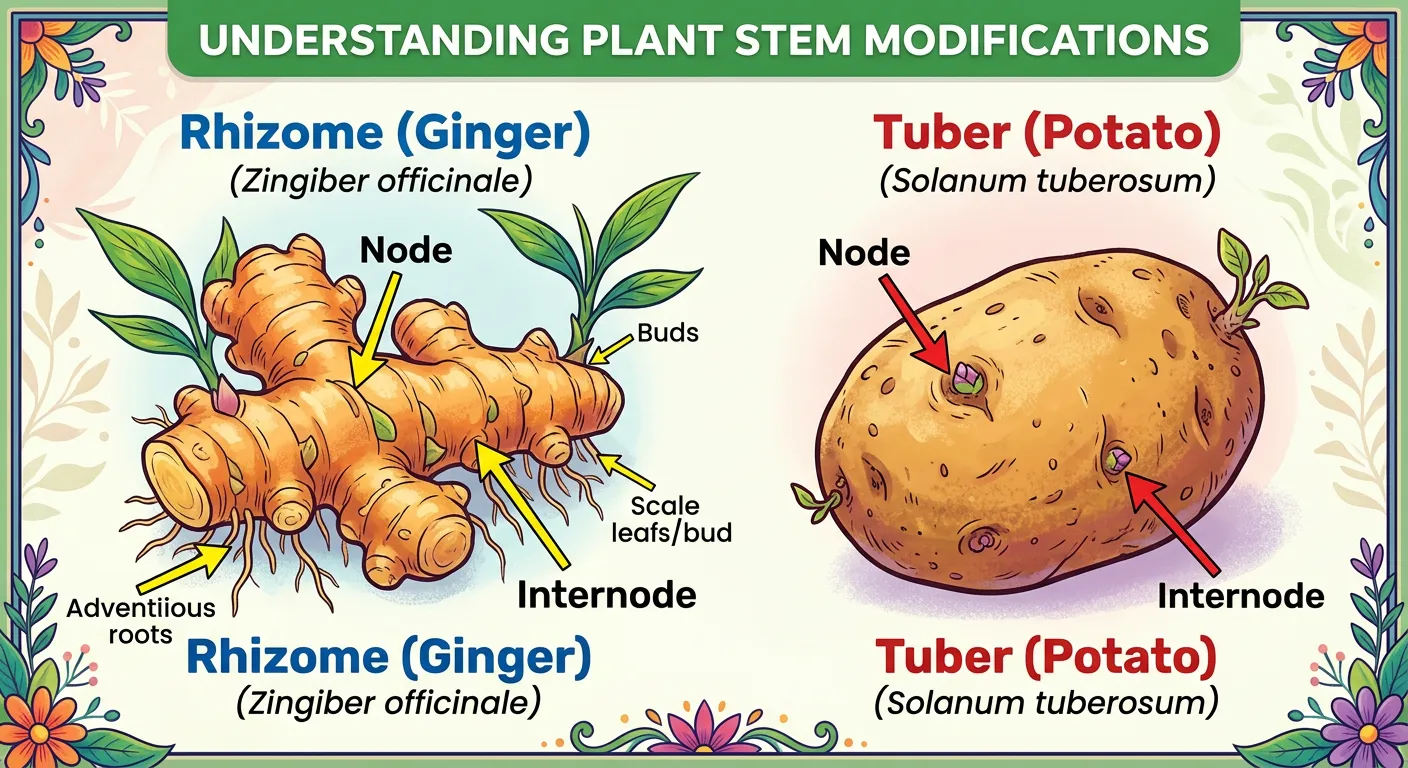
“Stems aren't just for support; they are master hoarders! Ginger acts like a bunker storing starch in a Rhizome, while the Potato is a swollen Tuber. They both have nodes and internodes—the secret code to identify that these are actually modified stems, not roots!”
The stem is the ascending part of the plant axis, but it is much more than just a flagpole for leaves. A stem's primary identity is defined by the presence of nodes (where leaves are attached) and internodes (the segments between nodes). This is the 'secret code' you must use to distinguish a modified underground stem from a root. Even if it is buried under the soil, if it has nodes, internodes, and scale leaves, it is a stem.
Underground stems are master hoarders. They store food to help the plant survive periods of dormancy, a process called perennation. For example, the Rhizome of Ginger and Turmeric grows horizontally under the soil, packed with nutrients. The Tuber of a Potato is actually a swollen stem tip; those 'eyes' you see on a potato are actually axillary buds located at the nodes.
Beyond storage, stems also modify for protection and climbing. Stem tendrils, which develop from axillary buds, help slender plants like Cucumbers, Pumpkins, and Grapevines climb. Conversely, Thorns—hard, woody, and pointed structures—protect plants like Citrus and Bougainvillea from hungry herbivores. Notice the difference between a thorn (modified stem) and a spine (modified leaf)—this is a classic NEET trap! Thorns arise from axillary buds, proving their stem-based origin.
Quick Revision Points
- Stems develop from the plumule of the embryo.
- Diagnostic features: Presence of nodes, internodes, and buds (axillary or terminal).
- Underground Stems: Potato (Tuber), Ginger (Rhizome), Zaminkand/Colocasia (Corm).
- Stem Tendrils: For climbing; found in gourds (Cucumber, Watermelon) and Grapevines.
- Thorns: For protection; found in Citrus and Bougainvillea.
NEET Exam Angle
- Critical Distinction: Potato is a stem tuber (has buds/eyes), whereas Sweet Potato is a root modification. This is the most common confusion point in exams.
- Example Check: Bougainvillea has thorns (stem), while Cactus has spines (leaf). Do not mix these up!
| Modification Type | Example | Primary Function |
|---|---|---|
| Rhizome | Ginger, Turmeric | Storage & Perennation |
| Tuber | Potato | Food Storage |
| Thorn | Citrus, Bougainvillea | Defense/Protection |
| Tendril | Cucumber, Grapevine | Climbing/Support |
05Leaf Morphology: Lamina Structure and Venation Patterns
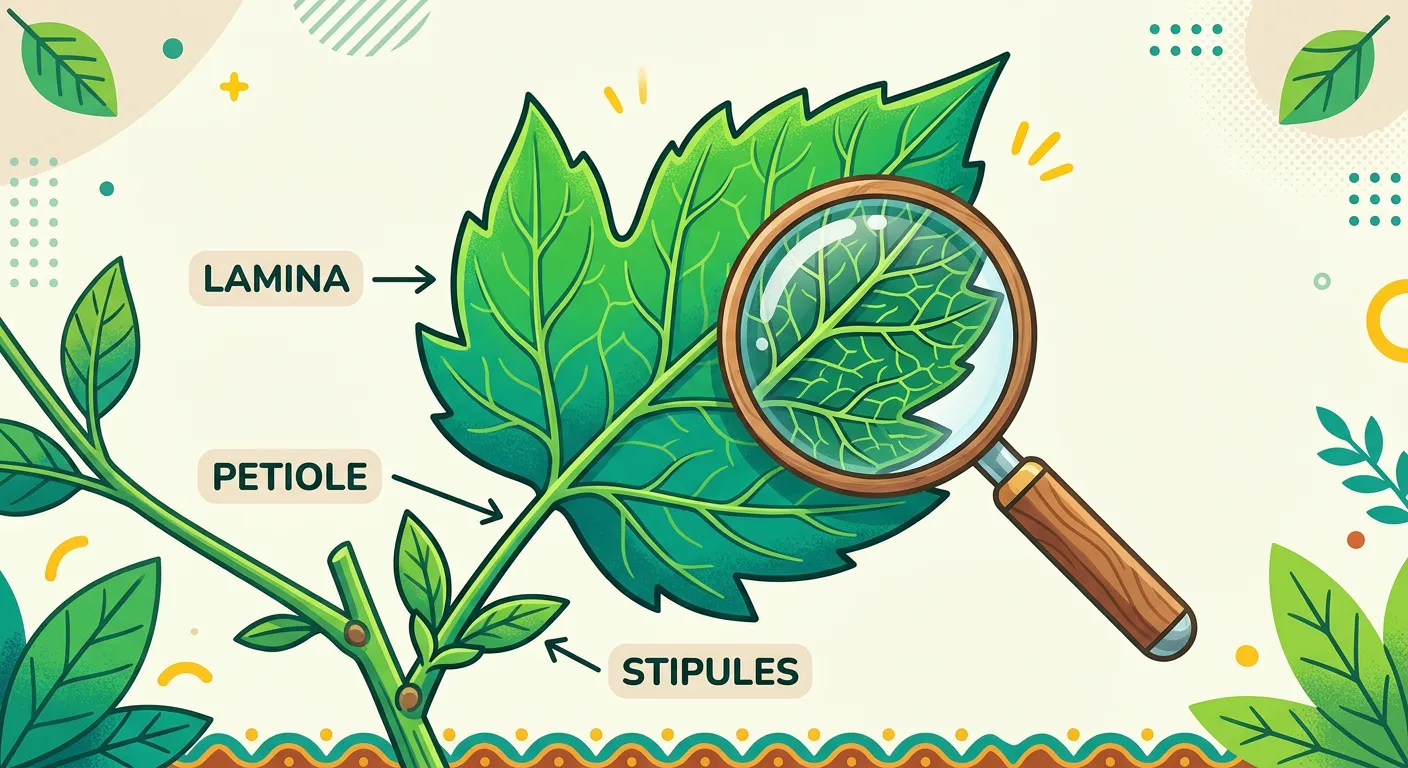
“The leaf is the kitchen! The flat blade, or Lamina, captures sunlight, while the Petiole connects it to the stem. Whether it is reticulate venation like a Hibiscus or parallel like a Banana, these patterns are your key to identifying plant families during the exam.”
The leaf is the biological kitchen of the plant, where photosynthesis transforms light into life-sustaining energy. A typical leaf consists of three main parts: the leaf base, the petiole, and the lamina (leaf blade). The leaf base is where it attaches to the stem, sometimes protected by small leaf-like structures called stipules. In monocots, the leaf base often expands into a sheath covering the stem.
The petiole is the stalk that holds the lamina out toward the light. A long, flexible petiole allows the leaf blade to flutter in the wind, which cools the leaf and brings fresh air to the surface for gas exchange. The lamina is the expanded green part where the real work happens. It is criss-crossed by veins and veinlets, which provide structural support and act as the plant's plumbing system for water and nutrient transport.
One of the most important diagnostic tools for NEET is venation—the arrangement of veins in the lamina. In Reticulate venation, common in Dicots (like Hibiscus or Peepal), the veins form a complex network. In Parallel venation, common in Monocots (like Banana or Grasses), the veins run parallel to each other. Identifying the venation pattern is the quickest way to tell if a plant is a monocot or a dicot without looking at its seeds or roots.
Quick Revision Points
- Leaves originate from shoot apical meristems and are arranged in an acropetal order.
- Three parts: Leaf base, Petiole, and Lamina (leaf blade).
- Reticulate Venation: Network-like pattern; characteristic of Dicots.
- Parallel Venation: Parallel vein arrangement; characteristic of Monocots.
- The midrib is the prominent vein in the middle of the lamina.
NEET Exam Angle
- Acropetal order: Remember that new leaves are at the top, and older ones are at the base.
- Venation is a high-probability 'Match the Column' topic. Banana = Parallel; Hibiscus = Reticulate.
- Pay attention to the Pulvinus: In some legumes, the leaf base may become swollen.
| Feature | Reticulate Venation | Parallel Venation |
|---|---|---|
| Pattern | Network/Web-like | Parallel/Straight lines |
| Plant Group | Mostly Dicots | Mostly Monocots |
| Examples | Peepal, China Rose, Mango | Grass, Wheat, Maize, Banana |
| Function | Higher structural rigidity | Flexible support for long leaves |
06Phyllotaxy Mastery: Strategic Arrangement for Photosynthetic Efficiency
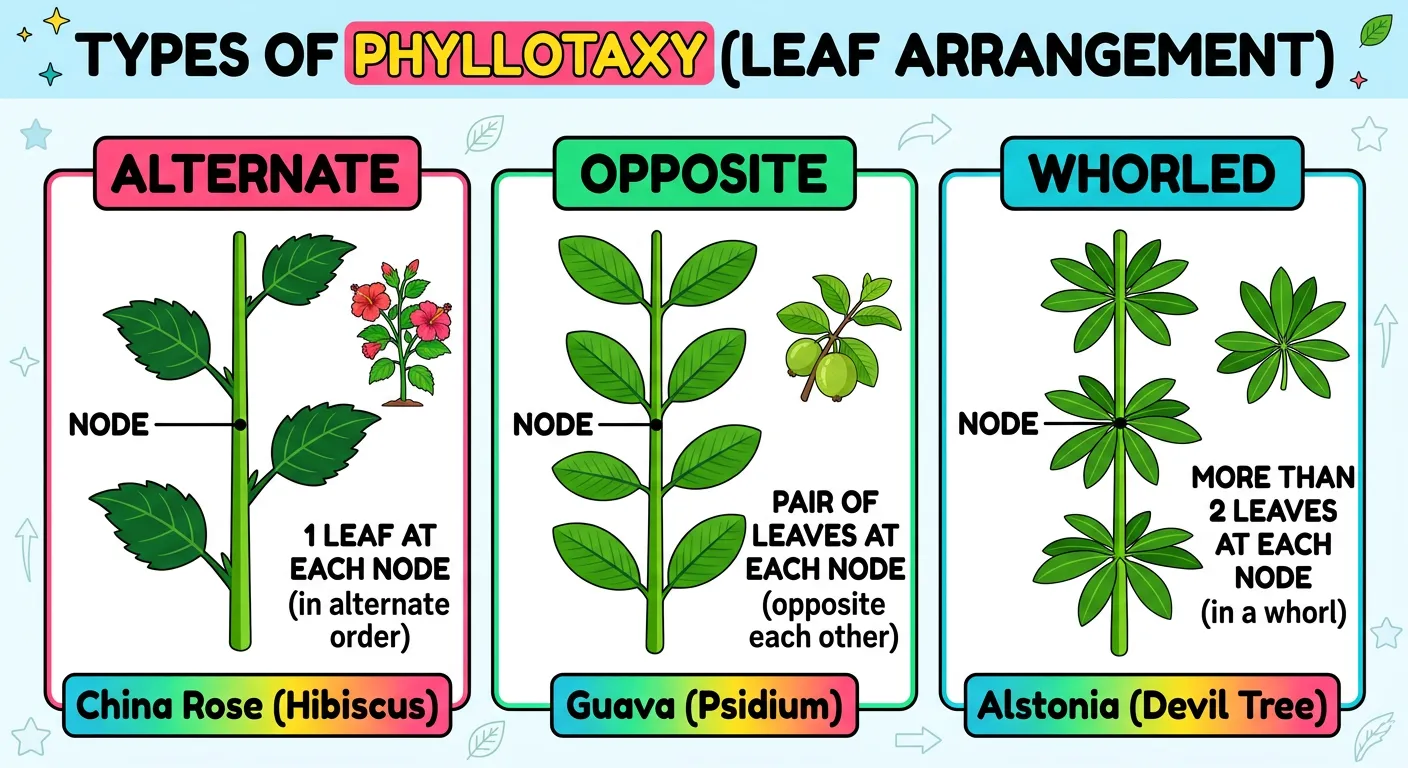
“How leaves arrange themselves on a stem is called Phyllotaxy. Like seating arrangements in a classroom, they can be Alternate, Opposite, or Whorled. Memorize these three patterns with their classic examples—China Rose, Guava, and Alstonia. It is a high-yield topic for your NEET paper!”
Plants are master architects that never leave anything to chance. The way leaves are arranged on a stem, known as Phyllotaxy, is a strategic decision made by the plant to ensure that every leaf gets the maximum amount of sunlight while minimizing shading of the leaves below it. For a NEET student, memorizing the three main types of phyllotaxy and their specific examples is a non-negotiable task.
First, we have Alternate Phyllotaxy. Here, a single leaf arises at each node in an alternating fashion. This is the most common pattern and can be seen in plants like the China Rose, Mustard, and Sunflower. It creates a spiral-like effect that covers all angles of light. Next is Opposite Phyllotaxy, where a pair of leaves arises at each node, facing each other. Think of it like a set of stairs. Classic examples include Calotropis and Guava.
Finally, there is Whorled Phyllotaxy. This is when more than two leaves arise at a single node, forming a circle or 'whorl' around the stem. The textbook example here is Alstonia. Understanding these patterns isn't just about naming; it’s about recognizing the evolutionary advantage of light harvesting. When you are in the exam hall, visualize these plants—see the alternate leaves of a Hibiscus versus the paired leaves of a Guava tree. This mental imagery is much more effective than simple list-reading.
Quick Revision Points
- Phyllotaxy: The pattern of arrangement of leaves on the stem or branch.
- Alternate: Single leaf per node (e.g., China rose, Mustard, Sunflower).
- Opposite: Pair of leaves per node (e.g., Calotropis, Guava).
- Whorled: More than two leaves per node (e.g., Alstonia).
- Main Purpose: To avoid overcrowding and maximize sunlight interception.
NEET Exam Angle
- The example Alstonia is a frequent guest in NEET MCQs because it is the only primary example given for whorled phyllotaxy.
- Questions often combine phyllotaxy with venation to test your comprehensive knowledge of a specific plant (e.g., China Rose has alternate phyllotaxy and reticulate venation).
- Memorization Hook: 'A' for Alternate/Alstonia? NO! Alstonia is Whorled. Be careful with that common trap.
07Leaf Modifications: Evolutionary Adaptations for Climbing and Defense
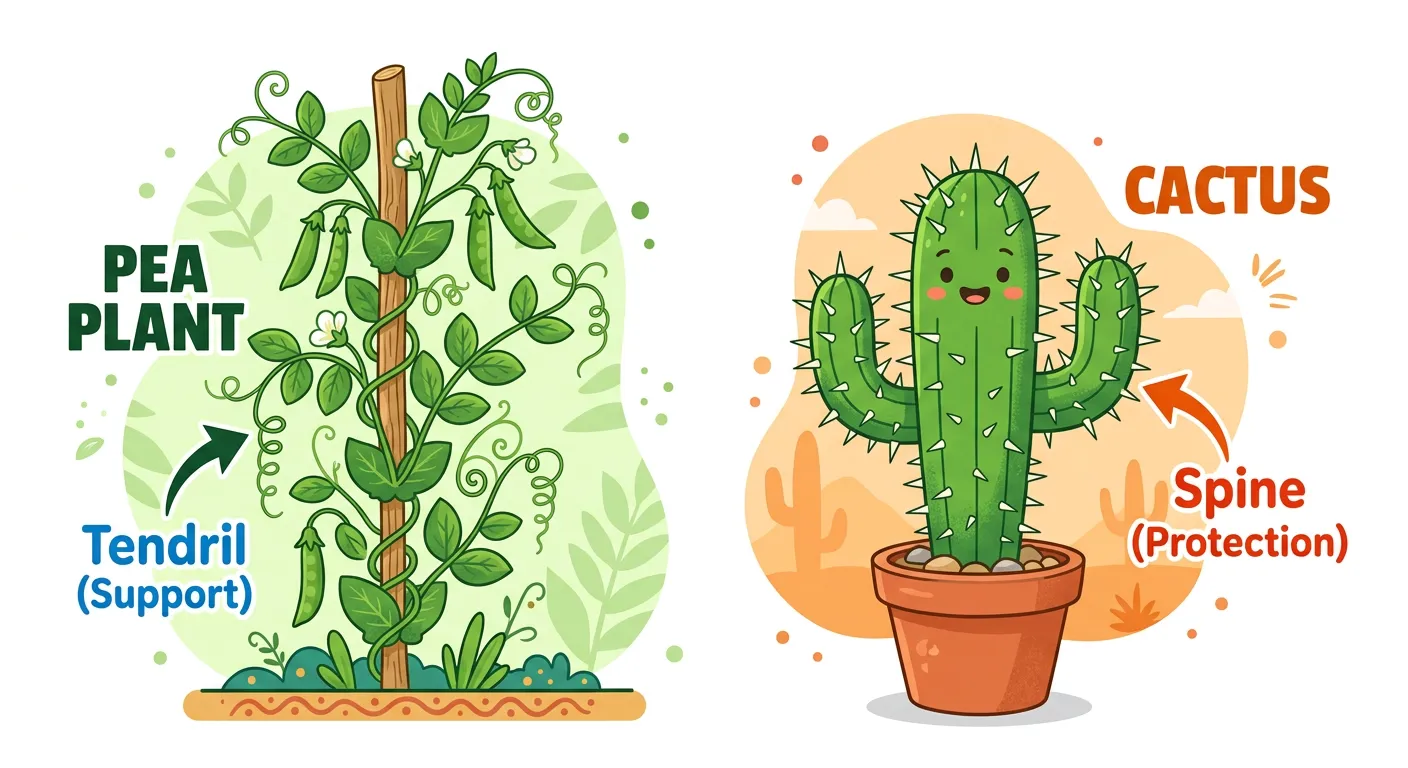
“Finally, leaves adapt to survive! Pea plant leaves turn into Tendrils to climb high, while Cactus leaves become Spines to protect against thirsty herbivores. Nature is genius! Keep these examples in your mind, and you are ready to ace any question on plant morphology.”
Just like roots and stems, leaves can also quit their 'day job' of photosynthesis to take on specialized roles. In the world of botany, leaves are incredibly versatile. When a plant needs to climb but lacks a woody trunk, its leaves might transform into Tendrils. In the Pea plant (Pisum sativum), the upper leaflets become sensitive, coiled structures that grab onto nearby supports, allowing the plant to reach for the sun.
In arid environments where water is scarce and thirsty animals are many, leaves take a defensive turn. In Cacti, the leaves are modified into sharp Spines. This serves a dual purpose: it provides a formidable defense against herbivores and significantly reduces the surface area for transpiration, helping the plant conserve water. In these cases, the stem usually takes over the photosynthetic duties (becoming a phylloclade).
Food storage is another major leaf modification. When you peel an Onion or a bulb of Garlic, you aren't looking at stems or roots—you are looking at fleshy, succulent leaves that have stored food for the plant's next growing season. Finally, some leaves perform even more exotic tasks. In insectivorous plants like the Venus Flytrap or Pitcher plant, the leaves are modified traps to catch nitrogen-rich prey. This morphological flexibility is what allows plants to thrive in every corner of the Earth, from the driest deserts to the densest jungles.
Quick Revision Points
- Tendrils: For climbing (e.g., Peas). Do not confuse with stem tendrils (e.g., Cucumber).
- Spines: For defense and water conservation (e.g., Cacti). Do not confuse with stem thorns (e.g., Citrus).
- Fleshy Leaves: For food storage (e.g., Onion, Garlic).
- Phyllode: The petiole becomes green and leaf-like for photosynthesis (e.g., Australian Acacia).
- Insectivorous modifications: Leaves modified into traps (e.g., Pitcher plant).
NEET Exam Angle
- Confusion Alert: Pea tendrils are modified leaves, but Cucumber tendrils are modified stems. This is a favorite 'Comparison' question.
- Storage Check: Onion and Garlic store food in leaves; Potato stores food in stems; Carrot stores food in roots. Group these in your notes!
- The Australian Acacia (Phyllode) is an important example of a petiole taking over leaf functions when the lamina is short-lived.
Recommended Reading
Explore related Biology topics to build deeper chapter connections for NEET.
- Families · Topic 2.10
- Animal Tissues · Topic 2.11
- Frog Morphology · Topic 2.12
- Digestive System · Topic 2.13
- Circulatory System · Topic 2.14
- Respiratory System · Topic 2.15
- Jump to Key Terms (Quick Revision)
- Review Common NEET Mistakes
- Solve NEET Practice MCQs
- Read Topic FAQs
- Practice NEET MCQs
- Solve NEET PYQs
📚 Key Terms
⚠️ Common NEET Mistakes
- 1Mistaking Sweet Potato (root modification) for Potato (stem modification) regarding food storage.
- 2Confusing Thorns (modified stems in Citrus) with Spines (modified leaves in Cactus).
- 3Identifying Pea tendrils as stem modifications; they are actually leaf modifications (Cucumber has stem tendrils).
- 4Thinking that all underground plant parts are roots; remember to check for nodes and internodes to identify stems.
- 5Incorrectly pairing Alstonia with opposite phyllotaxy; it is the primary example for whorled phyllotaxy.
📝 NEET PYQ & Practice Questions
Test your understanding of Morphology and Modifications with NCERT-aligned sample questions.
Which of the following statements is correct regarding "Taproot System" in the context of NEET Biology?
In NEET question papers, questions related to "Morphology and Modifications" predominantly test:
Consider Prop Roots associated with Morphology and Modifications. What is the primary characteristic expected in NEET MCQs?
Master Morphology and Modifications with NeetQ AI Tutor
Practice 50+ topic-wise MCQs, previous 15 years NEET questions, and get step-by-step doubt resolution instantly.
❓ Frequently Asked Questions
What is the primary difference between a Taproot and a Fibrous root system?
The primary difference lies in their development and structure. A taproot system develops from the persistent primary root (radicle) and is common in dicots like mustard. A fibrous root system occurs when the primary root is short-lived and is replaced by many roots originating from the stem base, typical of monocots like wheat.
How can you distinguish a modified underground stem like a potato from a root?
You can identify a modified stem by the presence of nodes, internodes, axillary buds (like the 'eyes' of a potato), and scale leaves. Roots lack these structures. For example, a potato is a stem tuber because it has buds, while a sweet potato is a modified root because it does not.
What are the three main types of phyllotaxy with their NEET-relevant examples?
The three types are: 1. Alternate (one leaf per node, e.g., China rose, Mustard, Sunflower), 2. Opposite (two leaves per node, e.g., Calotropis, Guava), and 3. Whorled (more than two leaves per node, e.g., Alstonia).
Why do plants like Maize and Sugarcane develop stilt roots?
Maize and Sugarcane develop stilt roots for additional mechanical support. Since these plants have relatively tall, thin stems and often grow in soil that doesn't provide deep anchorage, these roots emerge from the lower nodes of the stem to act as supportive 'struts'.
What is the functional significance of reticulate vs parallel venation in plants?
Reticulate venation (network-like) provides strong structural support for broader leaves in dicots. Parallel venation (veins running side-by-side) is common in the long, narrow leaves of monocots, allowing for flexibility and efficient transport across the length of the blade.
How do leaf modifications like spines and tendrils aid in plant survival?
Leaf tendrils (e.g., in Peas) allow weak-stemmed plants to climb toward sunlight. Spines (e.g., in Cacti) protect the plant from herbivory and reduce water loss by minimizing the surface area for transpiration in arid climates.
Written By
NEET Content Strategist & Biology Expert
Sangita Kumari is a NEET educator and content strategist with over 6 years of experience teaching Biology, Chemistry, and Physics to Class 11 and 12 aspirants. She helps bridge the gap between traditional NCERT preparation and modern AI-powered learning. Her content is trusted by thousands of NEET aspirants across India.